
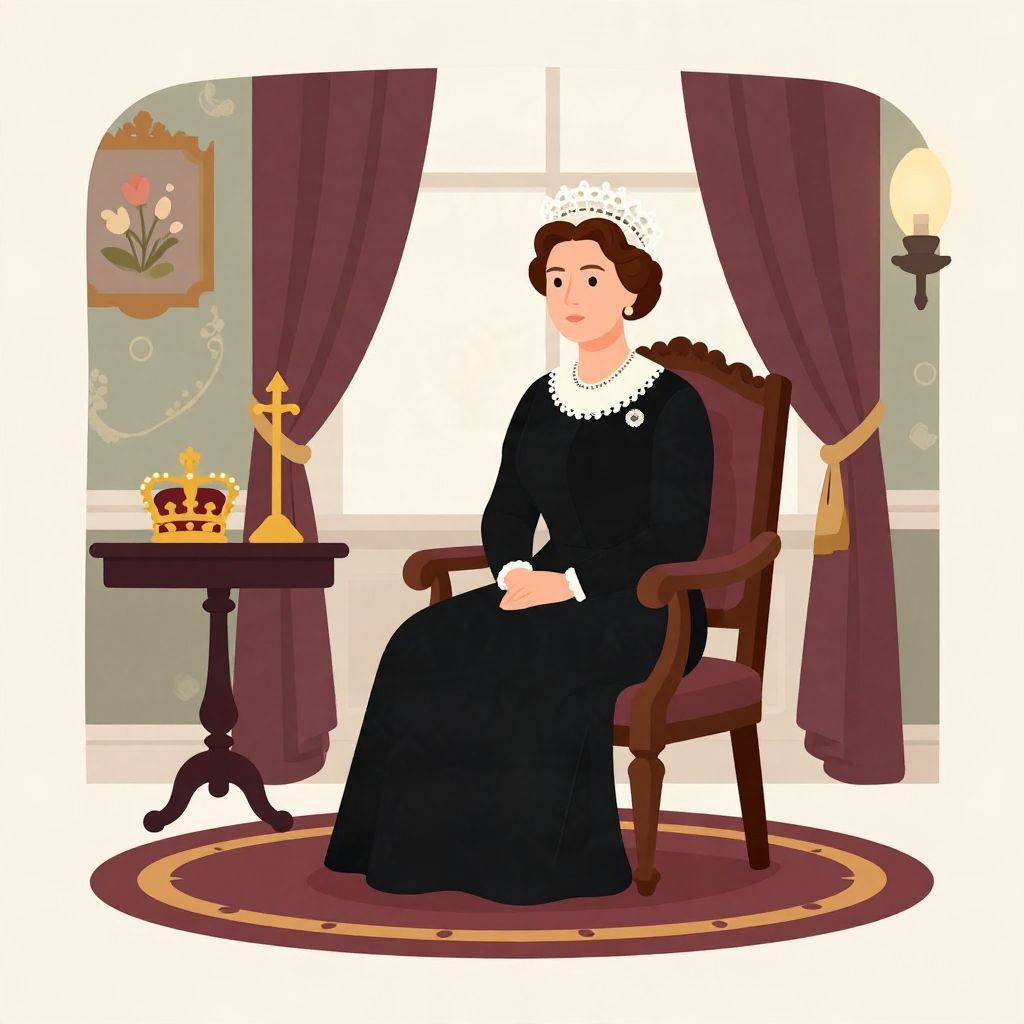
What did Queen Victoria look like? The short answer is that she was a small, sturdy woman with a round face, dark eyes, and a serious expression in youth, later becoming fuller-faced and more matronly with age. Because photography became common during her reign, we can trace her appearance far better than that of most earlier monarchs.
Her image changed over time, but the broad impression remained consistent: plain rather than glamorous, dignified rather than strikingly beautiful, and increasingly associated with the solemn, respectable style that came to define the Victorian age.
What Did Queen Victoria Look Like?
Queen Victoria was generally described as short and compact, with a broad face, dark brown eyes, and dark hair in her younger years. She was not usually considered conventionally beautiful, but she had a strong, expressive presence. As she aged, she became heavier, wore widow’s black, and was most often seen in formal, restrained portraits.
Victoria’s Appearance in Youth
Her physical features
Born in 1819, Victoria was a small child and remained relatively short as an adult, standing around 4 feet 11 inches tall. Contemporary descriptions and surviving portraits suggest a round face, a fair complexion, and dark eyes. Her hair was dark brown when young, and she often wore it simply, in the styles expected of a princess in the early 19th century.
As a young woman, she was not delicate in appearance. She had a solid build and a direct gaze that many observers found memorable. Some portraits make her look soft and youthful; others emphasize her firmness and self-possession. Like many royal portraits, these images were shaped by artistic convention as much as by realistic likeness.
What people thought of her looks
Victoria was rarely described in terms of classical beauty. Instead, writers and courtiers often commented on her liveliness, intelligence, and strong personality. That mattered in a monarchy where appearance was tied to symbolism. She needed to look regal, not merely pretty, and her face and posture often conveyed authority more effectively than elegance.
How Her Look Changed Over Time
Victoria’s appearance changed noticeably across her long reign, and this is one reason the question “What did Queen Victoria look like?” has more than one answer. In youth she appeared energetic and compact; in middle age she became more solemn and heavier; in widowhood she adopted the black clothing and restrained styling that became inseparable from her public image.
Marriage and early reign
After her marriage to Prince Albert in 1840, Victoria’s public image became more carefully managed. Portraits from this period often show her in elegant gowns, with elaborate hairstyles and royal jewelry. Yet even then, she was not presented as a dazzling beauty. The emphasis was on domestic virtue, monarchy, and stability, especially after the turbulence of the late Georgian and early Victorian years.
Widowhood and the black-clad queen
Prince Albert died in 1861, and Victoria entered a long period of mourning. From then on, she was most commonly seen in black dresses, veils, and mourning caps. This became one of the most famous aspects of her appearance. The black clothing was not merely personal grief; it also became a public symbol of duty, loss, and endurance.
In later photographs, Victoria appears fuller-faced, with a more severe expression and a less youthful posture. Her body changed with age, as did the conventions of royal portraiture. By the end of her life, she was usually depicted as a grandmotherly figure, small but commanding, wrapped in dark fabrics and surrounded by the visual language of empire and mourning.
How We Know What Queen Victoria Looked Like
Portraits, photographs, and eyewitness accounts
Unlike many earlier rulers, Victoria lived during the rise of photography. That means historians can compare painted portraits, photographs, sketches, and written descriptions. This gives a fuller picture, though each source has limits. Portraits were often idealized, while photographs could be staged, posed, or carefully selected for public use.
Early in her reign, artists such as Sir George Hayter produced formal portraits that emphasized youthful majesty. Later photographs, including those taken in the mid- and late 19th century, show a more realistic version of her face and figure. Together, these sources reveal both the woman herself and the image the monarchy wanted the public to see.
The role of public image
Victoria’s appearance was never just personal. As queen, her body and clothing were part of state symbolism. She had to project legitimacy, morality, and continuity. For that reason, her image was carefully composed in official portraits and public appearances. The result is that “what she looked like” is also a question about how Britain wanted its queen to be seen.
Victoria’s Style and Clothing
Queen Victoria’s clothing strongly shaped how people remembered her. In youth she wore fashionable court dresses, fitted bodices, and elaborate hairstyles. After Albert’s death, she adopted mourning dress almost permanently. Black silk, lace, veils, brooches, and widow’s caps became central to her visual identity.
This style had lasting influence. The association of black clothing with Victorian seriousness and respectability owes much to Victoria herself. Her personal grief became part of a broader cultural mood, reinforcing the era’s reputation for restraint, moral discipline, and emotional control.
Jewelry and symbols
Victoria also used jewelry to communicate meaning. Brooches, cameos, and lockets were more than decoration; they often carried sentimental or dynastic significance. In portraits and photographs, these details helped soften the severity of her mourning clothes and reminded viewers of family, continuity, and monarchy.
Was Queen Victoria Beautiful?
That depends on the standards used. By modern celebrity standards, she would not usually be described as glamorous. By the standards of her own time, she was considered respectable and expressive rather than strikingly beautiful. Her appeal lay less in physical perfection than in the authority and emotional depth her face conveyed.
It is also important to remember that beauty judgments are historical. Nineteenth-century ideals for women, especially queens, mixed grace, modesty, and moral seriousness. Victoria’s appearance suited the role she came to embody: a sovereign whose image suggested duty, family, and endurance more than ornament.
Why Queen Victoria’s Appearance Matters Historically
A monarch whose image shaped an era
Victoria’s appearance matters because it became part of the cultural identity of the 19th century. Her black mourning dress, stern expression, and compact figure helped define the visual language of the Victorian age. She was not simply a ruler who lived during the period; she became one of its most recognizable symbols.
Photography and modern monarchy
Victoria also belongs to the first generation of monarchs whose likeness was widely circulated through photography. This changed the relationship between ruler and public. People could see their queen in a more immediate way than ever before, and that helped make the monarchy feel both more human and more public-facing.
Timeline of Victoria’s Changing Image
- 1819–1837: Princess Victoria is depicted as a young, dark-haired royal with a round face and lively expression.
- 1837–1840s: Early reign portraits show a youthful queen emphasizing dignity and authority.
- 1840–1861: As wife and mother, she appears in formal court dress, often in carefully staged portraits.
- After 1861: Widowhood transforms her public image; black mourning clothing becomes central.
- Late 19th century: Photographs show an older, heavier, more severe-looking queen, widely associated with Victorian respectability.
What Did Queen Victoria Really Look Like in Historical Memory?
In historical memory, Queen Victoria is often imagined as a stern older woman in black, but that is only part of the story. She was once a young princess with dark hair and a round, animated face, and later a queen whose appearance reflected grief, authority, and age. Her look evolved with her life and reign.
The most accurate answer is that Queen Victoria looked like a short, solidly built woman whose face and clothing changed over time but whose public image remained unmistakable. She was not remembered for beauty in the conventional sense, but for a powerful visual identity that came to define an entire era. For related historical image questions, see what Julius Caesar looked like and what George Washington looked like.