
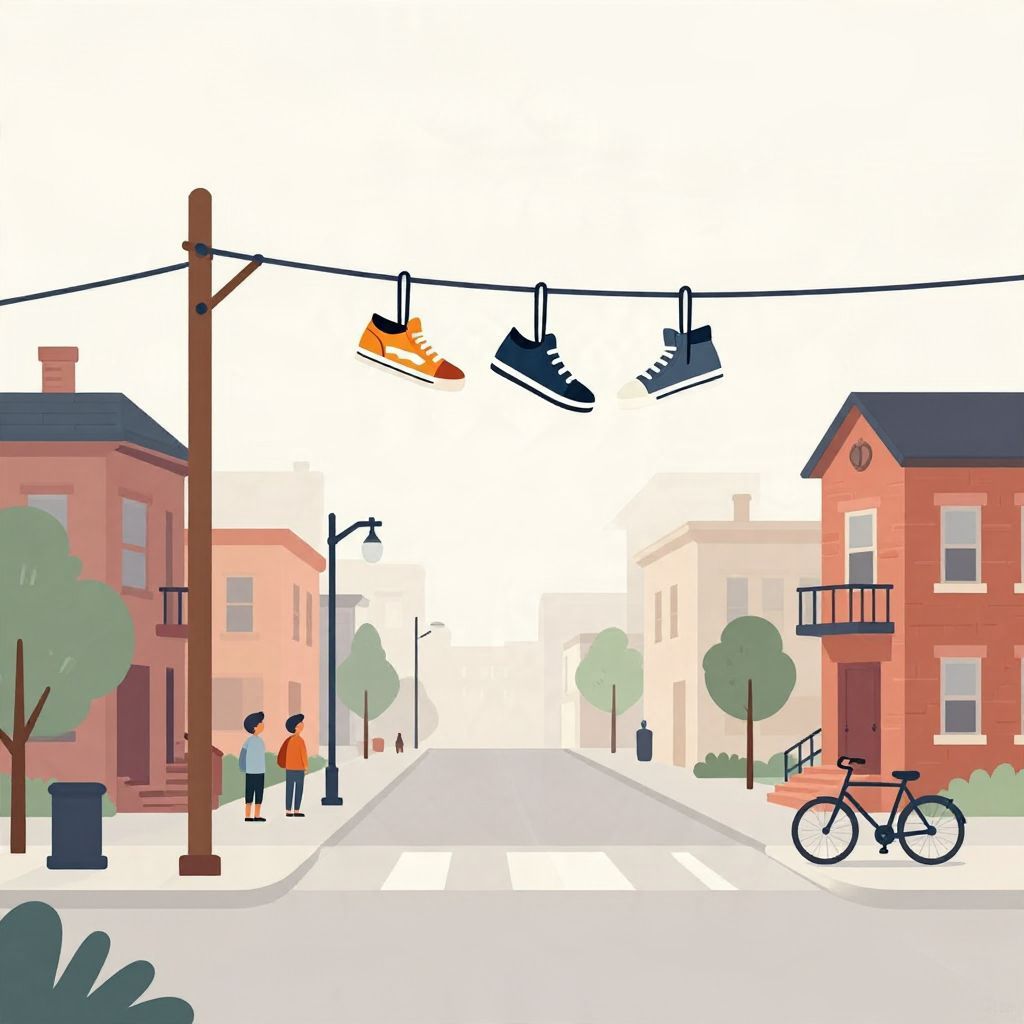
What does shoes on a powerline mean? The short answer is that there is no single, universally accepted meaning. Hanging shoes over electrical or telephone lines has appeared in many places and periods, and the interpretation depends heavily on local context. What looks like a simple act can signal a prank, a memorial, a neighborhood marker, or, in some settings, a rumor tied to crime or gang activity.
Because the practice is so widespread and informal, its history is less a single origin story than a pattern of repeated uses and changing meanings. Understanding it means separating documented social behavior from urban legend, and recognizing how public spaces become sites for communication, protest, memory, and myth.
What Does Shoes On A Powerline Mean?
“Shoes on a powerline” usually refers to a pair of shoes tied together and thrown so they hang from a wire or cable. Historically, the meaning is not fixed. In different communities it has been interpreted as a prank, a rite of passage, a memorial, a sign of territory, or simply a random act with no deeper message.
Origins and Early History of the Practice
There is no single verified origin for shoes hanging from powerlines. The practice likely developed wherever overhead wires, ropes, and urban street culture intersected. Because powerlines and telephone lines spread widely in the late 19th and 20th centuries, the visual possibility of tossing objects onto them became part of modern city life.
Historically, the act seems to have emerged in multiple places independently rather than from one inventor or one original custom. That makes it different from a tradition with a clear ceremonial source. In many cases, the meaning was assigned after the fact by neighbors, police, journalists, or local storytellers.
Why powerlines became a canvas for public gestures
Overhead utility lines are visible, elevated, and accessible from sidewalks, alleys, schoolyards, and vacant lots. That makes them ideal for symbolic acts that are meant to be noticed. The shoes do not need to remain in place for long to make an impression; the point is often the visual disruption itself.
In that sense, shoes on a powerline belong to a broader history of street-level symbolism. People have long used fences, walls, bridges, and wires to leave marks, messages, or tokens. The shoes are not unique as an object, but they are especially striking because they are ordinary items made strange by suspension in the air.
Common Meanings People Have Attached to Shoes on a Powerline
The meaning varies by place, but several interpretations recur. Some are grounded in social observation; others are folklore or rumor. No single explanation applies everywhere, and in many cases there may be no intended meaning at all.
- Prank or mischief: Often the simplest explanation is that someone threw the shoes up for fun.
- Marking a place: In some neighborhoods, people read it as a territorial sign or a local landmark.
- Memorial or tribute: Shoes may be hung to remember a person, especially after a death or departure.
- Coming-of-age gesture: In school or youth settings, it can function as a dare, joke, or rite of passage.
- Rumored gang symbol: This is a common claim, but it is often overstated and not reliable as a universal explanation.
The gang myth and why it spread
One of the most persistent modern interpretations is that shoes on a powerline indicate gang territory, drug sales, or a warning to outsiders. While such claims have circulated widely, historians and urban researchers treat them cautiously because the evidence is inconsistent. In some places, people may indeed associate the image with criminal activity, but that does not make it a dependable code.
This is a good example of how urban legends grow. A visible and unusual object invites explanation, and once a rumor takes hold, it can spread faster than the truth. The result is that a harmless prank in one neighborhood may be read as a threat in another.
Timeline: How the Meaning Changed Over Time
The history of shoes on wires is best understood as a loose timeline of modern urban culture rather than a single continuous tradition. Its meanings shifted as cities changed, as youth cultures developed, and as media stories amplified certain interpretations.
- Late 19th to early 20th century: Overhead utility lines become common in towns and cities, creating the physical setting for the practice.
- Mid-20th century: The act appears in local street culture as a prank or neighborhood spectacle, though documentation is uneven.
- Late 20th century: Media reports and local rumors increasingly attach gang-related meanings to the image.
- 1990s to 2000s: The symbol becomes widely recognized in popular culture, often detached from any specific local context.
- Today: It is usually interpreted case by case, with many communities seeing it as either harmless vandalism or an ambiguous sign.
Why the 20th century matters
The spread of electricity and telephones transformed the urban landscape. Once wires crossed streets everywhere, they became part of the visual language of public space. Objects hanging from them were hard to ignore. In the 20th century, as youth culture became more visible and urban neighborhoods were more heavily policed and discussed in the media, the shoes gained new layers of meaning.
That history helps explain why the same image can mean very different things depending on the decade. A pair of shoes in the 1950s might have been seen as a schoolyard prank; by the 1990s, many people were primed to see gang symbolism, even without evidence.
Historical Significance: More Than Just a Strange Image
Shoes on a powerline matter historically because they show how ordinary objects can become symbols in public space. The practice reveals how communities interpret signs, how rumors travel, and how urban environments generate their own informal languages. It is a small but revealing example of social meaning being created from everyday materials.
Public space and informal communication
Historians of urban life often pay attention to graffiti, posters, stickers, and other unofficial messages. Shoes on a powerline belong in that same category of street-level expression. Even when no one can agree on the meaning, the object invites people to ask questions about who placed it there and why.
That uncertainty is part of its significance. The shoes do not communicate in a fixed code; instead, they expose the way communities read signs through memory, fear, humor, and local knowledge. In that sense, the object is less a message than a prompt for interpretation.
Memory, loss, and local identity
In some settings, hanging shoes can function as a memorial. People may leave them to mark the death of a friend, the end of a school year, a move away from the neighborhood, or another personal turning point. These meanings are usually local and informal, passed along by word of mouth rather than ceremony.
That memorial function gives the practice a human dimension often missing from sensational stories. Not every pair of shoes is a threat or a joke. Sometimes it is a sign that a place holds memory, and that the street itself has become part of a story of loss or transition.
How to Interpret Shoes on a Powerline Responsibly
The safest historical approach is to avoid assuming a single meaning. Context matters: the neighborhood, the number of shoes, the condition of the shoes, nearby memorials or schools, and local stories all affect interpretation. Without that context, any explanation is tentative.
- If the shoes appear near a memorial or shrine, they may be part of remembrance.
- If they are in a school area, they may be a prank or dare.
- If local residents attach a specific meaning, that local meaning matters more than a general internet claim.
- If no context is available, the most historically careful answer is that the meaning is uncertain.
What historians avoid claiming
It would be misleading to say that shoes on a powerline always mean gang activity, or always mean a memorial, or always mean nothing. Historical interpretation depends on evidence, and with this topic the evidence is often anecdotal. Responsible history leaves room for ambiguity rather than forcing a neat answer onto a messy social practice.
Conclusion
Shoes on a powerline do not have one fixed historical meaning. The practice likely arose in modern urban settings where overhead wires made public gestures visible, and over time it accumulated multiple interpretations: prank, memorial, marker, rumor, and sometimes a supposed gang sign. Its real historical significance lies in how communities assign meaning to ordinary objects in shared space.
In other words, the shoes are less a universal code than a local story. To understand them, you have to ask who placed them there, where, and in what social setting. That is why the question remains interesting: it reveals how history is often written not only in monuments and documents, but also in small, ambiguous acts on the street.