
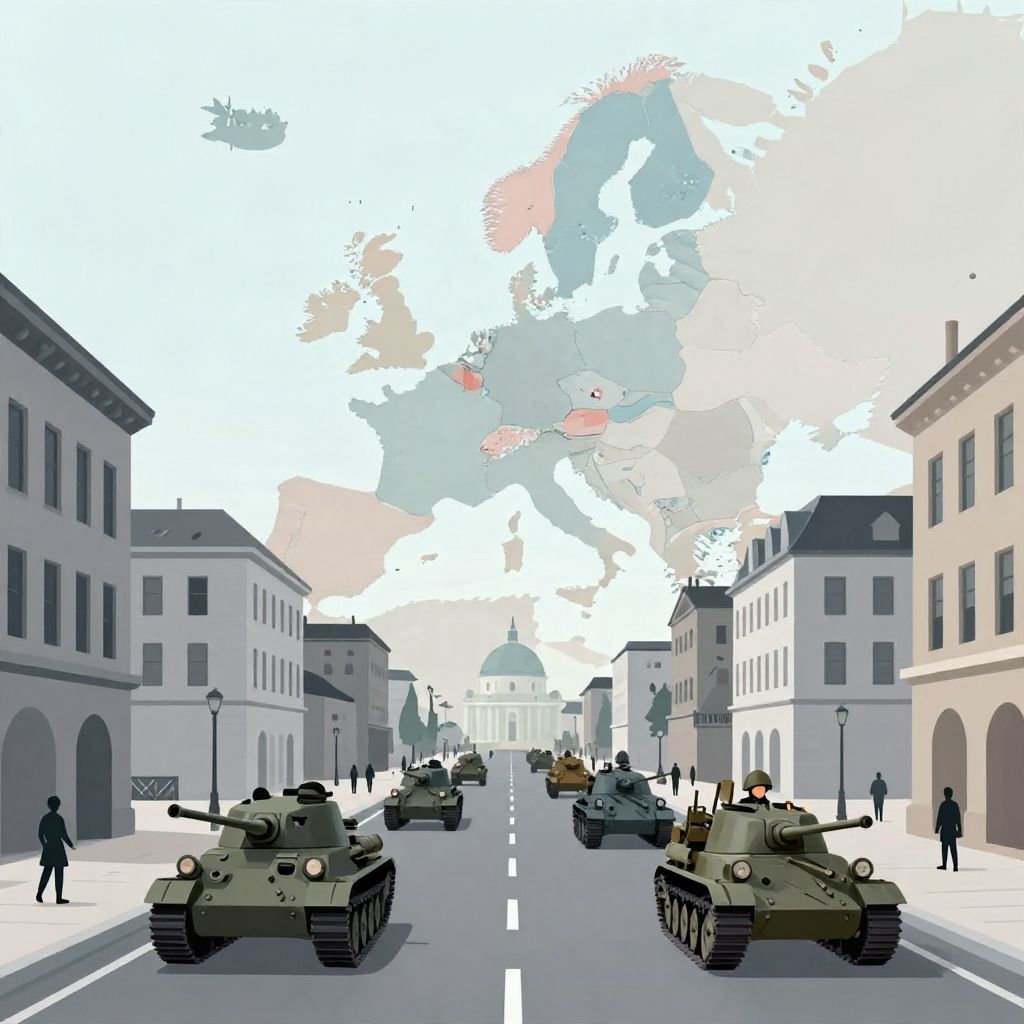
What if Germany won World War II? It is one of the most asked counterfactual questions in modern history because the war’s outcome shaped borders, governments, human rights, and the balance of power for decades. To answer it responsibly, we have to separate what actually happened from what might have followed if Nazi Germany had defeated its enemies.
The short answer is that a German victory would probably have meant a far more brutal, authoritarian Europe under Nazi control, with the Holocaust expanded or continued, resistance movements crushed, and the United States and Soviet Union forced into a very different global rivalry. But the exact shape of that world would depend on how Germany “won” and when the war ended.
What if Germany won WW2?
If Germany had won World War II, Europe would likely have been reorganized under Nazi domination, with occupied territories turned into client states, colonies, or directly ruled regions. The Nazi regime’s racial ideology suggests that victory would not have produced peace in the usual sense, but a violent imperial order marked by mass deportation, forced labor, and genocide.
Why a German victory was possible only in certain scenarios
Germany did not need to conquer the entire world to “win.” In historical analysis, victory could mean several different outcomes: forcing Britain to make peace in 1940, defeating the Soviet Union in 1941–42, or reaching a negotiated settlement before the United States fully mobilized. Each path would have produced a different postwar world.
Britain leaving the war
After France fell in 1940, Germany’s best chance was to pressure Britain into a settlement. If Britain had accepted peace, Germany could have consolidated Western Europe and focused on the Soviet Union. But Britain’s refusal, especially under Winston Churchill, kept the war alive and gave the Allies a base for eventual return to the continent.
The Soviet Union collapsing
Operation Barbarossa, launched in June 1941, was the decisive eastern campaign. If the Red Army had collapsed in 1941 or 1942, Germany might have seized enormous territory and resources. Yet that would not automatically have meant stable control. The Soviet state was vast, and Nazi occupation policies were so violent that they fueled resistance rather than submission.
The United States staying out or arriving too late
Germany also benefited from the possibility that the United States might remain neutral longer or be unable to project power effectively into Europe. In reality, American industrial strength and entry into the war after Pearl Harbor made a German long-term victory much less likely. Without U.S. intervention, the balance of power would have looked very different.
How Nazi rule would likely have changed Europe
A German victory would almost certainly have meant a Nazi-dominated Europe, not a conventional peace treaty system. Hitler and the Nazi leadership envisioned a racial empire in which Germans ruled over conquered peoples. Central and Eastern Europe were intended for colonization, exploitation, and demographic transformation, especially through the removal or destruction of populations deemed inferior.
Western Europe under pressure
In places like France, the Netherlands, Belgium, and Norway, Germany might have installed collaborationist governments or direct military rule. Some states could have remained formally independent but politically subordinate. Even then, sovereignty would have been limited, and German economic control would likely have dominated trade, labor, and security policy.
Eastern Europe as a colonial frontier
Nazi plans for Eastern Europe were especially radical. The regime wanted “living space” in the east, a concept tied to conquest, resettlement, and ethnic cleansing. Large parts of Poland, Ukraine, Belarus, and western Russia were expected to be transformed into agricultural and strategic zones for German settlement, with local populations expelled, enslaved, or killed.
Resistance would not have disappeared
Even if Germany had won major battles, occupation would still have faced resistance. Guerrilla warfare, sabotage, exile governments, and underground networks were already active during the war. A German victory might have reduced the chances of liberation, but it would not have guaranteed lasting stability.
What would have happened to the Holocaust?
One of the most important historical points is that a German victory would not have ended Nazi persecution; it would likely have intensified it. The Holocaust was already underway during the war, and Nazi policy toward Jews, Roma, Slavs, disabled people, and others was genocidal. Victory could have expanded the machinery of murder across a wider area.
Genocide as policy, not an accident of war
The Nazi regime’s persecution was not simply a wartime excess. It was central to its ideology. That means a victorious Germany would probably have continued deportations, ghettoization, mass shootings, starvation policies, and extermination camp operations wherever it controlled territory.
The scale of loss could have been even greater
Because the war itself disrupted Nazi plans and eventually defeated Germany, many victims survived only because the regime collapsed before it could fully carry out its ambitions. A German victory might have prevented liberation of camps and extended genocidal policies to additional populations and regions.
Could Germany have ruled the world?
Probably not in the literal sense. Even a victorious Germany would have faced major limits: economic strain, occupied populations, internal rivalries, and the difficulty of managing huge territories. Nazi Germany was powerful, but it was also unstable, dependent on war, and deeply divided by competing institutions and personalities.
Why empire would have been hard to sustain
Germany’s military strength did not automatically translate into durable governance. Occupation requires administration, transport, food supply, and legitimacy, and Nazi rule had little of the last two. The more brutal the occupation, the more likely it was to generate insurgency, sabotage, and long-term instability.
Hitler’s system was not built for compromise
The Nazi state was ideologically rigid. It was not designed to share power, negotiate equality, or accept pluralism. That rigidity made it effective at destruction but weak at building a lasting international order. A German victory might have created a large empire, but not necessarily a stable one.
How the United States and Soviet Union might have responded
If Germany had won in Europe, the global balance of power would likely have shifted into a tense Cold War-like standoff, but with different actors and geography. The United States might have remained a dominant maritime power, while the Soviet Union could have been weakened, relocated, or partially destroyed depending on the terms of defeat.
America as a defensive superpower
The United States might have concentrated on the Atlantic, the Americas, and the Pacific. A Nazi-controlled Europe would have posed a strategic threat, but geography would still have protected the U.S. homeland. American policy might have focused on containment, rearmament, intelligence, and support for underground opposition movements.
The Soviet Union’s uncertain fate
If the USSR had been defeated, it might have fragmented rather than simply surrendered. Some historians imagine a rump Soviet state east of the Urals; others see a collapse into regional authorities or German occupation zones. What is clear is that the eastern front was central to the war’s outcome and to any alternate future.
Everyday life in a Nazi victory scenario
For ordinary people, a German victory would likely have meant more surveillance, censorship, forced labor, rationing, and political terror. Life under Nazi rule already involved these conditions in occupied areas. A successful German empire would probably have extended them across much of Europe, though not in identical form everywhere.
Who would benefit?
The main beneficiaries would have been Nazi elites, military administrators, collaborators, and some industrial interests tied to the regime. Even so, benefits would have been limited and insecure. Nazi systems often rewarded loyalty temporarily while producing fear, competition, and arbitrary violence.
Who would suffer most?
Jews, Roma, Slavs, political dissidents, disabled people, prisoners of war, and many civilians in occupied territories would have faced the greatest danger. A German victory would likely have meant prolonged persecution, forced displacement, and continued mass murder for millions.
Historical significance of asking this question
Asking what if Germany won World War II is not just a game of speculation. It helps explain why the actual Allied victory mattered so much. The defeat of Nazi Germany prevented the full realization of a regime built on conquest, racial hierarchy, and genocide. It also shaped the postwar creation of the United Nations, NATO, the division of Europe, and modern human rights politics.
Why counterfactual history has value
Counterfactuals are useful when they are grounded in real constraints. They help historians test causation: Which events were decisive? How close was the outcome? What depended on leadership, industry, logistics, ideology, or chance? In this case, the question highlights how fragile the wartime balance really was in 1940 and 1941.
What the real war teaches
The actual history of World War II shows that Germany’s early victories were dramatic but not decisive enough to overcome its strategic errors, overextension, and the combined power of its enemies. It also shows that Nazi ideology was not a side issue; it was central to what Germany was fighting for and why a German victory would have been so dangerous.
So, if Germany had won World War II, the world would likely have become more authoritarian, more violent, and more unequal, especially in Europe. The exact borders and governments are impossible to know with certainty, but the broad historical evidence points to a grim conclusion: Nazi victory would have meant imperial rule, intensified genocide, and a far darker twentieth century. For related reading, see why France fell so quickly to the Nazis and what the Gestapo was.