
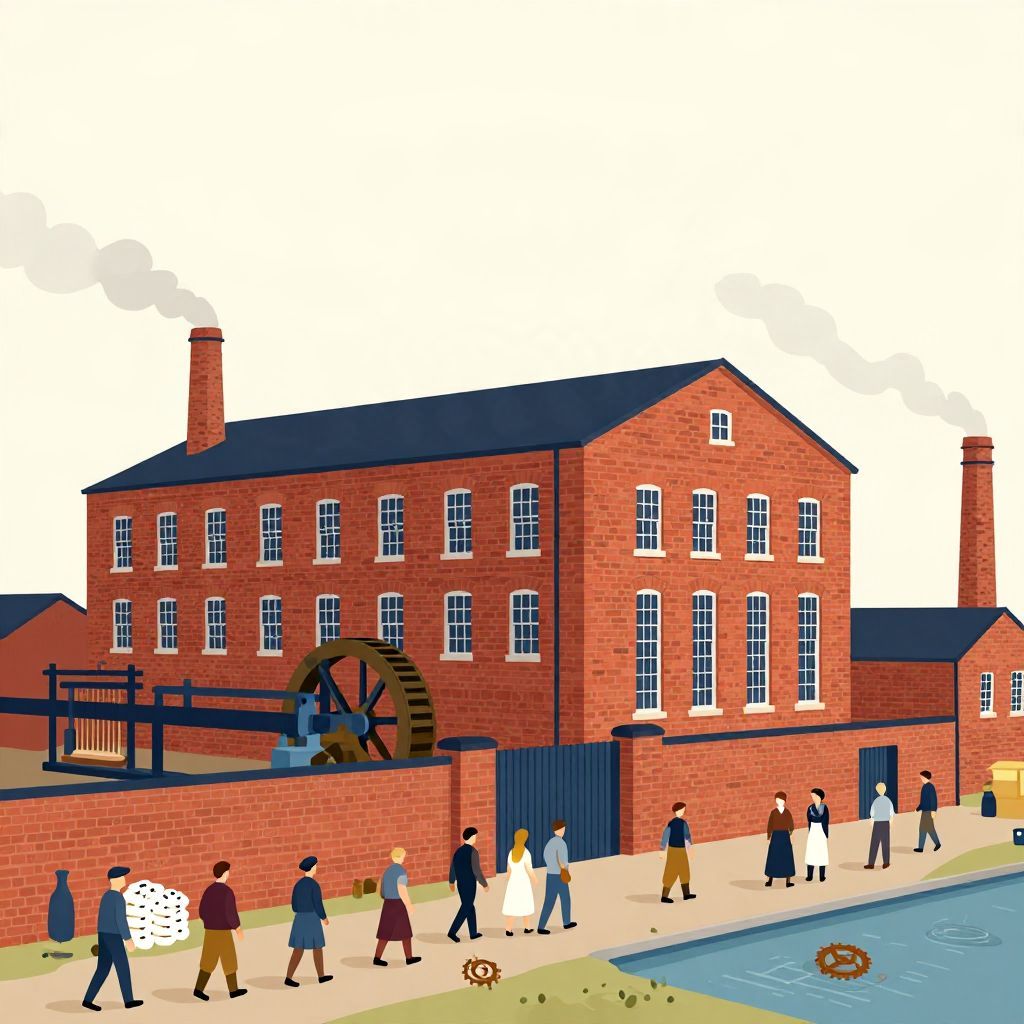
The factory system is one of the defining changes of the Industrial Revolution. It transformed production from small workshops and household labor into large, centralized workplaces where machines, power sources, and workers were brought together under one roof.
Understanding the factory system helps explain how modern industry, urban growth, wage labor, and mass production developed in Britain and then spread across the world.
What Is the Factory System?
The factory system is an industrial method of production in which goods are made in a centralized building using machinery, division of labor, and a workforce paid wages. It emerged in the late 18th and early 19th centuries, first in Britain, and became the foundation of modern industrial capitalism.
How the Factory System Changed Work
Before factories, most goods were produced in homes, small shops, or on farms through the putting-out system, where merchants supplied raw materials to workers who made items by hand. The factory system concentrated production in one place, replaced much hand labor with machines, and shifted control from artisans to owners and managers.
From household production to centralized industry
In older systems, a family might spin thread, weave cloth, or make metal goods as part of domestic life. Factories broke that pattern. Workers now traveled to a workplace, followed fixed hours, and performed narrow tasks within a larger production process. This change made output faster, more regular, and easier to scale.
Why machinery mattered
The factory system depended on machines that could outperform hand tools in speed and consistency. In textiles, inventions such as the spinning jenny, water frame, and power loom made it possible to produce cloth on a much larger scale. Once machines were expensive and bulky, it made sense to gather them in one building where one power source could run many of them.
Where and When Did the Factory System Begin?
The factory system developed during the Industrial Revolution, especially in Britain from the late 1700s onward. Early textile factories appeared in the 1770s and 1780s, with the cotton industry becoming the clearest early example. By the early 19th century, factory production had spread to other parts of industry and to other countries.
Britain as the first major factory society
Britain had several advantages: access to capital, growing markets, coal and iron resources, colonial trade networks, and a legal and political environment that supported private investment. These conditions did not create factories by themselves, but they made large-scale industrial investment more likely and more profitable.
Textiles led the way
Textile manufacturing was among the first sectors to industrialize because cloth was in high demand and could be mechanized relatively early. Cotton, in particular, became central to factory growth. The need to spin and weave huge quantities of fiber encouraged the use of water power first and then steam power, which freed factories from dependence on rivers.
Why the Factory System Developed
The factory system did not appear simply because inventors built machines. It developed because new technology, business incentives, and labor needs reinforced one another. Owners wanted higher productivity and lower costs, while growing populations and expanding markets created demand for more goods.
Economies of scale
Factories could produce more goods at lower cost per item than scattered home production. Centralized production reduced waste, allowed closer supervision, and made it easier to standardize quality. These advantages helped factory-made goods compete successfully with handmade products.
Power sources and infrastructure
Water wheels were important in the earliest factories, but steam power, especially after improvements associated with James Watt in the late 18th century, made industrial production far more flexible. Factories could now be placed closer to labor supplies, transport routes, and markets rather than only beside fast-flowing rivers.
Labor discipline
Factory owners needed workers to arrive on time, repeat tasks reliably, and adapt to machine-paced production. This required new forms of discipline. Bells, clocks, supervisors, fines, and rules became common features of factory life. In many places, the factory system reshaped everyday habits as much as it reshaped production.
What Was Life Like in Early Factories?
Early factory life was often harsh, especially for the poor, women, and children who made up a large share of the workforce. Long hours, repetitive tasks, dangerous machinery, dust, heat, and low wages were common. Conditions varied by industry and employer, but the early factory was rarely a comfortable place to work.
Women and children in the workforce
Factory owners often hired women and children because they could be paid less than adult men and because their smaller hands were sometimes seen as useful for textile work. Child labor became a major social issue in industrial Britain and later in other industrializing societies. Reform movements gradually pushed for limits on hours and age.
Urban growth and crowded living conditions
Factories drew workers into towns and cities, accelerating urbanization. Many industrial cities grew rapidly and without adequate housing, sanitation, or clean water. Overcrowding and disease were common consequences of industrial expansion. The factory system therefore changed not only work but also the physical shape of society.
How the Factory System Spread Beyond Britain
By the early 19th century, the factory system spread to Europe and North America, then to other parts of the world. It traveled through migration, investment, imitation, and trade. Nations that wanted to compete economically often adopted factory methods in textiles, iron, steel, and later other industries.
Industrialization in the United States
In the United States, factory production expanded especially in the Northeast during the early 1800s. American industrialists adapted British methods while also developing their own systems of labor recruitment and mechanized production. Textile mills became a major symbol of industrial change, and factory towns grew around them.
Global consequences
As factories multiplied, they increased demand for raw materials such as cotton, coal, rubber, and metals. They also produced large quantities of manufactured goods for domestic and overseas markets. This helped tie industrial economies more tightly to global trade networks and, in some cases, to imperial expansion.
How the Factory System Changed Society
The factory system did more than reorganize production. It altered class relations, family life, politics, and the environment. Its effects were uneven: some people gained new opportunities, while many workers faced exploitation and insecurity. Over time, these tensions helped inspire labor movements and reform laws.
Rise of industrial capitalism
Factories encouraged investment, profit-seeking, and the concentration of wealth in the hands of owners and financiers. Managers and industrialists gained influence, while wage laborers became increasingly dependent on employers for income. This shift is central to the history of industrial capitalism.
Labor reform and resistance
Workers did not accept factory discipline passively. They protested low wages, long hours, unsafe conditions, and child labor. Some formed unions; others supported political reform movements. Governments gradually responded with factory acts and labor regulations, though change was often slow and contested.
Environmental impact
Factories relied heavily on coal in the 19th century, contributing to smoke, pollution, and urban environmental damage. The factory system helped launch the fossil-fuel economy that still shapes industrial life today. Its environmental legacy is one of the most important long-term consequences of industrialization.
The Factory System and the Industrial Revolution
The factory system is often treated as synonymous with the Industrial Revolution, but the two are not exactly the same. The Industrial Revolution was the broader historical process of technological, economic, and social transformation. The factory system was one of its most visible and important organizational forms.
Why historians see it as a turning point
Historians emphasize the factory system because it changed how goods were made, how labor was organized, and how time itself was measured in industrial society. It marked a move from dispersed, seasonal, and skill-based production toward centralized, continuous, and machine-driven production.
Not every industry became factory-based at once
Some sectors industrialized faster than others. Agriculture, construction, domestic service, and many crafts remained outside the factory system for a long time. Even within industry, the transition was uneven. The factory system expanded gradually rather than replacing all older forms of work overnight.
Why the Factory System Still Matters
The factory system shaped the modern world. It made mass production possible, helped create industrial cities, and established the wage labor system that still underpins much of the global economy. It also generated the social problems—exploitation, inequality, and pollution—that later reformers and governments tried to address.
In simple terms, the factory system was the organization of labor and machinery in one centralized workplace, and it became the engine of industrial society. To see how it fit into broader economic change, you may also want to read about the Market Revolution and how industrialization led to imperialism.