
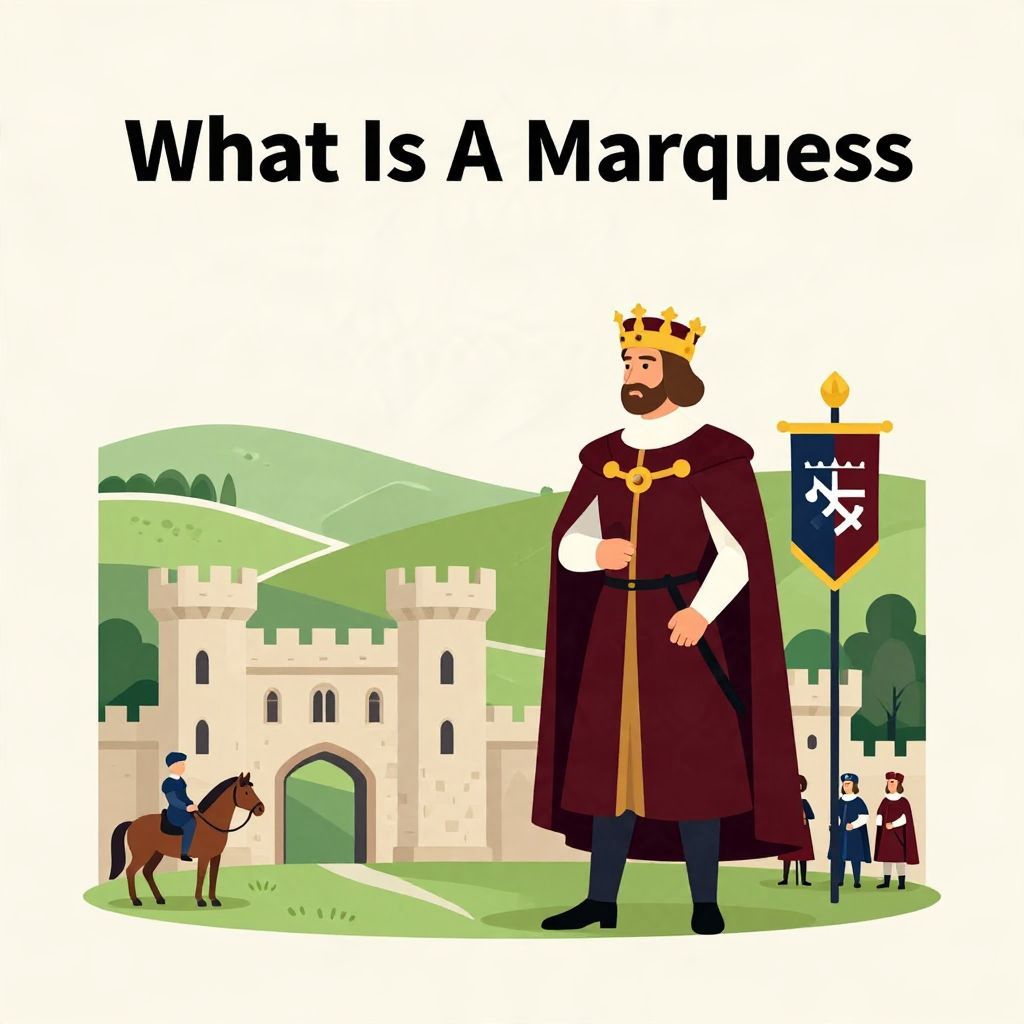
What is a marquess? In European nobility, a marquess is a hereditary title ranking below a duke and above an earl or count. The title emerged in the medieval frontier zones of western Europe, where rulers needed powerful nobles to defend borderlands and administer them on their behalf.
Over time, the marquess became less a military office and more a mark of aristocratic rank. Its meaning changed from a practical border command to a ceremonial dignity within noble hierarchies, especially in Britain, France, and Italy.
What Is A Marquess?
A marquess is a noble title traditionally associated with the governance or defense of a march, meaning a border territory. In the British peerage, a marquess ranks below a duke and above an earl. The female equivalent is marchioness, either by marriage or as a title in her own right in some cases.
Where Did The Title Marquess Come From?
The word marquess comes from the same root as march, a frontier or border region. The title developed in medieval Europe, especially in the Carolingian and post-Carolingian world, when rulers needed trusted nobles to hold and defend borderlands against rival powers, raiders, or unstable neighboring territories.
The meaning of “march” in medieval Europe
In the Middle Ages, a march was not just a line on a map. It was a militarized zone, often exposed to attack and requiring special authority. A noble entrusted with such a region might be given broader powers than a typical count because frontier defense demanded quick decisions, local initiative, and military readiness.
From office to rank
At first, the title was tied closely to function. A marquess was, in effect, a border lord. But as medieval states became more centralized, the practical frontier role weakened. The title survived as a hereditary rank in the aristocratic hierarchy, even when its holder no longer governed a march.
How Did The Title Develop In History?
The title’s history is best understood as a shift from military necessity to social prestige. In early medieval Europe, frontier rulers needed autonomy. By the later Middle Ages and early modern period, monarchs increasingly controlled territory directly, so noble titles became symbols of status rather than administrative jobs.
Medieval origins
Border regions along the edges of kingdoms and empires were often unstable. Rulers delegated authority to nobles who could raise troops, build defenses, and negotiate local power. These frontier lords were sometimes called margraves in German-speaking lands, a term closely related to marquess. Different languages developed different forms, but the underlying idea was similar.
Adoption in Britain
In England, the title of marquess appeared relatively late compared with duke, earl, and baron. It was introduced in the 14th century, a period when English nobility was becoming more formalized. The title did not replace older ranks; instead, it filled a place between duke and earl in the developing peerage system.
Its introduction was not universally welcomed. Some nobles viewed it as an unfamiliar or even awkward rank because English aristocratic tradition had long favored older titles. Over time, however, it became an accepted part of the hierarchy.
What Does A Marquess Rank Above And Below?
In the British peerage, a marquess ranks below a duke and above an earl. In continental systems, the closest equivalents may be a marquis in France or a margrave in parts of the Holy Roman Empire and later German states. Exact ranking can vary by country and historical period, but the title generally denotes high nobility.
- Above: earl or count, depending on the system
- Below: duke
- Female form: marchioness
- Related continental titles: marquis, margrave, markgraf
Why the ranking mattered
Rank determined precedence at court, ceremonial status, and sometimes political influence. While a marquess might no longer command a border province, the title still carried social weight. In aristocratic societies, hierarchy shaped marriages, landholding, access to the monarch, and the order in which nobles were recognized publicly.
What Was The Original Role Of A Marquess?
The original role of a marquess was tied to frontier defense. A marquess was expected to secure a borderland, organize military response, and maintain order in a region where royal authority could be weaker or more contested. This made the title especially important in times when kingdoms were fragmented and communication was slow.
Military responsibility
Frontier nobles often needed to maintain castles, local levies, and alliances with neighboring lords. Their regions could be vulnerable to invasion, rebellion, or cross-border conflict. The title therefore carried a practical purpose: it identified a lord whose power was meant to protect the realm’s edge.
Administrative authority
Because a march was often distant from the royal center, a marquess might exercise greater local authority than nobles inland. This could include justice, taxation, military mobilization, and settlement policy. In practice, the exact powers varied widely by region and century.
How Did The Title Change Over Time?
As monarchies strengthened, the frontier function of the marquess became less important. Kings and queens increasingly relied on bureaucrats, standing armies, and direct royal administration. The title remained, but its meaning shifted from office to honorific rank within a noble order.
Loss of frontier function
By the late medieval and early modern periods, many marquessates no longer corresponded to actual border defenses. Some were attached to estates far from any frontier. The title persisted because aristocratic systems valued continuity, inheritance, and ceremonial distinction.
Modern ceremonial use
In modern Britain and other constitutional monarchies, a marquess is generally a peerage title with social and ceremonial significance rather than governing power. The holder does not rule a territory. Instead, the title marks family status, historical continuity, and precedence within the nobility.
Marquess, Marquis, And Margrave: Are They The Same?
These titles are closely related but not identical. Marquess is the English form. Marquis is the French form, though in English it can also refer to a continental nobleman. Margrave comes from German usage and literally refers to a count of the march. All share the same frontier origin.
Language and tradition
The differences are largely linguistic and historical. In France, the title marquis became common in the nobility. In the German lands, margrave or markgraf emphasized the border function. English adopted marquess as its own peerage term. The titles are comparable, but each developed within a distinct political culture.
Who Became A Marquess?
Marquesses were usually members of the hereditary nobility, often rewarded for loyalty, service, or family prestige. In some cases, monarchs created new marquessates to honor powerful families or to strengthen alliances. In others, a noble house rose in rank over generations as its influence grew.
Creation by monarchs
Because peerage titles were granted by the sovereign, they could be used strategically. A king or queen might elevate a loyal noble to marquess to reward service or balance the power of other magnates. This made the title part of court politics as much as aristocratic tradition.
Inheritance
Like other hereditary titles, a marquessate usually passed through the family line according to the rules attached to the patent or custom of the realm. Succession could be straightforward or complicated, depending on whether the title allowed female inheritance, collateral succession, or extinction in the absence of heirs.
Why Does The Title Still Matter Today?
The title matters because it reveals how medieval Europe organized power. A marquess was originally a frontier defender, but the survival of the title shows how institutions outlast the conditions that created them. Today it is a reminder that noble ranks were once tied to military and territorial realities, not just social prestige.
A window into feudal society
Studying the marquess helps explain how medieval rule worked: kings depended on nobles, nobles depended on land, and borderlands demanded special arrangements. The title is therefore more than a curiosity. It reflects the practical needs of states before modern borders, centralized armies, and professional administration.
Social memory and ceremony
Even after the old frontier role disappeared, the title remained embedded in aristocratic identity. That continuity is one reason noble titles still attract interest. They preserve a memory of the political world that created them, even when their original purpose has faded.
So, What Is A Marquess In Historical Terms?
Historically, a marquess was a high-ranking noble originally responsible for a border territory or march. Over time, the title became a hereditary rank of honor, especially in Britain and parts of continental Europe. Its history shows how military necessity, royal power, and aristocratic hierarchy shaped medieval and early modern society.
In short, a marquess is not just a title of rank; it is a surviving trace of Europe’s frontier past. If you want to explore related noble ranks, see what a royal title means and what a duchess is.