
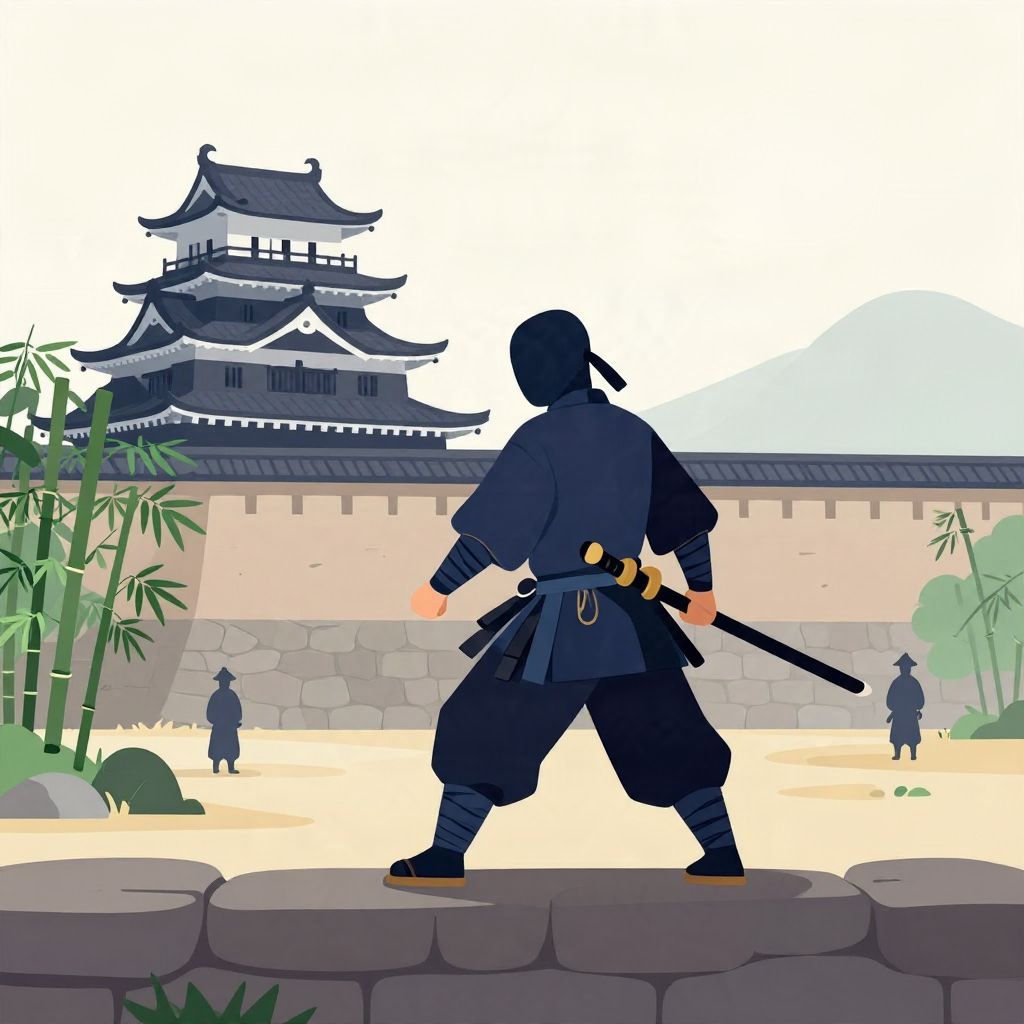
What is a shinobi? In Japanese history, a shinobi was a covert operative, scout, infiltrator, or spy—someone trained to gather information, move secretly, and sometimes sabotage or mislead an enemy. The word is closely associated with the later popular image of the “ninja,” but the historical reality was broader and less theatrical than modern fiction suggests.
Shinobi were products of Japan’s medieval and early modern warfare, especially the turbulent centuries of feudal conflict. Their work was shaped by practical military needs: reconnaissance, intelligence, deception, and survival in dangerous political landscapes.
What Is a Shinobi?
A shinobi was a person trained in stealth and intelligence work in premodern Japan. The term generally refers to covert agents who infiltrated enemy territory, observed troop movements, carried messages, or carried out sabotage. While “ninja” is the more familiar modern word, “shinobi” is the older Japanese term and is closer to the historical reality.
Where Did the Shinobi Come From?
The origins of shinobi are not tied to a single founder or moment. They developed gradually out of the needs of warfare in medieval Japan, especially during the late Kamakura period, the Muromachi period, and the long age of civil war known as the Sengoku period, roughly the 15th and 16th centuries.
As rival warlords fought for land and power, armies needed information. A commander who knew where an enemy camp was located, how many troops it held, or whether a bridge had been destroyed held a major advantage. Shinobi emerged to meet that need. They were not a separate “order” in the modern sense, but specialists drawn from local networks, warrior families, and communities with practical knowledge of terrain, disguise, and infiltration.
Regional traditions and the Iga and Kōka areas
Two regions often associated with shinobi are Iga and Kōka, mountainous areas in central Japan. These regions became famous because local groups there developed reputations for stealth, intelligence gathering, and irregular warfare. Historians generally agree that these communities were important, but popular stories sometimes exaggerate them into a single secret society. In reality, they were part of a wider pattern of medieval military specialization.
What Did Shinobi Actually Do?
Shinobi performed practical tasks that supported warfare and political control. Their work was usually less dramatic than modern films suggest. The most important functions were reconnaissance, infiltration, deception, and communication.
Common duties of a shinobi
- Scouting enemy fortifications and roads
- Observing troop numbers and movements
- Delivering secret messages
- Setting fires or causing confusion behind enemy lines
- Spreading false information
- Escorting or rescuing important people in dangerous conditions
Some shinobi may also have engaged in assassination or sabotage, but the historical evidence for highly stylized “ninja” behavior is limited. Their value lay in information and disruption, not in supernatural skill or elaborate weaponry. In many cases, they relied on ordinary tools, careful planning, and local knowledge rather than exotic gadgets.
Shinobi and the Word “Ninja”
“Ninja” is a later reading of the same characters often associated with shinobi. In Japanese usage, shinobi and ninja both refer to covert activity, but “shinobi” is the older term and appears more naturally in historical contexts. The modern global image of the ninja became especially popular in the 20th century through novels, film, manga, and television.
This distinction matters because the popular ninja is often portrayed as a black-clad super-spy with impossible combat abilities. Historical shinobi were more likely to be practical operatives working in the shadows of war. They may have blended into ordinary clothing, used disguise, and avoided direct confrontation whenever possible.
Why the modern image differs from history
Later entertainment traditions favored mystery, speed, and spectacle. Over time, these stories created a more uniform and dramatic figure than the historical shinobi, who were diverse in background and role. The result is that the word “ninja” now often evokes a cultural icon, while “shinobi” is better for discussing the historical profession.
How Were Shinobi Trained?
There is no single surviving curriculum that defines shinobi training across all of Japan. What can be said with confidence is that their skills would have included movement through difficult terrain, observation, disguise, timing, and the ability to read social situations quickly. Some likely learned from family traditions or local military networks, while others gained experience through service to powerful lords.
Training probably emphasized practical adaptability. A successful shinobi needed to know how to enter a castle town unnoticed, how to recognize guard patterns, how to carry information securely, and how to retreat without being caught. These are skills that overlap with scouting and espionage in many other historical societies.
Skills associated with shinobi
- Stealth and concealment
- Navigation and fieldcraft
- Disguise and impersonation
- Observation and memory
- Basic weapons use
- Communication under secrecy
Shinobi in the Sengoku Period
The Sengoku period, often translated as the “Warring States” period, was the high point of shinobi activity. From the mid-15th century into the early 17th century, Japan was fragmented among competing daimyō, or regional lords. Constant warfare made intelligence especially valuable, and shinobi became part of the military landscape.
During this era, a successful campaign could depend on knowing whether an enemy castle had weak defenses, whether a supply route was vulnerable, or whether an alliance might collapse. Shinobi helped answer those questions. Their work was often invisible in chronicles because secrecy was part of the job, which is one reason the historical record is fragmentary.
Notable historical context
Some prominent warlords, including Tokugawa Ieyasu, are associated in later tradition with the use of shinobi. It is reasonable to say that major military leaders employed covert agents, but specific stories should be treated carefully unless supported by strong evidence. Many accounts were written after the events and may reflect later legend as much as fact.
Were Shinobi the Same as Samurai?
Not exactly. Some shinobi came from samurai backgrounds, and some served samurai lords, but the roles were different. Samurai were warrior-retainers whose status was tied to open military service, loyalty, and rank. Shinobi worked in secrecy and often operated outside the ideals of honorable face-to-face combat.
That said, the boundary was not always rigid. In medieval Japan, military roles could overlap. A samurai might perform intelligence work, and a shinobi might also be a local warrior or messenger. The important point is that “shinobi” describes a function, not a single class of people.
What Is Myth and What Is History?
Many modern ideas about shinobi come from folklore, later storytelling, and entertainment rather than direct evidence. Historians can identify some broad truths: shinobi existed, they served military and political needs, and they were especially important in periods of conflict. Beyond that, many details become uncertain.
Common myths to treat cautiously
- That all shinobi wore black uniforms
- That they routinely used magical powers or impossible weapons
- That there was one secret, unified “ninja clan” controlling all shinobi
- That every famous story about a ninja is historically verified
In reality, stealth often meant blending in rather than dressing in a uniform that announced one’s presence. The black-clad costume is a theatrical convention that became visually useful in stage performance and later popular media. Historical shinobi would have adapted their appearance to the situation.
How Did Shinobi Change Over Time?
As Japan moved toward unification under the Tokugawa shogunate in the early 17th century, large-scale civil war declined. The need for battlefield infiltration did not disappear entirely, but the social and military environment changed. Covert activity continued in various forms, yet the classic wartime shinobi became less central than during the Sengoku era.
In the long peace of the Edo period, the image of the shinobi gradually shifted from a practical wartime specialist to a subject of stories, manuals, and legend. Later writers and performers helped preserve and transform that image, eventually giving rise to the modern ninja stereotype.
Why Do Shinobi Still Matter Today?
Shinobi remain historically important because they show how warfare depends on intelligence as much as on battlefield force. Their story also reveals how history and popular culture can diverge. The real shinobi were not fantasy figures; they were part of the practical machinery of medieval Japanese conflict.
Understanding shinobi helps explain how Japanese states and warlords managed secrecy, surveillance, and strategy in an age before modern intelligence services. It also reminds us that some of the most influential actors in history are the ones who leave the fewest obvious traces.
So, what is a shinobi? Historically, it is a covert operative in premodern Japan—an observer, infiltrator, messenger, and sometimes saboteur—whose reputation later grew into the modern image of the ninja. The best way to understand shinobi is to see them not as legends, but as specialists shaped by the demands of war, secrecy, and survival.