
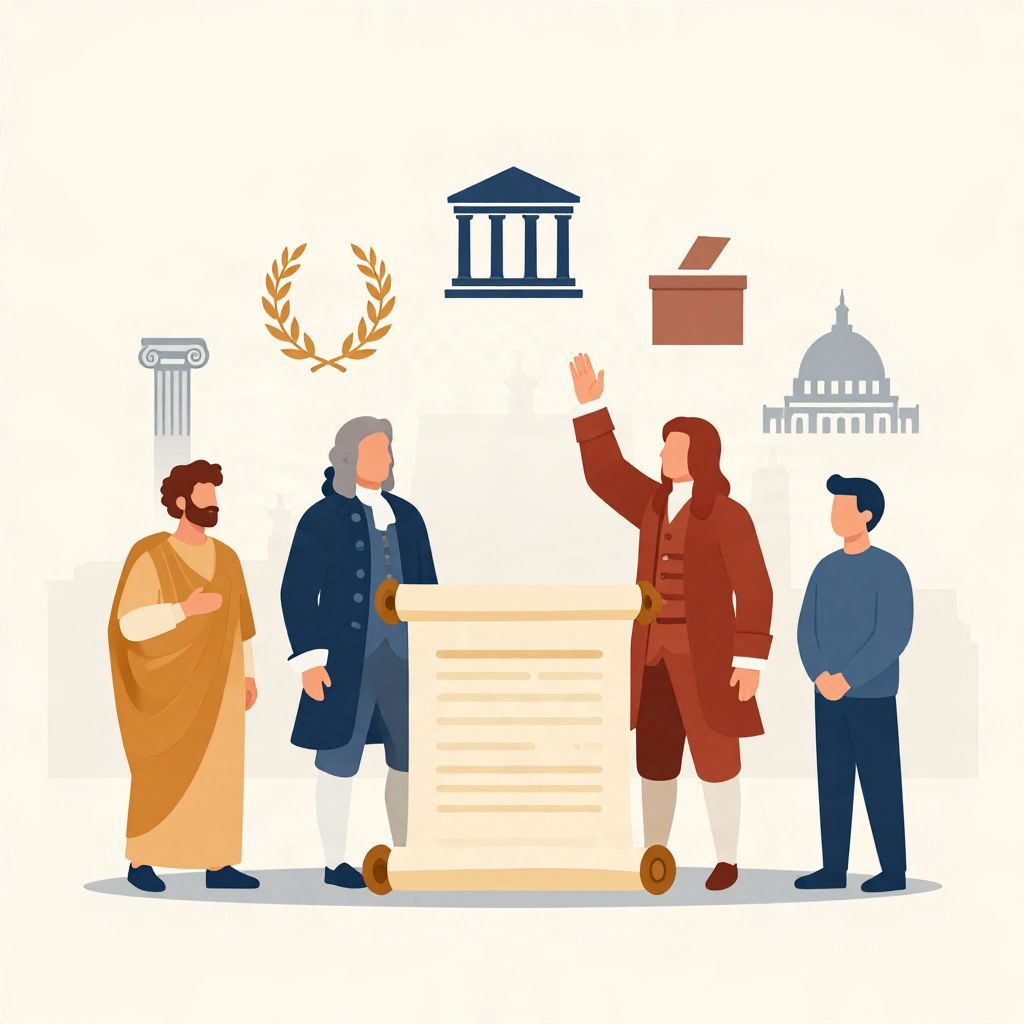
Political ideology is one of the most important ideas in modern history, shaping how people think about power, government, rights, and society. It helps explain why revolutions happen, why parties form, and why citizens disagree about the role of the state.
But what is political ideology, exactly? In historical terms, it is a structured set of beliefs about how society should be organized and governed. Those beliefs are not timeless: they emerged gradually, especially in the age of revolutions, mass politics, and modern nation-states.
What Is Political Ideology?
Political ideology is a coherent set of ideas about politics and society, including who should hold power, what government should do, and what values matter most. It can be broad, like liberalism or socialism, or more specific, like nationalism or conservatism. Ideologies give political movements a framework for action and justification.
Where Did Political Ideology Come From?
Although people have argued about justice and rule since antiquity, political ideology in the modern sense developed mainly in the late 18th and 19th centuries. The French Revolution, the American Revolution, industrialization, and the rise of mass politics created a world in which competing political programs had to be explained, defended, and organized.
Ancient and premodern roots
Ancient philosophers such as Plato and Aristotle wrote about government, virtue, and citizenship, and medieval thinkers debated kingship, law, and divine authority. These were important foundations, but they were not “ideologies” in the modern sense. Most premodern societies did not have mass political parties or broad public competition over alternative social systems.
The revolutionary age
The late 1700s changed political language dramatically. The American Revolution and especially the French Revolution forced Europeans and Americans to define what legitimacy meant: monarchy, republic, popular sovereignty, equality, rights, and citizenship all became contested ideas. In this period, “ideology” began to resemble a modern political map of competing visions.
How Did the Word “Ideology” Develop?
The term “ideology” was coined in post-revolutionary France around the turn of the 19th century, usually associated with the thinker Antoine Destutt de Tracy. He used it to mean the study of ideas and their origins. Over time, the word shifted from a neutral intellectual term to one that described political belief systems, often with a critical edge.
From neutral study to political label
At first, “ideology” referred to the analysis of ideas, not to propaganda or party doctrine. In the 19th century, however, critics increasingly used it to suggest that political beliefs were not objective truths but socially shaped systems of thought. Later thinkers, including Karl Marx, helped make “ideology” a powerful concept for analyzing how ideas can support power structures.
Why Political Ideologies Matter in History
Political ideologies matter because they turn scattered opinions into organized movements. They help people interpret inequality, define enemies and allies, and imagine a better future. Historically, ideologies have influenced constitutions, revolutions, empires, labor movements, decolonization, and modern elections.
They give politics a language
Ideologies provide words and concepts that make political conflict intelligible. A person may support limited government, social equality, religious authority, national unity, or revolutionary change, but ideology gives those preferences a broader meaning. It turns private views into public programs.
They shape institutions
Once an ideology becomes influential, it can reshape laws and institutions. Liberal ideas helped inspire constitutional government and civil rights. Socialist ideas influenced labor protections and welfare states. Nationalist ideas helped build modern states but also fueled exclusion and conflict. Conservative ideas often worked to preserve hierarchy, tradition, and social order.
Main Types of Political Ideology
Political ideologies are not fixed categories, and real movements often blend several traditions. Still, historians usually identify a few major ideological families that emerged in the modern era and remain influential today.
Liberalism
Liberalism emphasizes individual rights, legal equality, representative government, and limits on arbitrary power. It grew out of Enlightenment thought and revolutionary politics in the 18th and 19th centuries. Liberalism has taken many forms, from classical laissez-faire ideas to modern social liberalism.
Conservatism
Conservatism developed as a response to revolutionary upheaval. It values tradition, social stability, gradual change, and respect for inherited institutions. In different countries and periods, conservatives have defended monarchy, religion, property, or national identity, though not always in the same way.
Socialism
Socialism emerged in the 19th century amid industrial capitalism and urban labor संघर्ष. It argues that wealth and power should be distributed more fairly and that collective action or public ownership may be needed to reduce exploitation. Marxism became one of its most influential branches, though socialism has included many non-Marxist traditions as well.
Nationalism
Nationalism holds that people who share a language, culture, history, or identity should govern themselves, often through a nation-state. It was a major force in 19th-century Europe and later in anti-colonial movements around the world. Nationalism could be liberating, but it could also become exclusionary or aggressive.
Fascism and authoritarian ideologies
Fascism arose in the early 20th century, especially after World War I, combining ultranationalism, anti-liberalism, anti-socialism, and a cult of strong leadership. It rejected democratic pluralism and often used violence, propaganda, and state control. Other authoritarian ideologies have also justified concentrated power, though not always in identical ways.
How Political Ideology Changed Modern History
Political ideology became central to modern history because it helped people organize mass movements in an age of expanding literacy, newspapers, parties, and elections. It also gave meaning to industrial conflict, imperial competition, and global war. In the 19th and 20th centuries, ideological struggle often became as important as dynastic or religious conflict had been in earlier eras.
Revolutions and reform
Revolutionaries used ideology to argue that old regimes were illegitimate and that new forms of government were necessary. Reformers used ideology to justify gradual change, such as expanding suffrage, abolishing slavery, or improving labor conditions. Political ideology made reform a matter of principle, not just convenience.
Empire and anti-colonial movements
European empires often justified rule through racial hierarchy, civilizing missions, or imperial nationalism. In response, anti-colonial leaders used liberal, socialist, religious, and nationalist ideas to demand independence. Ideology therefore worked on both sides of empire: to defend domination and to challenge it.
Twentieth-century conflict
The 20th century showed how powerful ideology could become. Liberal democracy, communism, fascism, and various nationalist movements competed across continents. The Russian Revolution of 1917, the rise of fascist regimes in Italy and Germany, the Cold War, and decolonization all reveal how ideas about society and power shaped global events.
Is Political Ideology the Same as Opinion?
No. An opinion is a single view on a topic, while ideology is a larger system of connected beliefs. For example, someone may oppose a tax increase as a personal opinion, but an ideology explains that position through broader principles such as limited government, market freedom, or distrust of state power.
Ideology is broader than policy preference
People often hold mixed or changing views, and not everyone fits neatly into one ideology. Still, ideologies matter because they connect many issues into a worldview. They help people decide not only what they want, but why they want it and how far they are willing to go to achieve it.
How Historians Study Political Ideology
Historians study political ideology by looking at speeches, pamphlets, party platforms, constitutions, newspapers, memoirs, and laws. They ask how ideas spread, who used them, and what social conditions made them persuasive. This approach shows that ideology is not just abstract theory; it is also a historical force shaped by class, religion, war, technology, and empire.
Ideas and material conditions
Many historians emphasize that ideologies do not float above society. They are shaped by real conflicts over land, labor, wealth, identity, and authority. At the same time, ideas matter in their own right: people act on beliefs, and those beliefs can transform institutions over time.
Why the Concept Still Matters Today
Political ideology remains useful because modern politics still involves competing visions of freedom, equality, order, identity, and the role of the state. Even when politicians claim to be “above ideology,” they usually still rely on assumptions about human nature, society, and power. Recognizing ideology helps explain both political conflict and political persuasion.
In historical perspective, political ideology is the language modern societies use to argue about who should rule and what a good society should look like. It emerged from revolution and modernity, and it continues to shape governments, movements, and everyday political choices. For related reading, see What Is Political Ideology and What Is Political Engagement.