
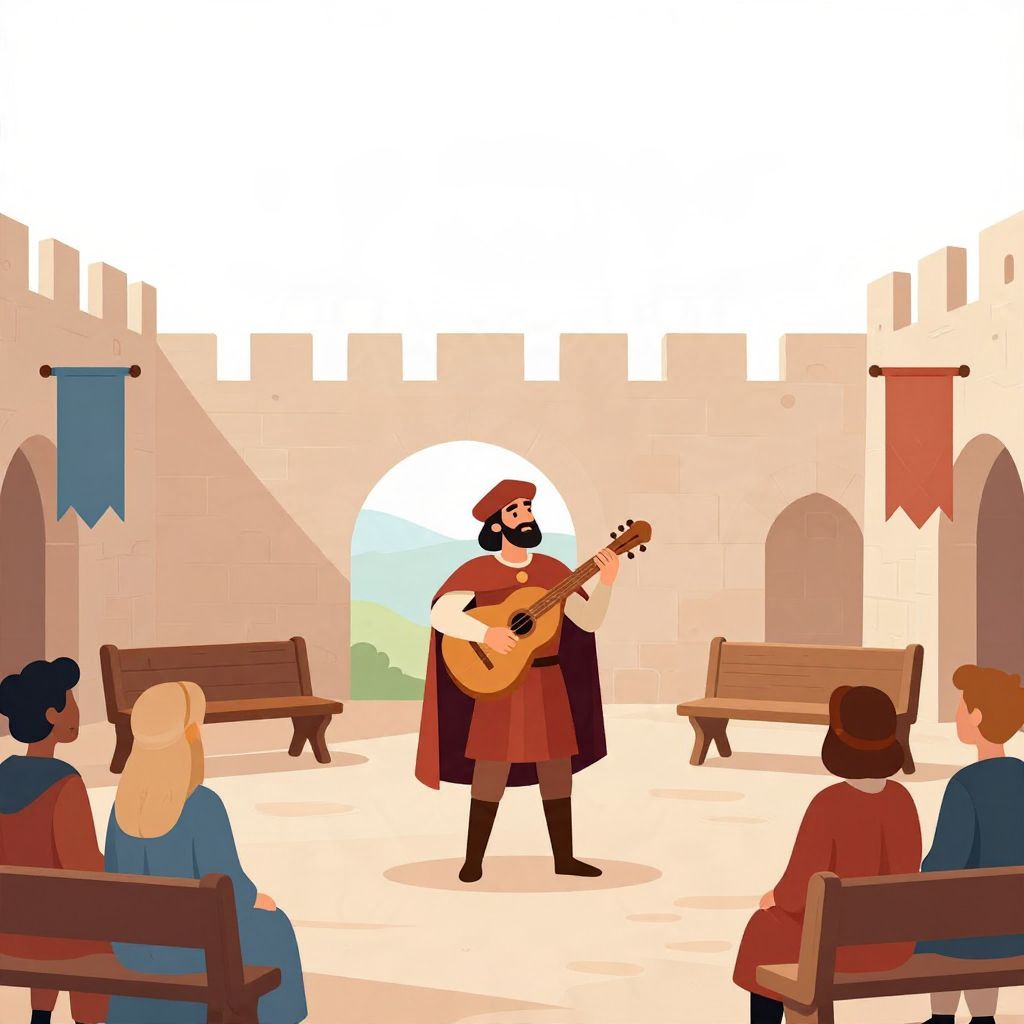
What is a troubadour? The word usually brings to mind a traveling singer-poet, but historically troubadours were more specific than that. They were lyric poets and composers who flourished in the courts of medieval southern France and nearby regions, creating a sophisticated tradition of songs about love, politics, honor, and social life.
Their work helped shape later European literature and music. To understand troubadours properly, it helps to look at where they came from, what they sang about, and why their cultural legacy still matters.
What Is a Troubadour?
A troubadour was a poet-composer of the medieval Occitan-speaking world, active mainly from the late 11th to the 13th centuries. Troubadours wrote and performed lyric poetry, usually in Old Occitan, and are best known for courtly love songs, though they also composed political, moral, and satirical verse.
Where Did Troubadours Come From?
Troubadours emerged in southern France, especially in regions such as Aquitaine, Provence, and Languedoc, around the end of the 11th century. Their culture spread into northern Italy, Catalonia, and other parts of Europe. The tradition developed in aristocratic courts, where poetry, music, and refined social behavior were highly valued.
The Occitan World
The language of the troubadours was Occitan, sometimes called Old Provençal in older scholarship. This was not the same as modern French. In medieval Europe, language boundaries were fluid, and the southern regions of France had a distinct cultural identity that helped shape troubadour art.
Historical Setting
Several forces encouraged the rise of troubadour culture: courtly patronage, aristocratic competition, and a growing taste for elegant vernacular literature. Rather than writing in Latin, the language of the Church and scholarship, troubadours elevated a local spoken language into a literary medium.
What Did Troubadours Do?
Troubadours composed and performed lyric songs, often accompanying themselves or being accompanied by instruments. Their poems were meant to be heard, not just read. They could entertain noble audiences, praise patrons, comment on political conflicts, or present stylized reflections on love and desire.
Performance and Patronage
Many troubadours depended on noble support. Some were aristocrats themselves; others came from lower social backgrounds and relied on courtly favor. Their success often depended on mobility, reputation, and the ability to adapt their art to different patrons and audiences.
Troubadours and Trouvères
The troubadours of the south should not be confused with the trouvères of northern France. Trouvères were similar poet-composers, but they used Old French rather than Occitan. Both traditions were part of a wider medieval lyric culture, yet they developed in different linguistic and regional settings.
What Themes Did Troubadours Write About?
Although troubadour poetry is often associated with romantic love, the tradition was broader than that. Troubadours wrote about desire, longing, jealousy, loyalty, war, morality, and politics. Their poems could be playful, serious, bitter, or highly formalized, depending on the genre and occasion.
Courtly Love
The most famous troubadour theme is fin’amor, or refined love. In these poems, the lover often served a noble lady with admiration, restraint, and emotional intensity. This idealized love was not simply “romance” in the modern sense; it was a literary code shaped by court culture and poetic convention.
Political and Satirical Poetry
Some troubadours wrote sharp political commentary. They could praise rulers, criticize enemies, or respond to conflicts such as feudal disputes and the Crusades. Others used satire to mock social behavior, hypocrisy, or bad poetry. The tradition was intellectually flexible, not limited to love lyrics.
Who Were the Most Famous Troubadours?
Several troubadours stand out in the historical record, though many names survive only through manuscripts and later anthologies. Among the best known are William IX, Duke of Aquitaine, often regarded as one of the earliest troubadours; Bernart de Ventadorn; Arnaut Daniel; and Bertran de Born.
William IX of Aquitaine
William IX (1071–1126) is often described as the first known troubadour. He was a powerful nobleman, not a wandering minstrel, and his surviving poems show the early sophistication of the tradition. His role demonstrates that troubadour culture began among elites, even though later performers came from varied backgrounds.
Bernart de Ventadorn
Bernart de Ventadorn, active in the 12th century, is especially associated with love poetry. His songs helped define the emotional and artistic style that later readers came to identify with troubadour verse.
Arnaut Daniel and Literary Prestige
Arnaut Daniel became famous for complex poetic technique. Later medieval writers admired him for his difficult style, and his reputation shows that troubadour poetry was valued not only for feeling but also for formal skill.
Were Troubadours the Same as Minstrels?
No. This is a common misunderstanding. Troubadours were primarily poet-composers, while minstrels were often performers, entertainers, or musicians who might sing, play instruments, or recite works created by others. The two roles could overlap, but they were not identical.
Social Status Matters
In medieval society, status mattered. Troubadours were often associated with authorship and elite literary culture, whereas minstrels were more likely to be professional entertainers. That said, medieval categories were not rigid, and some individuals moved between roles depending on patronage and circumstance.
How Did Troubadour Culture Spread?
Troubadour poetry spread through travel, courtly exchange, marriage alliances, and the movement of performers across regions. It reached northern Italy, the Iberian Peninsula, and parts of Germany, influencing local poetic traditions. The prestige of Occitan lyric helped make it an international model for courtly verse.
The Impact of the Albigensian Crusade
The Albigensian Crusade, launched in 1209, profoundly changed southern France. The conflict weakened many of the courts that had supported troubadour culture. Although the tradition did not disappear immediately, political upheaval and changing patronage contributed to its decline in its original homeland.
Transmission Through Manuscripts
Troubadour works survived because scribes copied them into chansonniers, or songbooks. These manuscripts preserved both lyrics and the names of many authors, though not always consistently. Because the tradition was originally oral and performative, the written record is incomplete and sometimes difficult to interpret.
How Should We Understand Troubadours Today?
Modern usage often turns “troubadour” into a general term for a wandering singer, but historically that is only partly accurate. The original troubadours were part of a highly developed literary culture. They were not simply traveling musicians; they were creators of a major medieval poetic tradition.
Myth and Popular Memory
Later centuries romanticized troubadours as free-spirited lovers or bohemian artists. That image contains some truth, but it can obscure the social and intellectual world in which they worked. Their poetry was shaped by courtly etiquette, patronage, language, and political change.
Why Are Troubadours Important in History?
Troubadours mattered because they helped establish vernacular lyric poetry as a prestigious art form. Their influence can be traced in later European literature, ideas of courtly love, and the development of poetic technique. They also show how culture could flourish in regional languages outside the Latin scholarly tradition.
Literary Legacy
Medieval and later writers drew on troubadour themes and forms. Their emphasis on emotion, artistry, and refined language influenced subsequent lyric traditions across Europe. Even when their original social world changed, their poetry continued to shape literary imagination.
Historical Significance Beyond Music
Troubadours are important not only for music history but also for social history. They reveal how medieval courts used art to express status, identity, and political values. Their songs offer evidence for the cultural life of aristocratic society in the High Middle Ages.
What Is a Troubadour in Simple Terms?
In simple terms, a troubadour was a medieval poet-musician from southern France and neighboring regions who wrote and performed songs in Occitan, especially between the late 11th and 13th centuries. The term now has a broader meaning, but historically it refers to a specific and influential literary tradition.
So, when asking what a troubadour is, the best answer is this: a troubadour was a medieval lyric poet-composer whose songs helped define courtly culture in southern Europe. Their legacy lives on in literature, music, and the modern imagination. For related reading, see what classical music is and what a buccaneer was.