
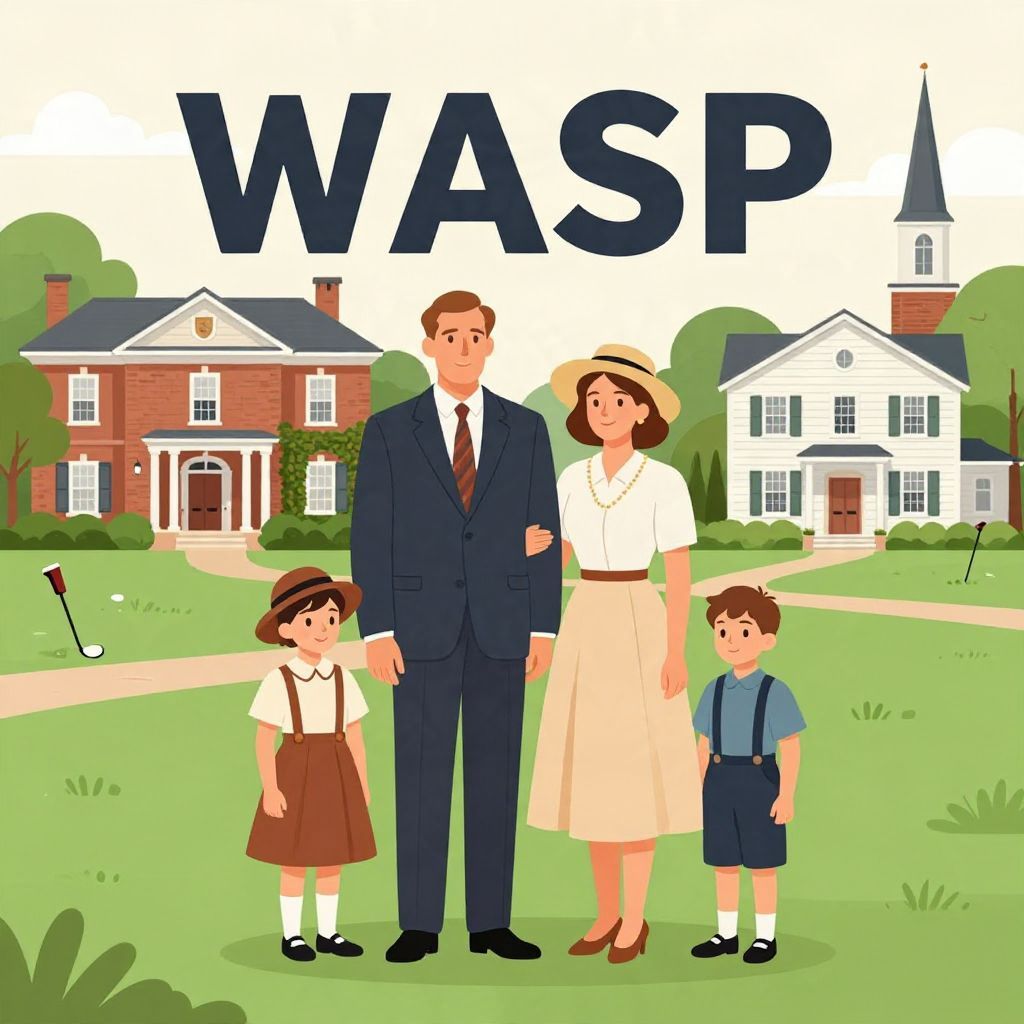
What is a WASP person? In American history, “WASP” is an acronym for White Anglo-Saxon Protestant. It refers less to a formal ethnic group than to a social label for people, usually of Northern European ancestry and Protestant background, who long held outsized influence in the United States.
The term became common in the 20th century, especially as historians and social critics used it to describe a powerful cultural elite. Its meaning has changed over time, and today it is often used with irony, criticism, or historical distance.
What Is a WASP Person?
A WASP person is someone identified as a White Anglo-Saxon Protestant, a term used in the United States to describe people associated with English or broader Northern European ancestry and Protestant Christianity. Historically, it signaled social status, cultural dominance, and access to power more than a strict biological or religious category.
Where Did the Term “WASP” Come From?
The acronym “WASP” emerged in the mid-20th century, though the social reality behind it was older. “White Anglo-Saxon Protestant” was a way of naming a group that had long been treated as America’s mainstream elite, especially in business, politics, education, and old social institutions.
From social description to shorthand
The phrase was not invented in colonial America. Instead, it developed as a modern shorthand for a class and cultural identity that had already existed for generations. By the 1950s and 1960s, writers and commentators used “WASP” to describe families who were often seen as old-stock, well-connected, and socially exclusive.
Why “Anglo-Saxon”?
The “Anglo-Saxon” part reflected older ideas about English ancestry and cultural inheritance. In practice, the term was never used with perfect precision. Many people labeled WASPs were not literally descended only from Anglo-Saxons; the label usually meant English-rooted, white, and Protestant, with a social style associated with established American elites.
How Did WASP Identity Develop in American History?
The roots of WASP identity go back to the English settlement of North America in the 17th century. English Protestants founded colonies in New England, Virginia, and elsewhere, and over time their language, laws, institutions, and religious traditions became highly influential in shaping the United States.
Colonial foundations
Early English colonists brought Protestant beliefs, English legal traditions, and assumptions about social hierarchy. In New England, Puritans built communities around Congregationalist religion. In the South, Anglican culture shaped plantation society. These regional differences mattered, but both helped establish English Protestant norms as central to colonial life.
Nation-building and elite power
After independence, many of the country’s most influential families still came from English Protestant backgrounds. They were prominent in commerce, law, universities, and government. Over the 18th and 19th centuries, this group did not remain unchanged, but it often retained prestige through wealth, education, family networks, and social institutions.
Immigration and boundary-making
As the United States received large waves of Irish, Italian, Jewish, German, Polish, and other immigrants in the 19th and early 20th centuries, “WASP” identity became more visible as a marker of the old establishment. The label helped distinguish those seen as already “inside” from newcomers who were often excluded from elite clubs, schools, and neighborhoods.
What Did Being a WASP Mean Socially?
Being called a WASP often implied more than religion or ancestry. It suggested a set of cultural expectations: restraint, private schooling, polished speech, inherited connections, and participation in institutions that favored established families. The term often referred to a social class as much as an ethnic background.
Typical associations
- Protestant church affiliation, especially Episcopal, Presbyterian, Congregationalist, or similar traditions
- English or Northern European ancestry
- Wealth or upper-middle-class status
- Attendance at elite preparatory schools and universities
- Membership in exclusive clubs or networks
Not a fixed or universal category
Not every white Protestant American was a WASP in the social sense. A rural farmer, factory worker, or recent immigrant Protestant would not necessarily have been included in the elite meaning of the term. Likewise, some families with non-English ancestry became absorbed into the broader category over time, especially if they gained wealth and social standing.
Why Was the WASP Label Important in U.S. History?
The term matters because it helps explain how power worked in the United States for much of its history. For a long period, white Protestant elites disproportionately shaped institutions such as Ivy League universities, major banks, diplomacy, publishing, and high politics. The label captures that dominance and the cultural assumptions behind it.
Education and institutions
Elite schools and colleges once favored applicants from established families, and many top institutions reflected Protestant social norms. This did not mean all members were WASPs, but the culture of these institutions often aligned with WASP values and networks. Access to such spaces could reinforce class advantage across generations.
Politics and public life
In the 19th and early 20th centuries, many presidents, senators, judges, and cabinet officials came from white Protestant backgrounds. Their prominence was not accidental; it reflected the broader exclusion of women, Black Americans, Native Americans, Catholics, Jews, and many immigrants from full political and social equality.
How Has the Meaning of “WASP” Changed Over Time?
The meaning of “WASP” has shifted significantly. Once a description of power and establishment status, it later became a more self-conscious social label and sometimes a term of critique. In recent decades, it has been used less as a direct identity and more as a historical shorthand for a fading elite culture.
From dominance to self-awareness
By the mid-20th century, the old Protestant establishment was still influential, but it was no longer unchallenged. New immigrants and their descendants had entered business and politics, and the civil rights era exposed the limits of older exclusionary systems. As a result, “WASP” increasingly described a recognizable style rather than an uncontested ruling class.
Humor, criticism, and stereotype
The term is often used humorously or critically to describe manners, tastes, or social privilege associated with upper-class white Protestants. Because of this, it can carry stereotypes. Some people embrace the label lightly; others reject it as reductive or outdated. Its meaning depends heavily on context and tone.
Is “WASP” the Same as “White” or “Protestant”?
No. “WASP” is narrower than simply being white or Protestant. It refers to a historically privileged cultural grouping within white Protestant America, especially those associated with English ancestry and old elite status. Many white Americans were never part of that social world, and many Protestants did not benefit from it.
Why the distinction matters
Confusing “WASP” with all white Protestants can blur important historical differences. The label points to a specific power structure, not a universal identity. It also highlights how ethnicity, religion, class, and social prestige overlapped in American life, especially before the mid-20th century.
What Are Some Common Misunderstandings About WASPs?
One common misunderstanding is that WASP refers to an official ethnic category. It does not. Another is that it describes only religious belief. In reality, the term usually combines ancestry, class, culture, and historical privilege. It is best understood as a social-historical label rather than a legal or scientific one.
Misconception: all early Americans were WASPs
Even in colonial times, America was never only English Protestant. Spanish, French, Dutch, African, Indigenous, and later many other peoples were part of the continent’s history. The WASP label reflects one especially powerful strand of American development, not the whole story.
Misconception: the term is timeless
“WASP” is a modern acronym applied retrospectively to older patterns. People in the 18th century did not call themselves WASPs. Historians and social commentators use the term to describe a long-running pattern of influence that became especially visible in the 19th and 20th centuries.
What Is the Historical Significance of WASP Culture?
WASP culture mattered because it helped define mainstream American institutions for generations. Its values shaped manners, education, leadership styles, and ideas of respectability. At the same time, its dominance also reflected exclusion, as power was often concentrated among those who fit the accepted racial and religious profile.
Legacy and decline
The influence of WASP elites declined as American society became more diverse and as barriers to participation slowly weakened. Immigration reform, suburbanization, the expansion of higher education, and civil rights struggles all altered the old balance. Yet traces of WASP influence remain visible in some institutions, social networks, and cultural expectations.
So, What Is a WASP Person Today?
Today, a WASP person usually means someone associated with the old White Anglo-Saxon Protestant establishment, or someone who fits the cultural image of that group. The phrase is less about formal identity than about historical power, inherited privilege, and a particular social tradition in American life.
In historical terms, the word “WASP” is useful because it names a real pattern: for much of U.S. history, white Protestant families of English or Northern European background held disproportionate influence. Understanding that pattern helps explain American class, religion, immigration, and exclusion. For related historical context, you may also want to explore articles on the history of immigration in the United States and American social class history.