
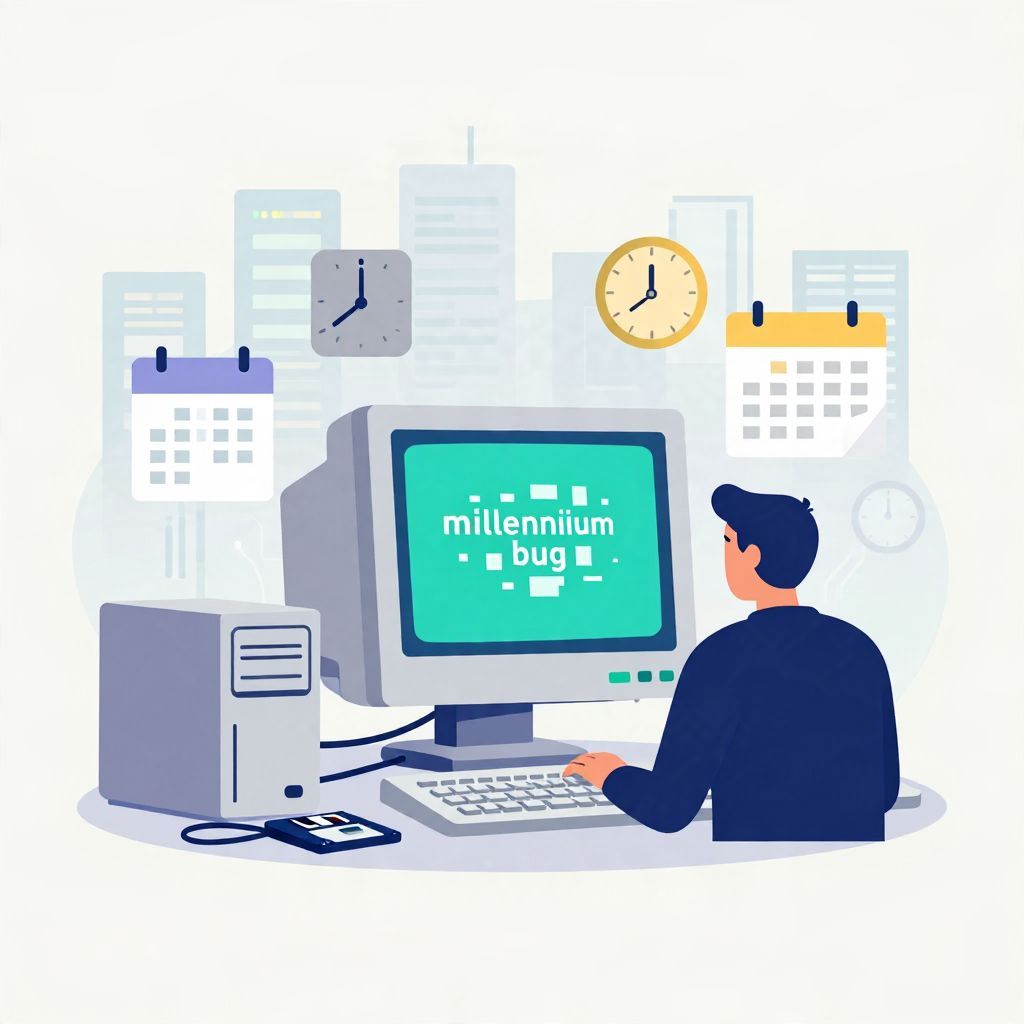
What does Y2K stand for? The short answer is “Year 2000.” The term became widely used in the 1990s to describe a computer problem tied to how many systems stored dates with only two digits for the year.
It is remembered today not just as a technical abbreviation, but as a symbol of late-20th-century anxiety about digital dependence. The Y2K issue touched governments, businesses, banks, utilities, and everyday life around the turn of the millennium.
What Does Y2K Stand For?
Y2K stands for “Year 2000.” The “Y” means year, the “2” represents the number 2, and “K” is shorthand for thousand. In common usage, it referred to the year 2000 and, more specifically, the “millennium bug” caused by computer systems that might misread the date when the calendar changed from 1999 to 2000.
Why Was “Year 2000” Shortened to Y2K?
The abbreviation followed a pattern used in computing and technical writing. By the late 20th century, “K” was widely used to mean thousand, as in “1K” for 1,000. Since “Y2000” was a bit bulky, “Y2K” became a compact label for the date problem and the broader public discussion around it.
The term was especially useful because the issue was not just about one day on the calendar. It described a design choice that had been common for decades: saving memory and storage space by recording years as “98” or “99” instead of “1998” or “1999.” That choice made sense when computer storage was expensive, but it created a risk when systems had to interpret “00.”
The Historical Origins of the Y2K Problem
The Y2K problem grew out of early computing practice in the 1960s and 1970s. Many programs and databases used two-digit years because storage was limited and costly. In that context, abbreviating the year was a practical solution, not a careless mistake. The problem emerged later, when those same systems were still in use as the year 2000 approached.
By the 1980s and early 1990s, governments and companies had become increasingly dependent on older software and mainframe systems. These systems often handled payroll, banking, insurance, transportation, and utility records. As the millennium neared, programmers realized that a date like “00” might be interpreted as 1900 rather than 2000, which could cause sorting errors, calculation failures, or system crashes.
Why two-digit years caused trouble
- Sorting errors: “00” could come before “99,” confusing chronological order.
- Age and age-based calculations: Systems might calculate a person’s age incorrectly.
- Interest and billing problems: Financial software could misread maturity dates or payment schedules.
- Embedded systems: Devices with date functions, from industrial controls to office equipment, might behave unpredictably.
How the Y2K Issue Became a Global Concern
What began as a technical maintenance issue turned into a major international concern because so many institutions relied on date-sensitive software. The problem was not limited to one country. It affected any place where older digital systems were still in use, which meant much of the industrialized world and many developing economies faced some level of risk.
During the 1990s, news coverage, government reports, and corporate planning elevated Y2K from a programming concern to a public issue. Businesses spent heavily on audits, code rewrites, testing, and replacement systems. Governments created task forces and urged institutions to prepare well before January 1, 2000. The scale of the response was itself historically significant: it showed how deeply modern societies had come to depend on invisible digital infrastructure.
Common public fears
Public discussion sometimes became exaggerated. Some predicted widespread blackouts, financial collapse, or even social disorder. Those worst-case scenarios did not generally occur, but the fears were understandable. In highly interconnected systems, a single date error could have cascading effects. The uncertainty made Y2K a genuine planning challenge, not merely a media panic.
The Timeline of Y2K
The Y2K story unfolded over several decades, not just at midnight on January 1, 2000. Its history is best understood as a long process of building, warning, preparing, and then assessing the outcome.
- 1960s–1970s: Two-digit year formats become common in early computer systems to save space and money.
- 1980s: The issue is known among programmers and system administrators, but it is not yet a major public concern.
- Early–mid 1990s: Awareness spreads as large organizations realize how many legacy systems still depend on two-digit dates.
- Late 1990s: Governments, banks, utilities, and corporations launch major remediation programs.
- January 1, 2000: The date change passes with relatively few major disruptions in most places.
- After 2000: Analysts debate how much of the smooth transition resulted from successful preparation versus the possibility that some risks were overstated.
What Happened When the Year 2000 Arrived?
When the calendar changed to 2000, the feared global breakdown did not occur. There were some glitches and localized problems, but no widespread collapse of infrastructure. In many cases, this outcome reflected years of expensive preparation: systems had been repaired, replaced, or closely monitored in advance.
That does not mean the concern was imaginary. The absence of catastrophe was partly the result of large-scale preventive work. In that sense, Y2K is a historical example of a risk that was reduced precisely because people took it seriously before the deadline arrived. It also became a lesson in how difficult it is to judge the value of prevention after the fact.
Why the outcome was relatively calm
- Many organizations had already fixed their most critical systems.
- Testing identified problems before the date change.
- Backup procedures and manual contingencies were put in place.
- Public and private sectors invested heavily in readiness.
Historical Significance of Y2K
Y2K matters historically because it reveals the hidden architecture of modern life. The episode showed that modern societies depend on software embedded in finance, transportation, communications, health care, and public administration. It also demonstrated how technical design decisions can have long-term consequences far beyond the moment they are made.
In a broader sense, Y2K marked a turning point in public awareness of digital risk. It helped introduce a more widespread understanding that computers are not just tools but systems with dependencies, assumptions, and vulnerabilities. That lesson has remained relevant in later debates about cybersecurity, software updates, infrastructure resilience, and technological planning.
What Y2K changed in the long run
- It encouraged better attention to software maintenance and legacy systems.
- It pushed organizations to inventory and test critical digital infrastructure.
- It made the public more aware of the fragility of technological systems.
- It became a reference point for later discussions of digital preparedness.
Why Y2K Still Matters in Popular Memory
Even though the feared disaster did not happen, Y2K remains culturally important. It is often remembered as a moment of intense anticipation at the edge of a new century and millennium. It also became shorthand for a problem that is technically real but publicly misunderstood, which is why the phrase still appears in discussions of software bugs and technology scares.
The term has also taken on a life beyond computing. In fashion, music, and design, “Y2K” now sometimes refers to the style and culture of the early 2000s. That newer meaning is separate from the original historical one, but it shows how a technical abbreviation can become part of wider cultural memory.
So, What Does Y2K Stand For in Historical Terms?
Historically, Y2K stands for Year 2000, but it also represents a major moment in the history of technology and public preparedness. It was the label for a date-related computer issue rooted in older programming practices and a global effort to prevent disruption at the millennium.
In the end, Y2K is remembered less for the disaster that did not happen than for the serious work done to avoid it. If you are interested in how technology shapes historical change, Y2K is a useful reminder that even a small abbreviation can point to a major turning point in modern history.