
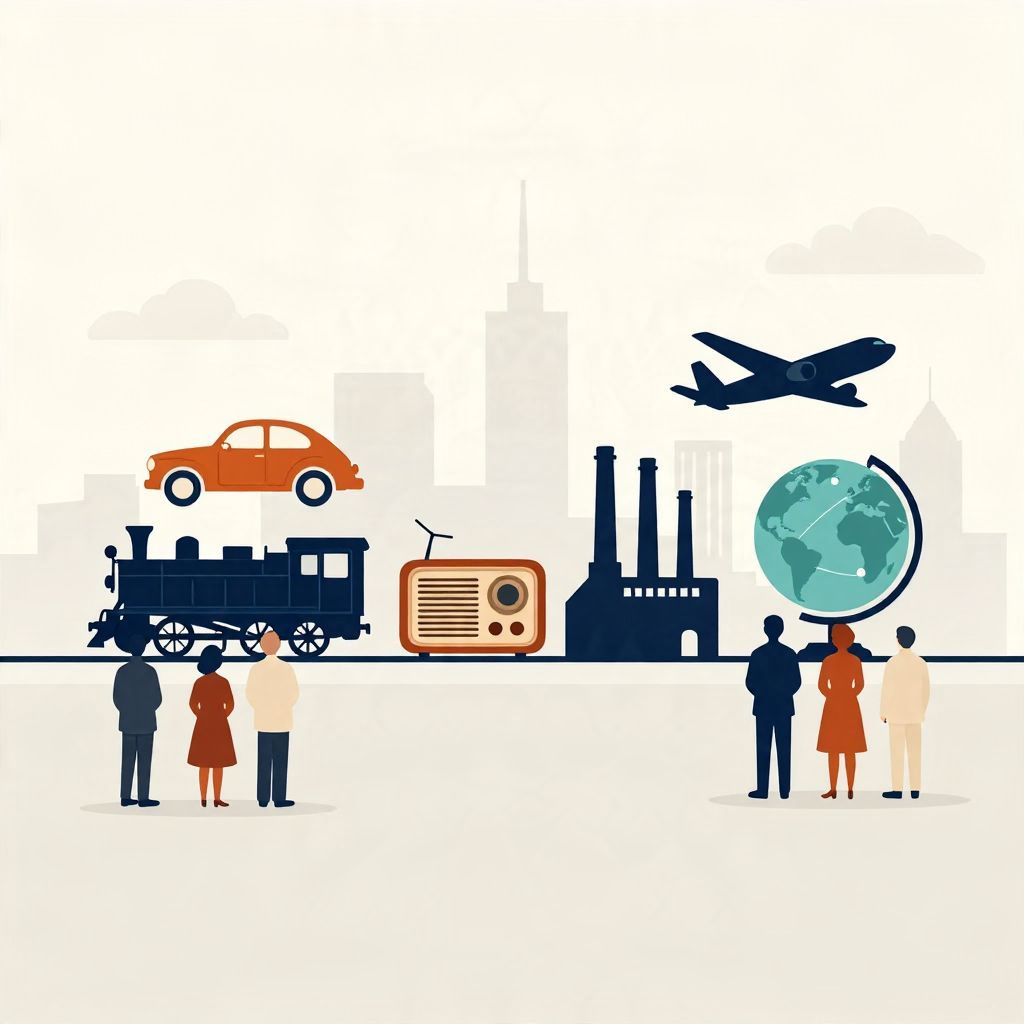
What is the 20th century? It is the period of history usually defined as the years from 1901 to 2000. In everyday language, people often use it to describe the dramatic age of world wars, mass politics, rapid technological change, decolonization, and the rise of a globalized world.
Because the century was shaped by so many upheavals, it is often remembered less as a neat calendar span and more as a turning point in modern history. Its meaning comes from the events that transformed how people lived, worked, fought, communicated, and understood power.
What Is the 20th Century?
The 20th century is the hundred-year period from January 1, 1901, to December 31, 2000. In the Gregorian calendar, centuries begin with year 1, not year 0, so the first century ran from 1 to 100, the second from 101 to 200, and so on. That means the 20th century began in 1901, even though many people casually think of the year 1900 as part of it.
Why people sometimes say 1900
There is a common popular habit of treating the “1900s” as the 20th century, but that is a shorthand for the 1900s decade range, not the formal century. Historians and calendars usually follow the strict numbering system, which places 1900 in the 19th century and 2000 in the 20th century’s final year.
Why the 20th Century Matters in History
The 20th century matters because it was one of the most transformative eras in human history. It saw two world wars, the Russian Revolution, the collapse of empires, the spread of democracy and authoritarianism, the Cold War, the end of formal colonial rule across much of Asia and Africa, and major advances in medicine, transport, communication, and computing.
It was also the century in which human society became unmistakably global. Wars, trade, migration, mass media, and international institutions linked distant regions more tightly than ever before. Events in Europe, North America, Asia, Africa, and the Middle East increasingly shaped one another in real time.
The 20th Century in Historical Context
From empires to nation-states
At the start of the century, much of the world was still dominated by empires: the British, French, German, Austro-Hungarian, Russian, Ottoman, and others. Over the course of the century, many of these imperial systems weakened or collapsed. New nation-states emerged after war, revolution, and anti-colonial struggle.
Industrial society becomes mass society
Industrialization did not begin in the 20th century, but the century accelerated it. Factories, railways, electricity, automobiles, telecommunications, and later aviation and computing reshaped work and daily life. Cities grew rapidly, and more people than ever before lived in urban environments.
Politics becomes ideological and global
The century was marked by powerful political ideologies: liberal democracy, socialism, communism, fascism, nationalism, and anti-colonial movements. These ideas did not remain abstract. They drove revolutions, civil wars, dictatorships, welfare states, and international rivalries that affected millions of lives.
Major Events That Defined the 20th Century
World War I and the end of old Europe
World War I (1914–1918) shattered the political order of Europe. It caused enormous military and civilian losses, destabilized economies, and helped bring down dynasties and empires. The peace settlements after the war redrew borders, but they also left unresolved grievances that would fuel future conflict.
Revolution in Russia
The Russian Revolution of 1917 overthrew the Romanov monarchy and led to the creation of the Soviet state. The rise of the Soviet Union had consequences far beyond Russia. It introduced a new model of government based on communist ideology and became a central force in global politics for most of the century.
The Great Depression
The Great Depression, beginning in 1929, was a worldwide economic crisis that caused unemployment, poverty, and political instability. It weakened faith in free-market systems in many countries and helped create conditions in which extremist movements gained support.
World War II
World War II (1939–1945) was the largest and deadliest conflict in history. It involved fighting across Europe, Asia, Africa, and the Pacific. The war ended with the defeat of Nazi Germany, Fascist Italy, and Imperial Japan, but it also exposed the scale of genocide, mass bombing, and total war.
The Holocaust
The Holocaust was the systematic murder of six million Jews by Nazi Germany and its collaborators, along with the persecution and killing of other groups. It remains one of the central moral and historical events of the century, shaping later human rights law, memory, and education.
The Cold War
After 1945, the world entered the Cold War, a long rivalry between the United States and the Soviet Union. It was not a direct war between the two superpowers, but it influenced conflicts, alliances, espionage, arms development, propaganda, and political life around the world from roughly 1947 to 1991.
Decolonization
From the mid-20th century onward, many colonies in Asia, Africa, and the Middle East gained independence. This process, known as decolonization, reshaped global politics. Some transitions were negotiated, while others involved war, partition, or prolonged struggle. India’s independence in 1947 and the wave of African independences in the 1950s and 1960s were especially significant.
Technological and scientific change
The century also transformed everyday life through innovation. Air travel, radio, television, antibiotics, nuclear power, satellites, and computers changed communication, medicine, warfare, and work. The latter part of the century saw the beginnings of the digital age, which would continue into the 21st century.
How Life Changed During the 20th Century
Work and the economy
At the beginning of the century, many people still worked in agriculture or manual labor. By the end, service industries, office work, and technology sectors had become far more important in many countries. Labor unions, minimum wage laws, and welfare programs expanded in some states, while others pursued different economic models.
Women’s rights and social change
The 20th century brought major gains in women’s political and social rights in many parts of the world. Women won the vote in numerous countries, entered paid work in larger numbers, and challenged older legal and cultural restrictions. These changes were uneven and often contested, but they permanently altered public life.
Civil rights and equality movements
Movements for racial equality, indigenous rights, labor rights, and broader civil rights became central features of the century. In the United States, the civil rights movement challenged segregation and discrimination. Elsewhere, anti-racist, anti-colonial, and human rights movements reshaped law and public debate.
Culture, media, and mass entertainment
Film, radio, recorded music, television, and later the internet’s early foundations created a mass media culture. Shared entertainment and news made public opinion more immediate and more international. Cultural influence increasingly crossed borders through popular music, cinema, fashion, and sports.
Key Turning Points by Decade
- 1900s–1910s: imperial tensions, industrial growth, and World War I
- 1920s: postwar recovery, social change, and cultural experimentation
- 1930s: economic depression and the rise of authoritarian regimes
- 1940s: World War II, the Holocaust, and the beginning of the Cold War order
- 1950s–1960s: decolonization, consumer society, and civil rights struggles
- 1970s: economic shocks, political realignment, and environmental awareness
- 1980s: reform, globalization, and the weakening of Soviet power
- 1990s: the Soviet collapse, new conflicts, and the rise of the internet age
Was the 20th Century the “Modern Age”?
Many historians describe the 20th century as part of the modern era, but the word “modern” can mean different things depending on the context. In broad historical terms, the modern world was already developing in earlier centuries through industrialization, empire, and political revolution. The 20th century accelerated those trends and made them global.
For that reason, some scholars speak of a “short 20th century,” especially when focusing on the years from 1914 to 1991. This is not a literal calendar century, but a historical interpretation that highlights the period shaped by world wars, ideological conflict, and the Cold War.
The End of the 20th Century
The century ended in 2000, but its historical significance did not stop there. The late 1990s already showed the rise of digital communication, global markets, and international institutions. At the same time, many unresolved issues from the century—war, inequality, migration, nationalism, and environmental stress—carried into the 21st century.
In that sense, the 20th century was both a completed era and the foundation of the present. Its revolutions, wars, inventions, and social movements continue to shape politics and everyday life today.
Conclusion: What the 20th Century Really Means
The 20th century was the hundred years from 1901 to 2000, but historically it means much more than a date range. It was the age in which old empires fell, new nations emerged, mass warfare reached unprecedented scale, and modern life was transformed by technology, ideology, and globalization. To understand the 20th century is to understand the making of the contemporary world. For related reading, see when the 20th century began and ended and what happened in 1945.