
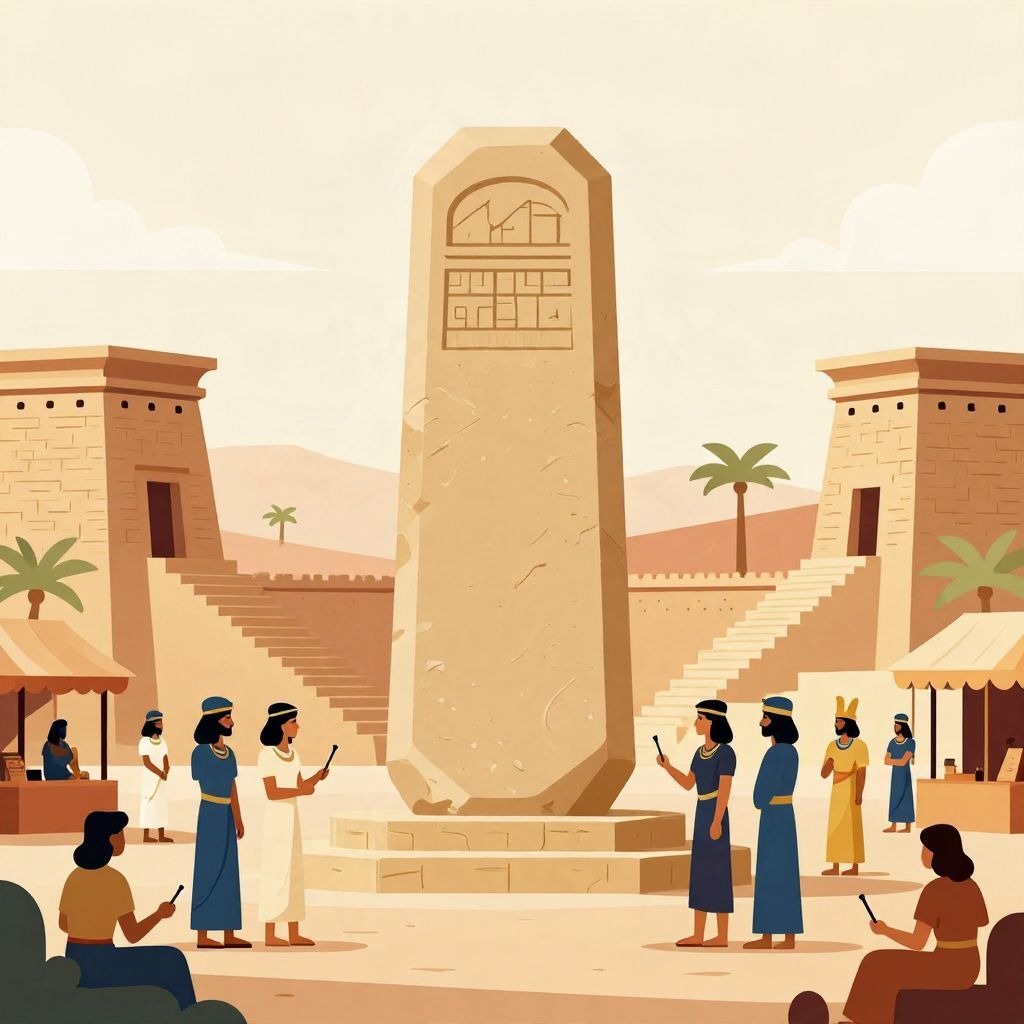
What is the Code of Hammurabi? It is one of the best-known law collections from the ancient world, created in Babylon under King Hammurabi, who ruled in the 18th century BCE. The text is famous for its “eye for an eye” style of justice, but it was more than a list of punishments: it also reflected royal authority, social hierarchy, and the practical problems of governing a large Mesopotamian kingdom.
Although often called a “code,” it was not a modern legal system in the contemporary sense. It was a public statement of law, order, and kingship carved on stone and meant to display Hammurabi as a just ruler chosen by the gods.
What Is The Code Of Hammurabi?
The Code of Hammurabi is a Babylonian law collection of about 282 legal rulings, usually dated to around 1754 BCE. It covers property, trade, marriage, labor, injury, and crime. Its importance lies not only in its rules, but in what it reveals about ancient Mesopotamian society, where status strongly shaped justice.
Where Did the Code of Hammurabi Come From?
The code emerged in Babylon, a major city in southern Mesopotamia, in what is now Iraq. Hammurabi ruled the Old Babylonian Empire during a period of political consolidation, when city-states and regional powers competed for control of land, irrigation, and trade routes. Law helped unify a diverse kingdom.
Hammurabi and Babylonian power
Hammurabi was not the first Mesopotamian ruler to issue laws. Earlier kings, such as Ur-Nammu and Lipit-Ishtar, had also produced legal collections. What made Hammurabi’s version famous was its scale, its careful organization, and the way it tied law to royal legitimacy. He presented himself as the shepherd of justice appointed by the gods.
The stele and its discovery
The laws were inscribed on a tall stone monument, or stele, with a relief showing Hammurabi receiving authority from the sun god Shamash, associated with justice. The stele was later taken to Susa in present-day Iran, likely as war booty. It was rediscovered by archaeologists in 1901–1902, which brought the text to modern attention.
What Did the Code of Hammurabi Say?
The code addressed many parts of daily life: contracts, wages, inheritance, theft, slavery, marriage, divorce, agriculture, and bodily injury. Its laws were meant to regulate a complex society where farmers, merchants, temple workers, and elites all depended on predictable rules. The penalties often varied according to social rank.
Examples of legal concerns
- Property and theft: rules against stealing animals, goods, or temple property.
- Trade and contracts: standards for loans, wages, and commercial agreements.
- Family law: marriage, divorce, adultery, and inheritance.
- Labor and agriculture: obligations of tenants, farmers, and builders.
- Violence and injury: penalties for assault, medical harm, and negligent construction.
“Eye for an eye” and social inequality
The famous principle of retaliation appears in some laws, but it was not applied equally to everyone. A penalty for injuring a nobleman could differ from the penalty for injuring a commoner or enslaved person. This is one reason historians stress that the code reflects a hierarchical society rather than a universal ideal of equal justice.
How Was the Code of Hammurabi Used?
Scholars debate how often the code was used as a practical courtroom manual. It may have functioned more as an authoritative model of justice than as a rigid statute book. Judges and local officials likely relied on custom, precedent, and royal authority as well as written law. The monument itself was a political statement.
Law as royal propaganda
Hammurabi’s prologue and epilogue frame the laws as evidence of his mission to establish justice and protect the weak. That does not mean the text was “fake,” but it does mean it was designed to project an image of ideal kingship. In the ancient Near East, ruling and lawmaking were closely linked.
What Makes the Code of Hammurabi Historically Important?
The code matters because it gives historians a detailed view of Mesopotamian society and the values of one of the ancient world’s major states. It shows a legal culture concerned with order, responsibility, and compensation, but also one that accepted unequal treatment based on status, gender, and class.
A window into everyday life
Unlike royal inscriptions that focus only on victories, the code touches ordinary concerns: canals, fields, houses, loans, marriage disputes, and professional accountability. It helps historians reconstruct how people lived and what kinds of conflicts were common in a river-based agricultural civilization.
Influence on later legal traditions
It is tempting to call the code the “first law code,” but that would be inaccurate. It was one of several early law collections. Its lasting significance comes from preservation and fame, not from being the earliest. Later societies, including those in the Near East and beyond, developed legal systems in very different ways, though the idea of written law as a marker of authority remained influential.
Was the Code of Hammurabi Fair?
By modern standards, many of its laws were harsh and unequal. Punishments could be severe, and social rank mattered greatly. Yet within its own historical setting, the code was part of a broader attempt to create stability in a kingdom facing disputes over land, labor, family inheritance, and violence. “Fairness” in the ancient world was not the same as modern equality before the law.
Social rank and legal status
The code distinguishes between different groups: free elites, ordinary free people, and enslaved people. This hierarchy shaped compensation and punishment. Women also appear in the laws, especially in marriage and property matters, showing that they had recognized legal roles, though within a patriarchal framework.
How Do Historians Interpret the Code Today?
Modern historians generally treat the Code of Hammurabi as both a legal text and a political artifact. It reveals real concerns about justice, but it also idealizes the king’s role. Rather than seeing it as a complete law book, scholars view it as a carefully crafted statement about how Babylon wanted to govern itself and be remembered.
What the code does not tell us
The code does not give a full picture of Babylonian law in practice. It leaves out many situations and does not explain every procedure. Archaeological and textual evidence from contracts, letters, and court records shows that daily legal life was more varied than the monument suggests. In other words, the code is invaluable, but not exhaustive.
Why Does the Code of Hammurabi Still Matter?
The Code of Hammurabi remains famous because it combines law, politics, religion, and social history in one surviving text. It is one of the clearest sources for understanding how an ancient empire tried to define justice. It also reminds us that written law has long been used to strengthen state power as well as to regulate society.
In short, the Code of Hammurabi was a Babylonian law collection created under King Hammurabi around 1754 BCE, designed to present him as a divinely sanctioned ruler and to organize a complex society through written rules. If you want to place it in its wider historical setting, you may also find it useful to read about what happened to Babylon and, for a broader view of ancient conflict and state power, what is the longest war in history.