
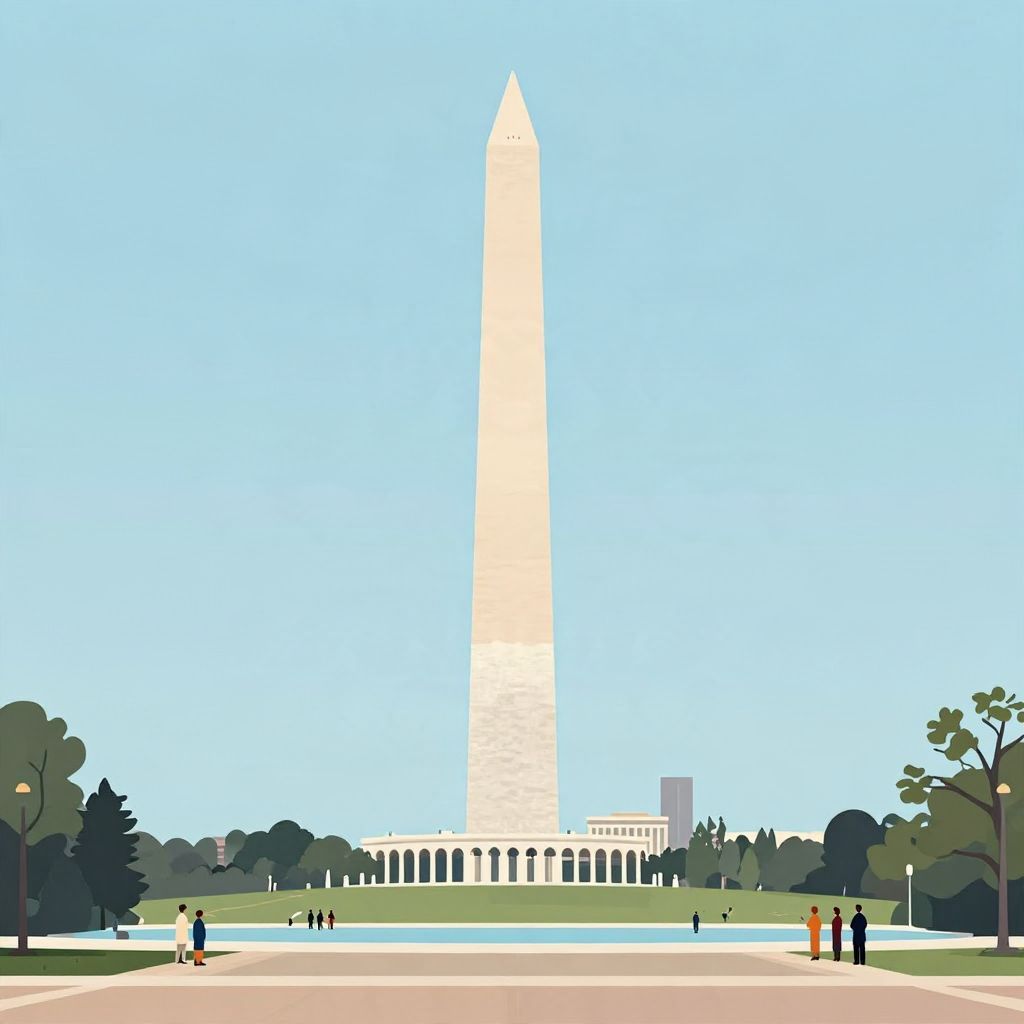
What is the Washington Monument? It is the tall marble obelisk in Washington, D.C., built to honor George Washington, the first president of the United States. More than just a famous landmark, it reflects how Americans in the 19th century chose to remember the Revolutionary era and the nation’s founding hero.
Its long construction history, interrupted by politics, money problems, and the Civil War, makes the monument as much a story about the United States as about Washington himself.
What Is the Washington Monument?
The Washington Monument is a 555-foot-5-inch obelisk on the National Mall in Washington, D.C., dedicated to George Washington. Begun in 1848 and completed in 1884, it was designed as a national tribute to Washington’s leadership in the American Revolution and his role in shaping the new republic.
Why Was the Washington Monument Built?
The monument was created to honor George Washington as a unifying national figure. In the early republic, Washington was widely admired not only as a military commander and president, but also as a symbol of republican virtue, restraint, and national independence. The monument’s purpose was commemorative rather than practical: it was meant to preserve memory and express civic reverence.
A memorial for the founding generation
In the decades after Washington’s death in 1799, Americans debated how best to remember him. A monumental tribute fit the era’s growing interest in public memory and national identity. Supporters saw the project as a way to give the young country a visible center of honor in its capital city.
Why an obelisk?
The choice of an obelisk was intentional. Obelisks were associated with permanence, grandeur, and ancient civilization. In the 19th century, they were often used for memorials because their simple vertical form suggested dignity and endurance. The Washington Monument’s design made it both classical in style and unmistakably modern in scale.
How and When Was It Built?
Construction began in 1848, but the project moved slowly and was interrupted for decades. The monument was not finished until 1884, and it opened to the public in 1888. Its long timeline reflects the financial, political, and social upheavals of the period, especially the sectional tensions that eventually led to the Civil War.
Key stages in the monument’s history
- 1799: George Washington dies.
- Early 19th century: Calls grow for a national memorial.
- 1848: Construction begins.
- 1854: Work stops after funding problems and political conflict.
- 1876: Construction resumes with federal support.
- 1884: The monument is completed.
- 1888: The interior elevator opens and the monument becomes fully accessible to visitors.
The first attempt and the pause
The original plan was ambitious, but fundraising proved difficult. The Washington National Monument Society, which led the effort, relied on donations and subscriptions. Political disputes weakened support, and in 1854 the project stalled after anti-Catholic and anti-immigrant activists briefly took control of the society. The interruption left the unfinished shaft standing for years as a visible sign of national division.
Completion after the Civil War
After the Civil War, the monument gained renewed importance. In 1876, during the nation’s centennial celebrations, Congress approved funds to restart construction. The completed monument was finally finished under the supervision of the U.S. Army Corps of Engineers. Its final height was adjusted slightly because of structural and material concerns, but the result remained the tallest stone structure in the world at the time.
What Does the Washington Monument Mean?
The Washington Monument means different things to different generations, but at its core it is a statement of national memory. It honors George Washington as a founder, yet it also reflects how Americans have tried to define the republic through monuments, public space, and civic ritual. It is both a memorial and a political symbol.
Washington as a model citizen
To many 19th-century Americans, Washington represented self-control, duty, and public service. Unlike kings and emperors, he voluntarily stepped away from power after military victory and two presidential terms. The monument therefore celebrates not just achievement, but the idea that leadership should be limited by republican principle.
A symbol of unity and tension
Although intended as a national symbol, the monument also reveals tensions in American history. Its long delay, changing sponsors, and postwar completion show how difficult it was to create shared national meaning in a divided country. The monument eventually became a unifying landmark, but its history is shaped by conflict as much as consensus.
What Does the Washington Monument Look Like?
The Washington Monument is a simple, towering white obelisk made primarily of marble, granite, and sandstone. Its clean lines and lack of ornament make it stand out among more decorative monuments. The design emphasizes height, symmetry, and visibility across the National Mall.
Architectural features
- Shape: Egyptian-style obelisk
- Height: 555 feet 5 1/8 inches
- Material: Marble, granite, and sandstone
- Location: National Mall, Washington, D.C.
- Interior: Stairway and elevator for visitors
Its height makes it one of the most recognizable structures in the United States. For much of the 19th century, it dominated the skyline of the capital and served as a visual anchor for the city’s ceremonial landscape.
How Did the Civil War Affect the Monument?
The Civil War did not physically damage the Washington Monument, but it profoundly affected its meaning and progress. The unfinished shaft stood through the conflict like a broken promise, and the nation’s struggle over union and slavery made Washington’s legacy more complicated. After the war, completing the monument became a way to reaffirm national continuity.
From unfinished project to national recovery
When construction resumed, the monument was no longer just a tribute to one man. It had become a symbol of a reunited nation trying to recover from civil war. In that sense, its completion in the 1880s marked both remembrance of Washington and a broader statement about American endurance.
Why Is the Washington Monument Important Today?
The Washington Monument remains important because it is one of the clearest physical expressions of American national memory. Millions of visitors see it as a landmark, but historians also view it as evidence of how the United States built a civic culture around memorials, public space, and founding ideals.
A landmark of memory and tourism
Today the monument is part of the National Mall’s historic landscape, surrounded by museums, memorials, and government buildings. It continues to shape how people experience the capital city, while also serving as a reminder that monuments are historical artifacts in their own right. They tell us not only whom a society honors, but how it chooses to remember itself.
What Is the Washington Monument in Historical Perspective?
Historically, the Washington Monument is more than a tall stone structure. It is a 19th-century memorial that reflects changing ideas about nationhood, leadership, and public memory. Its design, delay, and eventual completion all reveal how Americans transformed George Washington from a real historical figure into a lasting symbol of the republic.
That is why the Washington Monument matters: it is both a tribute to Washington and a record of the country that built it. For readers interested in the monument’s construction timeline, see when the Washington Monument was built. For another look at how monuments communicate historical meaning, you may also explore the purpose of the Great Wall of China.