
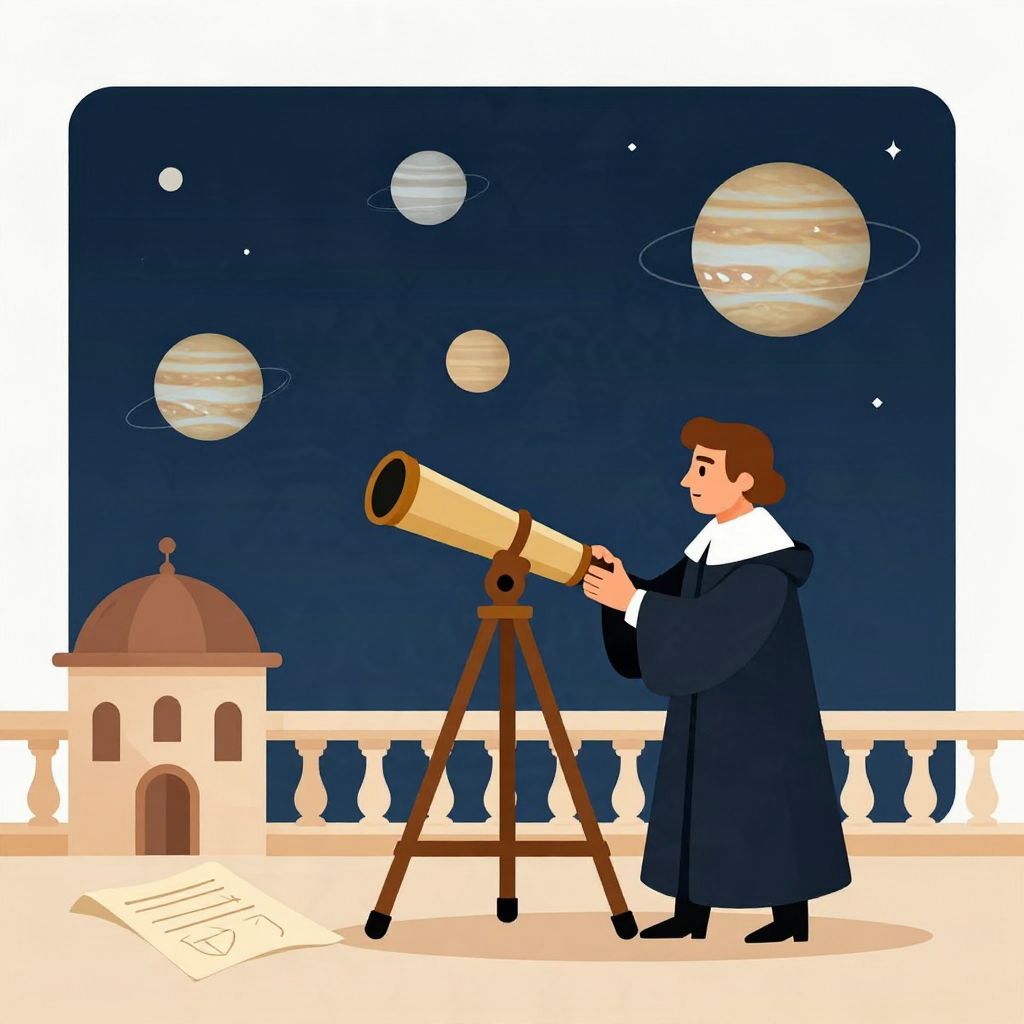
What was Galileo famous for? In the history of science, Galileo Galilei is best known as the Italian astronomer, physicist, and mathematician who helped transform natural philosophy into modern experimental science. He is especially associated with observations that supported the Copernican idea that Earth moves around the Sun, as well as with work on motion, falling bodies, and the use of the telescope.
His fame comes not from one discovery alone, but from the way his ideas challenged older authorities and changed how people studied nature. Galileo became a symbol of scientific curiosity, evidence-based reasoning, and conflict between new science and religious authority in early modern Europe.
What Was Galileo Famous For?
Galileo was famous for pioneering modern astronomy and physics. He improved the telescope, observed Jupiter’s moons, the phases of Venus, sunspots, and the rough surface of the Moon, and used these findings to support heliocentrism. He also advanced the study of motion and helped establish experimentation as a central method in science.
Galileo’s Place in History
Galileo Galilei was born in Pisa in 1564 and lived during a period of major intellectual change in Europe. The Renaissance had revived interest in ancient learning, but scholars were also beginning to question inherited ideas through observation and experiment. Galileo stood at the center of that shift.
He was not the first to suggest that Earth might move around the Sun. Copernicus had proposed a heliocentric model in 1543, and earlier thinkers had explored similar possibilities. Galileo’s importance lies in how forcefully he gathered evidence for the Copernican system and argued for it in public, at a time when many still accepted the Earth-centered universe of Aristotle and Ptolemy.
Galileo’s Famous Discoveries and Ideas
The telescope and the heavens
Galileo did not invent the telescope, but he greatly improved it and turned it into a scientific instrument. In 1609, he built telescopes powerful enough to observe the sky in unprecedented detail. These observations quickly made him famous across Europe.
He saw that the Moon was not a smooth, perfect sphere, as traditional cosmology often assumed, but had mountains and craters. He observed countless stars invisible to the naked eye, showing that the universe was far larger than many had imagined. He also discovered four moons orbiting Jupiter—now called the Galilean moons: Io, Europa, Ganymede, and Callisto.
That discovery was especially important because it showed that not everything in the heavens revolved around Earth. If Jupiter could have moons of its own, then the old geocentric model was no longer as secure as many had believed.
Venus, sunspots, and the changing heavens
Galileo also observed the phases of Venus. These phases made sense in a heliocentric system, where Venus orbits the Sun, but they were difficult to explain in the traditional Earth-centered model. This became one of the strongest observational arguments in favor of Copernican astronomy.
He studied sunspots as well, showing that the Sun itself was not a perfect, unchanging body. In the older Aristotelian view, the heavens were supposed to be flawless and immutable. Galileo’s observations suggested otherwise. The sky, like the Earth, was subject to change.
Motion, falling bodies, and early physics
Galileo was also famous for his work on motion. Through experiments and mathematical reasoning, he challenged the long-standing idea that heavier objects fall faster than lighter ones in a simple, direct way. He is often linked to the story of dropping objects from the Leaning Tower of Pisa, but that tale is probably more legend than documented fact.
Whether or not he performed that exact demonstration, his broader contribution was real. He showed that motion could be studied quantitatively, with measurements and formulas rather than only philosophical speculation. His work helped lay the groundwork for classical mechanics and later scientists such as Isaac Newton.
Why Galileo Became So Important
Galileo became important because he changed both what people believed about the universe and how they justified belief. He insisted that observation, experiment, and mathematics should guide scientific inquiry. In that sense, he was not just an astronomer; he was a major architect of the scientific method as it developed in early modern Europe.
He also helped make science public. His book Sidereus Nuncius (“Starry Messenger”), published in 1610, announced his telescopic discoveries in a way that attracted wide attention. He wrote in accessible prose as well as technical argument, helping spread new ideas beyond a small circle of specialists.
Support for heliocentrism
Galileo is most famous for defending the Copernican view that Earth moves around the Sun. This was not merely a technical astronomical debate. It touched theology, philosophy, and authority. If Earth was not the center of the cosmos, then traditional interpretations of nature and scripture had to be reconsidered.
Galileo argued that the Bible should not be read as a scientific textbook and that natural phenomena should be interpreted through evidence. This position was controversial, especially in the religious climate of the early 17th century, when the Catholic Church was responding to the Protestant Reformation and paying close attention to doctrinal authority.
Galileo and the Church
Galileo’s conflict with Church authorities is one reason he remains so well known. In 1616, the Copernican theory was formally treated with suspicion, and Galileo was warned not to present heliocentrism as established fact. For a time, he remained cautious.
He later published Dialogue Concerning the Two Chief World Systems in 1632, a work that compared the geocentric and heliocentric models. Although written as a dialogue rather than a direct attack, it clearly favored Copernican astronomy. The book brought him into serious conflict with the Roman Inquisition.
In 1633, Galileo was tried and forced to recant his support for heliocentrism. He was sentenced to house arrest for the rest of his life. The famous story that he muttered “And yet it moves” after recanting is popular, but historians treat it as doubtful legend rather than verified fact.
What the trial meant
The trial did not stop scientific progress, but it became a lasting symbol of tension between new knowledge and institutional authority. In later centuries, Galileo was often portrayed as a martyr for science. That image contains truth, but it can also oversimplify the historical context. The conflict was not simply “science versus religion”; it involved politics, interpretation, personality, and the limits of evidence available at the time.
Even so, the trial made Galileo a powerful historical figure. He came to represent the courage to follow evidence, even when doing so was risky.
What Galileo Was Not Famous For
It is worth clarifying what Galileo was not mainly famous for, because popular memory sometimes blurs the details. He was not the inventor of the telescope, though he improved it dramatically. He was not the sole originator of heliocentrism, since Copernicus had already proposed it and Kepler later refined it with elliptical orbits.
He also did not single-handedly create modern science. Rather, he was one of several major figures in a broader transformation that included Tycho Brahe, Johannes Kepler, Francis Bacon, René Descartes, and others. His fame rests on his unusually influential combination of observation, mathematics, argument, and public controversy.
Galileo’s Lasting Legacy
Galileo’s legacy reaches far beyond astronomy. He helped establish the idea that nature can be investigated through controlled observation and mathematical description. That approach became central to modern physics and astronomy.
His work also changed the status of scientific authority. Before Galileo, many scholars relied heavily on ancient texts. After him, evidence gathered through instruments and experiments carried greater weight. This shift did not happen overnight, but Galileo was one of the key figures who made it possible.
Influence on later science
- He helped normalize the use of instruments, especially the telescope, in scientific research.
- He strengthened the case for heliocentrism with direct observations.
- He advanced the mathematical study of motion and acceleration.
- He encouraged a more experimental, less purely book-based approach to knowledge.
Later scientists built on his work rather than simply repeating it. Newton’s laws of motion and universal gravitation, for example, drew on the foundations Galileo had helped create. In that sense, Galileo belongs to the story of how modern science became possible.
Why Galileo Still Matters Today
Galileo remains famous because his life captures a turning point in world history. He lived when old explanations of the universe were being tested by new tools and new methods. His discoveries were not only technically impressive; they also changed the relationship between evidence, authority, and belief.
Today, Galileo is remembered as a symbol of scientific inquiry, but the historical reality is richer than the legend. He was a skilled observer, a bold thinker, a persuasive writer, and a controversial figure whose ideas helped reshape how humans understand the cosmos. If you want to explore more broad historical context, you can also browse general history resources and related timeline articles such as what happened in 2013.