
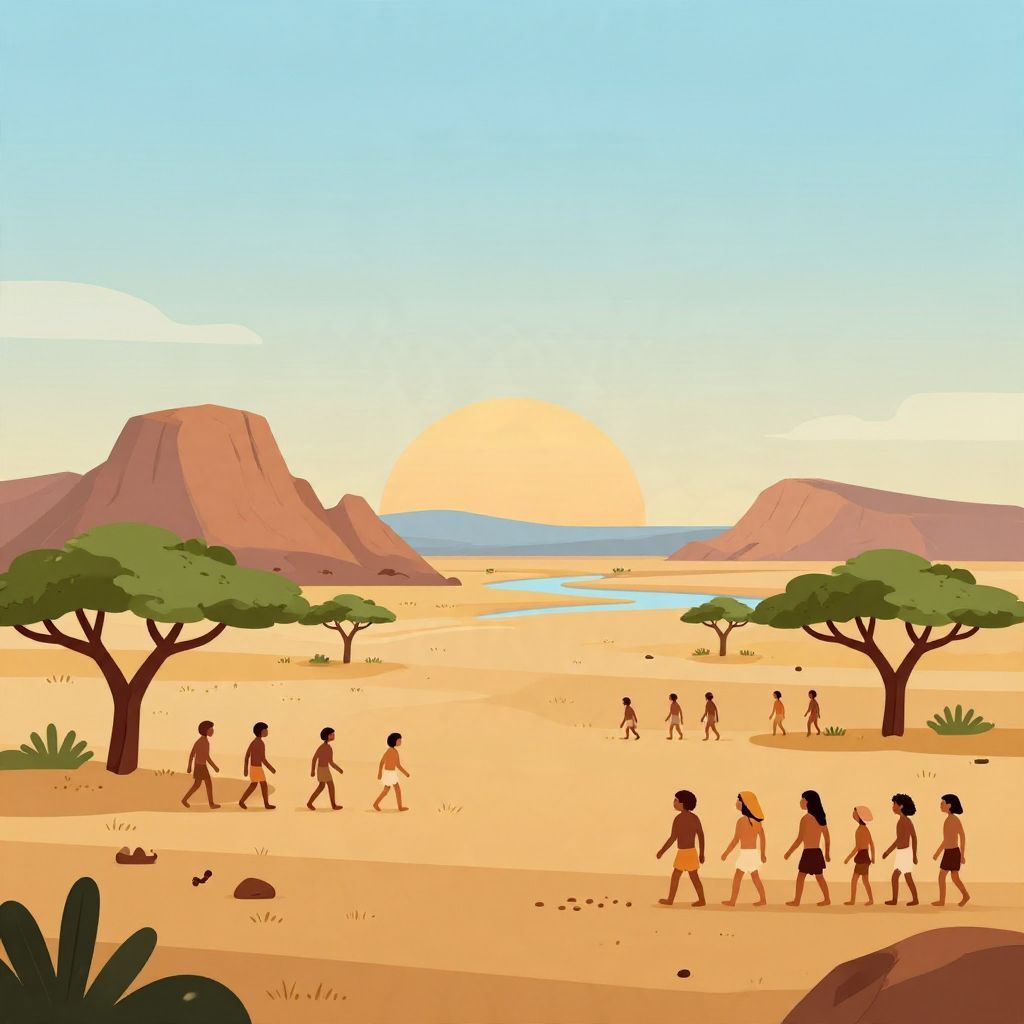
What was the first year on Earth with humans? The short answer is that there was no single “first year” in the way we count years today. Humans did not appear in one sudden moment with a calendar date attached; they emerged gradually over a very long evolutionary process. The earliest members of the human lineage lived hundreds of thousands of years ago, long before written history or numbered years.
If the question means the first year in which modern humans existed, the best answer is roughly 300,000 years ago. If it means the first year when any human ancestor existed, then the timeline reaches back several million years. The answer depends on how “humans” is defined, which is why historians, archaeologists, and paleoanthropologists usually speak in approximate dates rather than a single exact year.
What Was The First Year On Earth With Humans?
There was no single first year on Earth with humans. The earliest human ancestors appeared millions of years ago, while Homo sapiens—our own species—emerged in Africa about 300,000 years ago. Because human evolution was gradual, the question has no exact calendar year, only approximate milestones based on fossils, genetics, and archaeology.
Why There Is No Exact “First Year”
People often imagine human history as a line with a clear starting point, but evolution does not work that way. A population does not suddenly become “human” overnight. Instead, traits associated with humans—larger brains, tool use, upright walking, language capacity, and social complexity—appeared over time in different ancestral species.
That means the phrase “first year on Earth with humans” can refer to several different thresholds:
- First hominins: early relatives after the split from the chimpanzee lineage, roughly 6–7 million years ago.
- First members of the genus Homo: about 2.8 million years ago.
- First Homo sapiens: around 300,000 years ago.
- First year of recorded human history: much later, after writing developed around 3200 BCE.
So the “first year” depends on whether you mean human ancestors, the genus Homo, or anatomically modern humans.
When Did the First Human Ancestors Appear?
The earliest known hominins lived in Africa around 6 to 7 million years ago. These were not humans in the modern sense, but they were part of the evolutionary branch that eventually led to us. Fossil evidence from species such as Sahelanthropus and Orrorin suggests early steps toward upright walking and a separation from the ape lineage.
These early ancestors likely lived in changing environments of woodland and open habitat. Natural selection favored traits that helped them move, forage, and survive in mixed landscapes. Over time, this branch produced increasingly human-like species, but the process was slow and uneven.
Why this matters
If someone asks for the “first year with humans,” they may really be asking when our story began. In that broader sense, the answer starts not with a single species but with the earliest ancestors that set human evolution in motion.
When Did Homo sapiens First Appear?
The strongest current evidence places the origin of Homo sapiens in Africa about 300,000 years ago. Fossils from sites such as Jebel Irhoud in Morocco have helped push the date of our species’ emergence earlier than older textbook estimates. This does not mean one “first human” was born in a single year; rather, a population gradually acquired the traits we now identify as modern human.
These early humans were anatomically modern in important ways, but they still lived in prehistoric conditions. They hunted, gathered, made stone tools, and adapted to a range of African environments. Their world was shaped by climate shifts, migration, and long-term survival strategies rather than agriculture or cities.
What made them “human”?
Homo sapiens are defined by a combination of features, including a more rounded skull, smaller teeth and jaws than earlier hominins, and a brain capable of complex symbolic thought. Yet no single trait alone makes a fossil “human.” Scientists look at the full pattern of anatomy and behavior.
Did Humans Appear in One Year on a Calendar?
No. If you are asking for a year like 2026, 10,000 BCE, or 300,000 BCE, there is no exact one-year answer. Prehistoric chronology is measured in ranges because fossils are incomplete and dating methods have margins of error. A fossil may be dated to “about 300,000 years old,” not to a specific year with absolute certainty.
In addition, the Earth itself is about 4.54 billion years old, so human existence occupies only the tiniest fraction of planetary history. Humans are very recent on the geological timeline, even though our species has had an enormous impact on the planet.
How Scientists Date Early Human History
Scientists use several methods to estimate when humans first appeared. These methods do not produce perfect precision, but together they create a reliable timeline.
- Radiometric dating measures the decay of radioactive elements in volcanic layers and fossils.
- Stratigraphy studies the order of rock layers to compare relative ages.
- Genetics helps estimate when populations split and diversified.
- Archaeology reveals tools, hearths, and other signs of behavior linked to early humans.
Because these methods are based on evidence rather than tradition, the estimated date for the first humans can change as new discoveries are made. That is why older claims about human origins are sometimes revised.
How the Meaning of “Human” Changes the Answer
The biggest reason this question is tricky is that “human” can mean different things in different contexts. In everyday speech, people usually mean modern people like us. In scientific history, however, the term can include a wider family of hominins.
If you mean modern humans
The answer is about 300,000 years ago in Africa.
If you mean the human lineage
The answer is around 6 to 7 million years ago, when the ancestors of humans and chimpanzees had already diverged.
If you mean historically documented humans
The answer is much later, because writing appears only around 3200 BCE in Mesopotamia and a few other early centers of civilization.
So the “first year on Earth with humans” is not a single date but a question that changes depending on the definition being used.
What Was Earth Like When Early Humans Appeared?
When early humans and their ancestors lived, Earth was not a modern world of countries, roads, and cities. It was a landscape shaped by ice-age cycles, shifting rainfall, and changing ecosystems. Early humans had to adapt to environmental uncertainty, which helped drive innovation in tools, cooperation, and mobility.
During parts of this long period, Africa experienced wetter and drier phases that opened and closed habitats. These changes likely influenced migration and survival. Human ancestors did not simply endure nature; they evolved through constant interaction with it.
Human survival before civilization
For most of human existence, people lived as hunter-gatherers. They relied on knowledge of plants, animals, water sources, and seasonal change. This long prehistoric era shaped human biology and culture far more than the brief period of agriculture and urban life that followed.
From Early Humans to Recorded History
Even though humans existed for hundreds of thousands of years, written history is much younger. Writing developed around 3200 BCE, giving historians a record of kings, laws, trade, wars, and daily life. Everything before that is known through archaeology and scientific reconstruction rather than written testimony.
This distinction matters because many people confuse “first humans” with “first historical people.” The first humans were prehistoric; the first written records came much later. In other words, humans were on Earth long before history was being written down.
So What Is the Best Short Answer?
If you want the most accurate concise answer, it is this: there was no single first year on Earth with humans. The earliest human ancestors appeared around 6 to 7 million years ago, while modern humans, Homo sapiens, emerged in Africa about 300,000 years ago. The exact “first year” cannot be named because human evolution was gradual and prehistoric dating is approximate.
That is why historians and scientists speak in ranges, not exact calendar years. The story of humans is not a single starting point but a long unfolding process of evolution, migration, and adaptation. For more on the deep timeline, see when the Holocene started and how humans survived the Ice Age.