
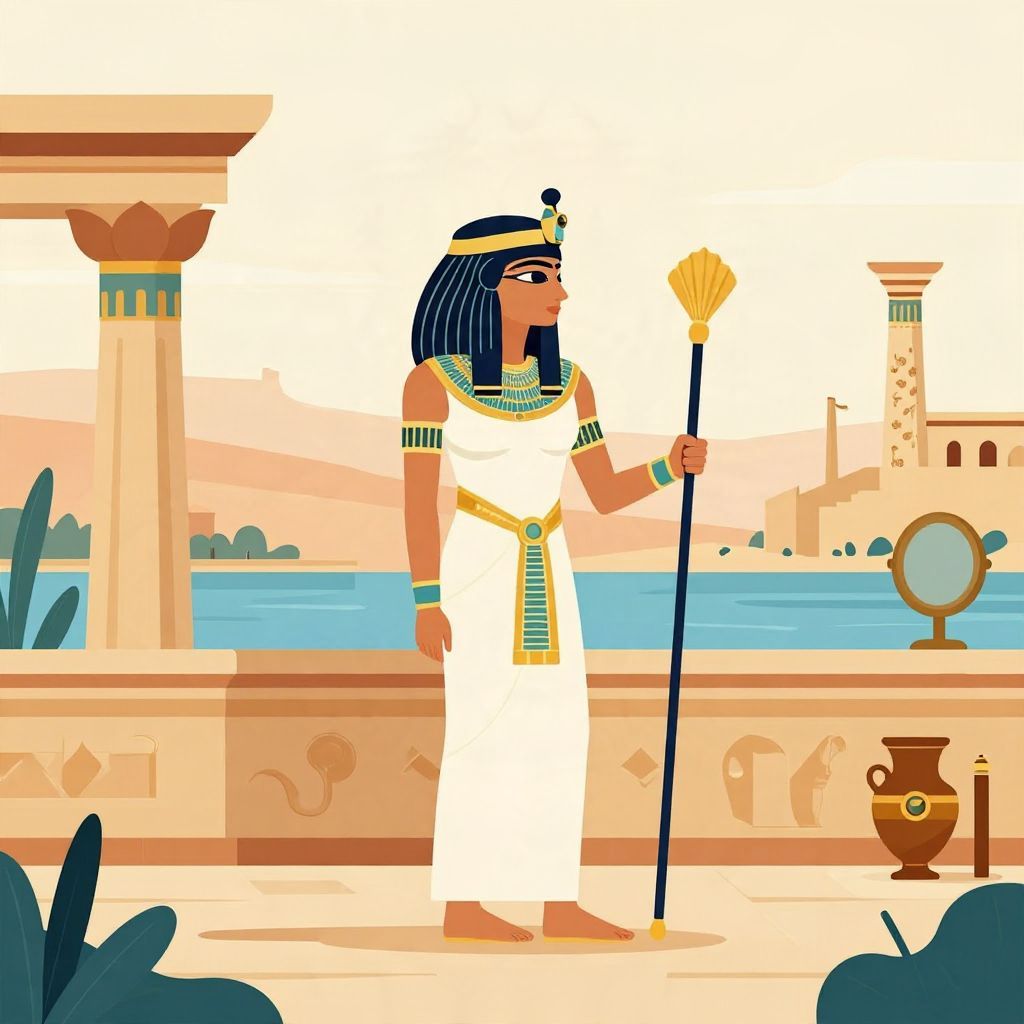
When did Cleopatra live? The short answer is that Cleopatra VII, the last active ruler of Ptolemaic Egypt, lived from 69 BCE to 30 BCE. She ruled during the final decades of the Hellenistic age, when Rome was rapidly expanding across the Mediterranean and Egypt was becoming entangled in Roman civil wars.
Her life sits at a turning point in ancient history. Cleopatra is famous not only for her relationships with Julius Caesar and Mark Antony, but also for her political skill, multilingual court, and role in the end of independent ancient Egypt.
When Did Cleopatra Live?
Cleopatra VII lived from 69 BCE to 30 BCE. She was born in Alexandria, ruled Egypt from 51 BCE until her death, and died in 30 BCE after Octavian’s conquest of Egypt. Her reign marked the end of the Ptolemaic dynasty and the beginning of Egypt as a Roman province.
Cleopatra’s Life in Historical Timeline
To understand when Cleopatra lived, it helps to place her in sequence. She was born into a Greek-Macedonian royal family that had ruled Egypt since the conquest of Alexander the Great. By her lifetime, the Ptolemaic kingdom was weakened by internal disputes and outside pressure from Rome.
- 69 BCE: Cleopatra is born, likely in Alexandria.
- 51 BCE: She becomes co-ruler of Egypt with her brother Ptolemy XIII.
- 48 BCE: Cleopatra allies with Julius Caesar during a civil conflict in Egypt.
- 47 BCE: Caesar helps secure her position; she remains queen.
- 46–44 BCE: Cleopatra visits Rome and later returns to Egypt after Caesar’s assassination.
- 41 BCE: She meets Mark Antony in Tarsus.
- 34 BCE: The Donations of Alexandria strengthen her children’s political claims.
- 31 BCE: Antony and Cleopatra are defeated at the Battle of Actium.
- 30 BCE: Octavian takes Egypt; Cleopatra dies soon afterward.
Who Was Cleopatra VII?
Cleopatra VII Philopator was the final ruler of the Ptolemaic dynasty, a line founded by one of Alexander the Great’s generals. Although often remembered as an “Egyptian queen,” she was ethnically Macedonian-Greek by dynasty, while also becoming the first Ptolemaic ruler to learn the Egyptian language and present herself as a traditional pharaoh.
She was not the only Cleopatra in her family. The name was common among the Ptolemies, but Cleopatra VII became the most famous because she ruled at the moment when Egypt’s independence was collapsing under Roman dominance.
The World She Was Born Into
Cleopatra was born into a politically unstable kingdom. The Ptolemaic court was wealthy, but royal succession was often violent and contested. Egypt still had enormous resources, especially grain and tax revenue, yet Rome increasingly influenced its politics. Cleopatra grew up in a world where diplomacy, family rivalry, and foreign intervention were closely linked.
What Was Happening in Egypt During Cleopatra’s Lifetime?
Cleopatra lived during the late Hellenistic period, roughly the last century before the Roman Empire emerged. Egypt was still officially independent, but Roman power was growing stronger every decade. Her reign unfolded amid civil wars in Rome, which gave her opportunities to negotiate, but also made her kingdom more vulnerable.
Egypt under Cleopatra was a multicultural center. Alexandria was one of the greatest cities in the Mediterranean, known for its library, scholarship, trade, and royal palace district. Cleopatra’s court blended Greek political traditions with Egyptian royal symbolism, reflecting the complex identity of the Ptolemaic state.
Why Cleopatra’s Dates Matter
Knowing when Cleopatra lived helps place her correctly in ancient chronology. She was not a figure of the pyramid-building age, nor of classical Greece at its height. She lived much later, in the same broad era as Julius Caesar, the final Roman Republic, and the transition toward imperial rule under Augustus.
This matters because Cleopatra’s story is often misunderstood. Some people imagine her as a distant “ancient Egyptian” figure from the era of the pharaohs of the pyramids, but she lived over 2,000 years after the Great Pyramid of Giza was built and near the end of ancient Egypt’s long independent history.
How Cleopatra Came to Power
Cleopatra became co-ruler in 51 BCE, likely as a teenager or young adult, alongside her younger brother Ptolemy XIII. The Ptolemaic system often required sibling marriage and joint rule, but such arrangements frequently led to conflict. In Cleopatra’s case, rivalry quickly escalated into civil war.
She was forced out of power for a time, then returned with Roman support during Caesar’s intervention in Egypt. Her alliance with Caesar was both personal and political: it helped her regain the throne and secure her position against domestic rivals.
Cleopatra and Julius Caesar
Cleopatra’s relationship with Julius Caesar is one of the best-known episodes of her life, but it should be understood in political context. Caesar was in Egypt pursuing his own civil war against Pompey’s allies. Cleopatra sought Roman backing to stabilize her rule, while Caesar saw strategic advantage in supporting a compliant Egyptian monarch.
Their alliance produced a son, Ptolemy XV Caesarion, though the extent of Caesar’s recognition of him remains debated. Cleopatra later visited Rome, where her presence caused fascination and controversy. After Caesar’s assassination in 44 BCE, she returned to Egypt and sought new allies.
Cleopatra and Mark Antony
After Caesar’s death, Rome split into rival factions. Cleopatra aligned herself with Mark Antony, one of the leading Roman power brokers. Their relationship was both political and personal, and it tied Egypt’s fate even more closely to Roman civil conflict.
Antony relied on eastern resources and Cleopatra’s wealth, while Cleopatra sought protection for her dynasty and her children. Their partnership culminated in the Donations of Alexandria in 34 BCE, when Antony publicly distributed eastern territories to Cleopatra and her children. In Rome, this was portrayed as a scandal and proof that Antony had been captured by a foreign queen.
The Battle of Actium and Its Consequences
The decisive turning point came in 31 BCE at the Battle of Actium, where Octavian’s forces defeated Antony and Cleopatra’s fleet. The battle did not immediately end the war, but it shattered their political position. The following year, Octavian invaded Egypt, and both Antony and Cleopatra died in 30 BCE.
With Cleopatra’s death, Egypt lost its independence and became a Roman province. Octavian soon became Augustus, the first Roman emperor. Cleopatra’s life therefore marks the end of one era and the beginning of another.
How Did Cleopatra Die?
Ancient sources report that Cleopatra died in 30 BCE, probably by suicide, though the exact method is uncertain. The traditional story says she died from the bite of an asp, but historians treat this with caution because the details come from later literary accounts and may be symbolic rather than factual.
What is certain is that her death followed Rome’s conquest of Egypt. Octavian had no reason to allow a surviving Ptolemaic ruler to become a rallying point for resistance, and Cleopatra understood that her political world had collapsed.
Common Misconceptions About Cleopatra’s Era
Cleopatra is often surrounded by myths, so it helps to separate fact from later legend.
- She was not from the age of the pyramids. Cleopatra lived more than two millennia after the first pyramids were constructed.
- She was not ethnically Egyptian in the dynastic sense. Her ruling family was Macedonian-Greek, though she adopted Egyptian royal identity and culture.
- She was not merely a seductress. Ancient and modern sources show her as a capable ruler, diplomat, and administrator.
- Her story is not only romantic. It is deeply tied to the collapse of the Roman Republic and the end of Hellenistic monarchy.
Why Cleopatra Still Matters Today
Cleopatra remains important because her life connects several major historical developments: the spread of Greek culture after Alexander, the decline of the Ptolemaic kingdom, and Rome’s transformation from republic to empire. She is one of the clearest examples of how a powerful individual can stand at the crossroads of larger historical forces.
Her reign also reveals the complexity of ancient identity. Cleopatra ruled Egypt as a Greek-speaking monarch who adopted Egyptian royal traditions, negotiated with Roman leaders, and used both diplomacy and symbolism to preserve her authority. Her life shows that ancient history was not static; it was shaped by alliances, propaganda, war, and cultural adaptation.
Cleopatra’s Historical Legacy
After her death, Roman writers often portrayed Cleopatra as a dangerous foreign queen, using her image to justify Octavian’s victory and the new imperial order. Later centuries turned her into a dramatic figure of romance and tragedy. Yet the historical Cleopatra was more than a legend: she was the last ruler of an ancient dynasty that had lasted nearly 300 years.
Her life from 69 BCE to 30 BCE captures the final chapter of independent pharaonic Egypt and the rise of Roman imperial power. If you want to place Cleopatra in the broader ancient world, it helps to compare her era with other major turning points, such as when the pyramids of Giza were built and the earlier civilizations of Mesopotamia.
In short: Cleopatra lived from 69 BCE to 30 BCE, ruled Egypt during a period of Roman expansion, and became the final pharaoh of the Ptolemaic dynasty. Her life ended with Egypt’s annexation by Rome, making her one of the most significant figures in the transition from the ancient world to the Roman Empire.