
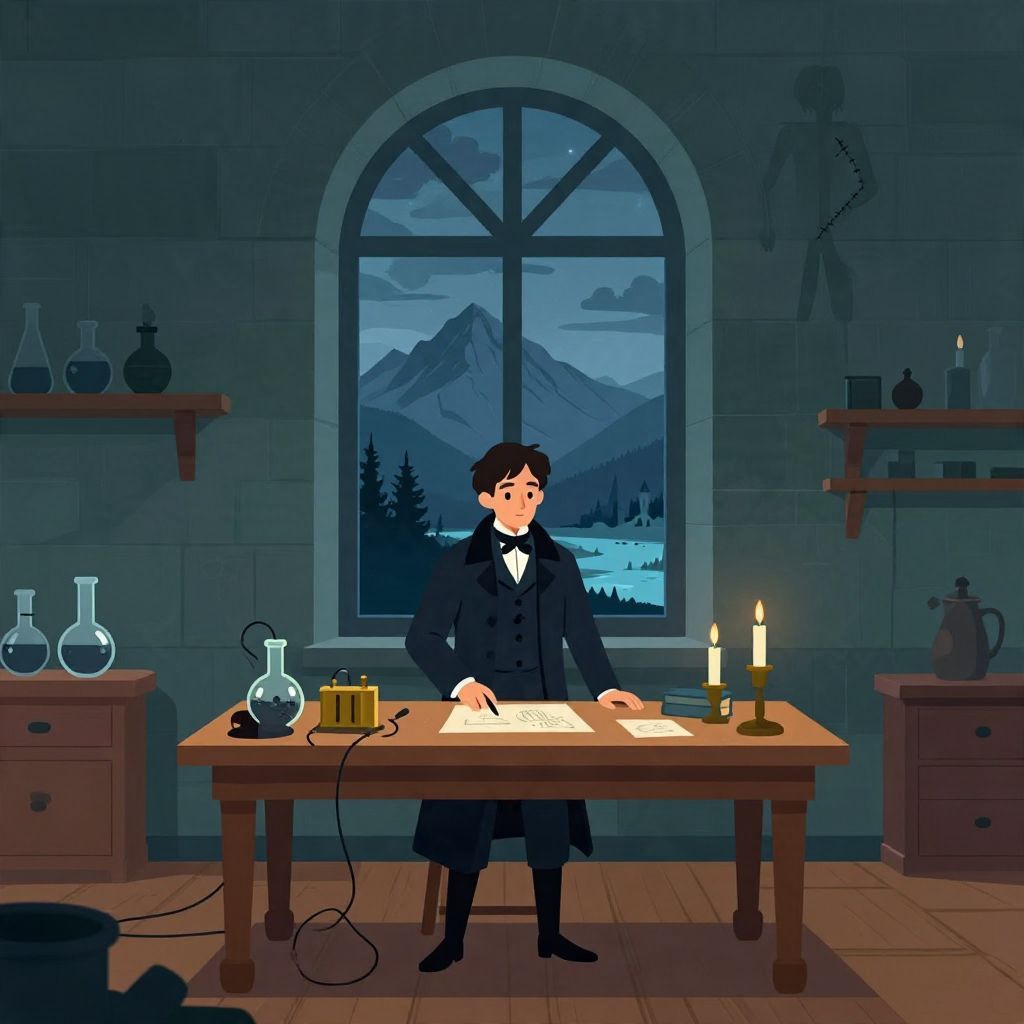
When does Frankenstein take place? The short answer is that Mary Shelley’s novel is set in the late 18th and early 19th centuries, with the main action unfolding across Europe from roughly the 1790s to the early 1800s. The story is not tied to one exact historical year, but its setting clearly belongs to the age of the French Revolution, Enlightenment science, and early Romanticism.
That historical backdrop matters because Frankenstein is not just a Gothic tale about a monster. It is also a novel shaped by the scientific ambitions, political upheavals, and cultural anxieties of Shelley’s own era.
When does Frankenstein take place?
Frankenstein takes place in the late 1700s and early 1800s, with events spread across Geneva, Ingolstadt, the Alps, Scotland, and the Arctic. The novel’s chronology is intentionally vague, but its social world fits the period around 1790–1810. That is the era of revolutionary politics, new scientific ideas, and intense debates about human progress, nature, and responsibility.
The novel’s timeline: a story told out of order
One reason the setting can feel confusing is that Mary Shelley does not tell the story in a straight line. Frankenstein uses letters, memories, and nested narratives, so the reader learns about events after they have already happened. The frame story begins in the Arctic with Captain Robert Walton, who writes to his sister from an expedition in the far north.
Walton then meets Victor Frankenstein, who tells the story of his life. Victor’s account begins in Geneva with his family history, childhood, education, and studies in natural philosophy. The creature’s own narrative comes later, after Victor has already abandoned him. This layered structure makes the novel feel timeless, but the details point to a specific historical moment.
Approximate sequence of events
- Geneva childhood: Victor grows up in a prosperous Swiss family in the late 18th century.
- University years: He studies at Ingolstadt, where his scientific obsession begins.
- The experiment: Victor creates life during his early adulthood, likely in the early 1800s.
- Flight and pursuit: The creature’s movement through Europe and the Alps follows shortly after.
- Arctic frame narrative: Walton’s expedition and Victor’s final pursuit take place near the end of the novel.
Because Shelley never gives exact dates, historians and literary scholars usually describe the setting as “contemporary” to the early 19th century rather than assigning a precise year.
The historical period behind the story
The most important historical setting for Frankenstein is the early 19th century, especially the years around 1790 to 1818, when the novel was written and first published. Shelley published the first edition anonymously in 1818, and the novel reflects the intellectual climate of the years immediately before and after that date. Its world is one of scientific experimentation, political revolution, and uncertainty about the limits of human knowledge.
Why the late 18th and early 19th centuries matter
This period was marked by dramatic change. The French Revolution beginning in 1789 challenged old political orders. Scientific inquiry was advancing rapidly, and many thinkers believed nature could be understood, classified, and even controlled. At the same time, critics worried that reason alone could not explain human experience, morality, or emotion.
Frankenstein captures that tension. Victor Frankenstein is driven by a desire to uncover the secret of life through science, but the novel shows the moral cost of pursuing knowledge without wisdom or empathy. That conflict fits the anxieties of Shelley’s age very closely.
Where is Frankenstein set?
The novel moves across several real and recognizable places in Europe. Geneva is Victor’s home and the center of his family life. Ingolstadt, in present-day Germany, is where he studies and creates the creature. The Alps become the setting for dramatic encounters and emotional reflection. Scotland and the Orkney Islands appear during Victor’s later travels. The story ends in the Arctic, a remote frontier that symbolizes isolation and the limits of human ambition.
Key locations in the novel
- Geneva: Victor’s birthplace and the home of the Frankenstein family.
- Ingolstadt: A university town associated with Victor’s scientific training.
- The Alps: A landscape of sublime beauty and terror.
- Scotland: A place of retreat and further experimentation.
- The Arctic: The final setting, where Walton and Victor meet.
These locations are not random. Shelley uses them to move the story from domestic security to scientific isolation, and finally to a frozen frontier where human control breaks down completely.
How the novel reflects its age
Frankenstein belongs to the age of Enlightenment science and Romantic criticism of it. That historical tension is central to understanding when the novel takes place. Victor’s education reflects a world fascinated by chemistry, anatomy, electricity, and the possibility of discovering natural laws. Yet the novel also warns that knowledge without moral responsibility can produce catastrophe.
Science in the background
Shelley was writing at a time when experiments on electricity and the nature of life captured the public imagination. The novel does not describe modern laboratory science in a literal sense, but it draws on real debates about whether life could be generated or animated through scientific means. Victor’s work is fictional, yet it echoes the era’s confidence in discovery and its fear of overreach.
Romanticism and the sublime
The mountains, storms, icy wastes, and lonely landscapes in Frankenstein are also historically significant. They reflect Romantic-era ideas about the sublime: nature as powerful, beautiful, and overwhelming. This was a reaction against a purely rational view of the world. In the novel, nature offers both comfort and terror, suggesting that human beings are small within a much larger universe.
Can we date the novel more precisely?
There is no single exact year inside the fictional timeline that scholars universally accept. Shelley deliberately avoids pinning the action to a specific date, and the novel’s references are broad enough to keep it flexible. Still, several clues place it in the period of Shelley’s youth and early adulthood, not in the medieval past or a fully modern industrial age.
For example, the family arrangements, travel routes, university life, and scientific interests all fit the early 1800s. The novel also assumes a Europe connected by elite travel and correspondence, but not yet transformed by railways or industrial mass society. That makes the most likely setting somewhere between the 1790s and 1810s.
Why scholars avoid a single exact date
- The novel gives few explicit calendar dates.
- Its frame narrative and flashbacks blur the chronology.
- Shelley was more interested in themes than in historical precision.
- The setting is meant to feel contemporary to readers in 1818, not historically distant.
The publication date versus the story’s setting
It is important to distinguish between when Frankenstein was published and when it is set. The novel first appeared in 1818, but the story itself begins earlier. That means Shelley was writing about a near-contemporary world rather than a past century. The revised edition of 1831 did not fundamentally change that setting, though it did alter some wording and emphasis.
This distinction helps explain why the novel feels both historical and immediate. Readers in 1818 would have recognized the social world of educated families, continental travel, and scientific ambition. At the same time, the novel’s Gothic style gives it a timeless, uncanny quality.
Why the setting matters to the meaning of the novel
The question “When does Frankenstein take place?” is not just a matter of chronology. The setting shapes the novel’s meaning. By placing the story in the age of scientific optimism and revolutionary change, Shelley asks whether human beings can master nature without consequences. Victor’s tragedy is not only personal; it reflects the dangers of unchecked ambition in a rapidly changing world.
The novel also explores social exclusion, responsibility, and the consequences of abandonment. The creature is not born evil. He becomes violent after rejection, isolation, and suffering. That theme would have resonated strongly in an era preoccupied with the rights of individuals, the education of the mind, and the moral duties of creators, parents, and governments.
Historical significance of the novel’s time period
The early 19th-century setting gives Frankenstein lasting historical significance. It captures a moment when old certainties were breaking down. Political revolutions had shaken Europe. Science was expanding its reach. Writers and thinkers were asking whether progress truly improved humanity. Shelley’s novel turns those questions into a haunting story that still feels modern because its concerns remain familiar.
That is why the novel continues to be read not only as fiction, but as a cultural document of its age. It reveals how people in the early 1800s imagined science, nature, family, and the limits of human power. In that sense, the setting is as important as the plot.
In short: when does Frankenstein take place?
Frankenstein takes place in the late 18th and early 19th centuries, most likely around the 1790s to 1810s, across Switzerland, Germany, Scotland, and the Arctic. Mary Shelley never gives a single exact year, but the novel clearly belongs to the world of the French Revolution, early Romanticism, and emerging modern science. For more context on the era surrounding the novel’s publication, see when the Market Revolution began and the history of the last penny.