
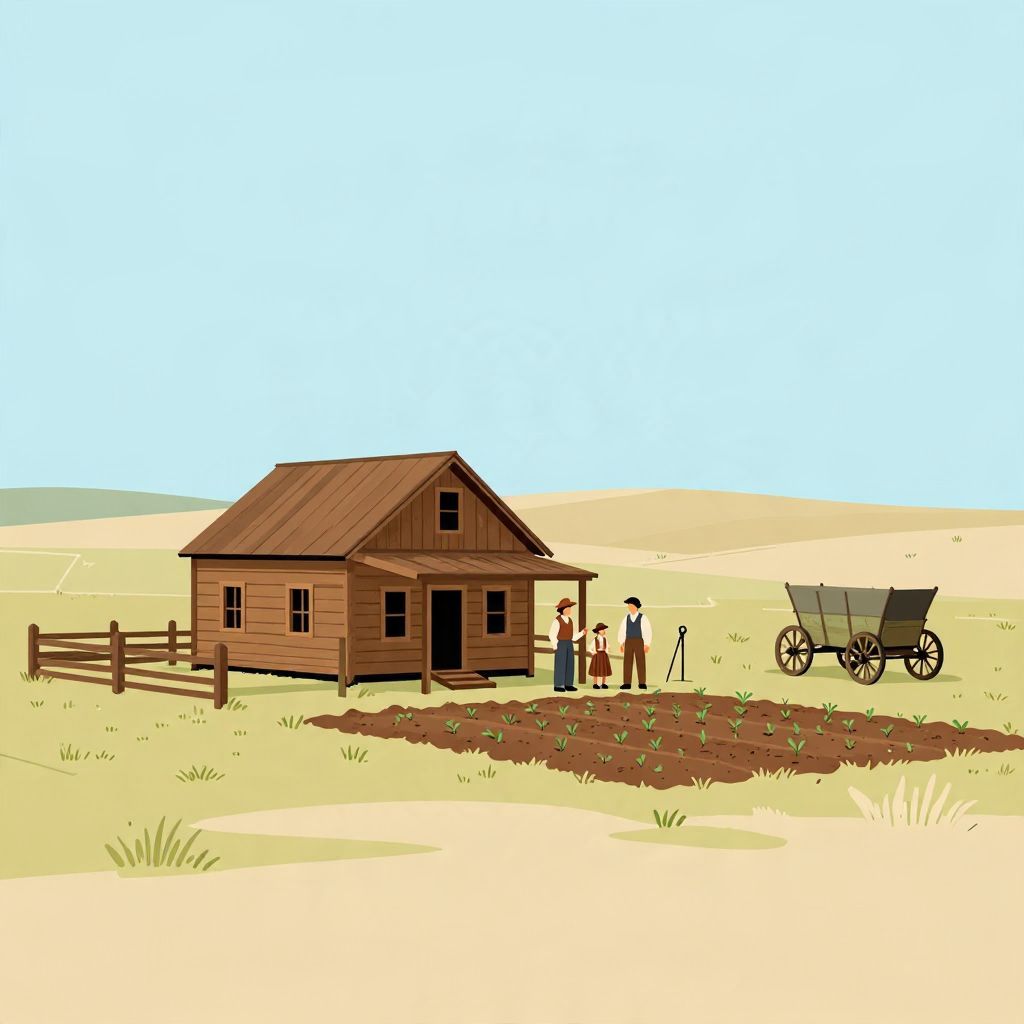
What was the Homestead Act? In simple terms, it was a major U.S. law that offered free or low-cost public land to settlers willing to live on it and improve it. Signed by President Abraham Lincoln in 1862, it became one of the most important land policies in American history.
The act helped drive westward expansion, encouraged farming and migration, and reshaped Native lands, the environment, and the American economy. Its history is about opportunity, but also conflict, displacement, and the limits of frontier life.
What Was the Homestead Act?
The Homestead Act was a federal law passed in 1862 that granted up to 160 acres of public land to eligible applicants, usually if they lived on the land, built a dwelling, and farmed it for several years. It aimed to populate the West with small farmers and strengthen U.S. claims to the territory.
Origins of the Homestead Act
The idea did not appear suddenly in 1862. For decades, many Americans had argued that the federal government should give away western land to ordinary settlers rather than sell it only to speculators and wealthy buyers. This debate grew from the early republic’s expansion and the belief that landownership could support independence and republican citizenship.
Earlier land policies
Before the Homestead Act, the government used land sales, surveys, and land offices to dispose of public territory. Policies such as the Northwest Ordinance helped organize western settlement, but they did not create the same broad promise of land for nearly anyone willing to work it. By the mid-19th century, reformers wanted a more democratic system.
Political conflict over western land
Support for homesteading was tied to larger sectional conflicts. Many northern lawmakers and free-soil advocates believed that western land should be opened to independent farmers rather than expanded slaveholding plantations. Southern politicians often opposed homestead proposals before the Civil War, partly because they feared the political consequences of new free states and a weaker slave system.
Why Was the Homestead Act Passed in 1862?
The Homestead Act became law during the Civil War, when many southern legislators who had blocked it were no longer in Congress. That political opening made passage possible. The Republican Party, which supported free labor ideology and western development, strongly backed the measure. It fit the wartime agenda of strengthening the Union and encouraging settlement in territories under federal control.
The role of Abraham Lincoln
President Abraham Lincoln signed the act on May 20, 1862. Lincoln and many Republicans saw small landownership as a foundation of opportunity and social mobility. The law also matched a broader vision of national growth: railroads, farms, towns, and new states linked together under federal authority.
How the Homestead Act Worked
The law was straightforward in principle, though difficult in practice. An applicant could claim a parcel of public land, usually 160 acres, by filing paperwork, paying a small fee, and meeting residence and improvement requirements. After a set period, the settler could receive legal title to the land.
Main requirements
- The applicant had to be of legal age or the head of a household.
- The land had to be public land available under the law.
- The settler had to live on the property, usually for five years.
- The settler had to improve the land, often by building a home and cultivating crops.
- After meeting the conditions, the settler could claim ownership.
Why 160 acres?
The 160-acre figure was meant to provide enough land for a family farm in many parts of the West. In practice, the size was often too small in arid regions where rainfall was limited, and too large for some families with little capital or labor. The law assumed a farming model that did not fit every landscape.
Who Benefited from the Homestead Act?
The act benefited many settlers, but not equally. Some families used it to build farms and towns, and many immigrants saw it as a path to landownership. Women could also file claims in some circumstances, especially if they were heads of households. Over time, the law became part of the story of immigrant settlement in the Great Plains and beyond.
Successes and limitations
For some people, the act opened real opportunity. For others, the costs of travel, tools, seed, shelter, and livestock made success difficult. A homestead was not truly “free” in any simple sense. Settlers often needed savings, credit, or help from railroads and local networks to survive the first years.
Fraud and speculation
Not all claims were made by family farmers settling permanently. Some people used the law fraudulently, filing claims and then selling them, or working with speculators who accumulated large amounts of land through loopholes and pressure. So while the act was designed to promote small ownership, its results were mixed.
Homesteading and Westward Expansion
The Homestead Act was one of the most powerful engines of westward expansion in U.S. history. It encouraged migration into the Great Plains, the Mountain West, and other federal lands. New rail lines, military posts, and territorial governments often developed alongside homesteading, making settlement part of a larger national expansion project.
Building towns and infrastructure
As settlers arrived, they built schools, churches, roads, grain elevators, and local governments. Towns often grew where transportation routes and land claims intersected. The act did not just place individual families on land; it helped create a broader settlement pattern that transformed the rural West.
Environmental challenges
Many homesteaders discovered that the environment was harsher than promotional literature suggested. The Great Plains had droughts, grasshopper infestations, severe winters, and unpredictable rainfall. In some places, farming methods imported from wetter regions were poorly suited to local conditions. These difficulties became especially visible in later crises such as the Dust Bowl, when overplowing and drought devastated parts of the region.
Impact on Native Americans
Any full answer to what the Homestead Act was must include its impact on Native peoples. The law was built on the assumption that the federal government could distribute lands that were already inhabited, hunted, farmed, and governed by Indigenous nations. In practice, homesteading accelerated dispossession.
Land loss and treaty pressure
As settlers moved west, Native communities faced increasing pressure from land cessions, broken treaties, military campaigns, and confinement to reservations. The Homestead Act did not create these conflicts by itself, but it intensified them by turning Indigenous homelands into parcels for private ownership under U.S. law. For many Native nations, the act represented invasion rather than opportunity.
How Long Did the Homestead Act Last?
The original law remained in force for decades, though it was amended many times. Congress adjusted rules for different regions and circumstances, including provisions for timber culture, desert land, and larger claims in some western areas. The basic homesteading system remained influential well into the 20th century.
End of the policy
The Homestead Act was not abolished immediately after the frontier era ended. It was gradually narrowed and eventually repealed in most contexts in the 1970s, though Alaska had special provisions that lasted longer. By then, the United States had changed dramatically, and large-scale public land settlement was no longer the same national project.
Why the Homestead Act Matters in History
The Homestead Act matters because it shaped the geography, politics, and social history of the United States. It helped create thousands of farms and communities, supported the growth of western states, and reinforced the ideal of the independent family farmer. At the same time, it contributed to the displacement of Native peoples and encouraged settlement in fragile environments.
Competing historical interpretations
Historians often describe the act in two overlapping ways. One view emphasizes democratic opportunity: landownership for ordinary people, especially immigrants and working families. Another emphasizes conquest: the transfer of land from Indigenous nations to settlers under federal power. Both interpretations are necessary to understand the law’s full meaning.
In Summary: What Was the Homestead Act?
The Homestead Act was a landmark 1862 U.S. law that offered public land to settlers who would live on it and improve it. It helped populate the West, supported small-farm ideals, and changed American settlement patterns, but it also deepened Native dispossession and exposed the limits of frontier farming. For more context, you may also want to read about the Northwest Ordinance and the Dust Bowl.