
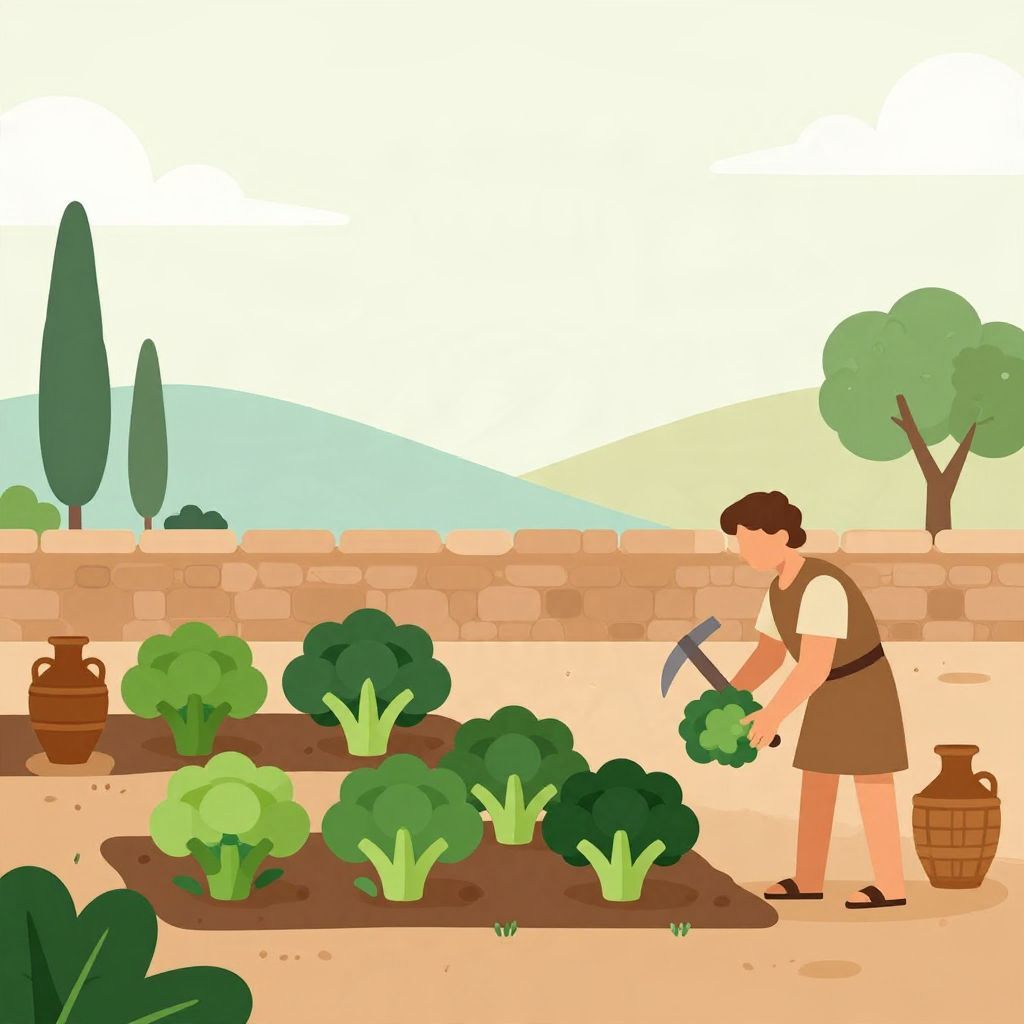
When was broccoli invented? The short answer is that broccoli was not “invented” in the modern sense; it was gradually developed from wild cabbage over many centuries. Most historians of food place its emergence in the ancient Mediterranean, with recognizable broccoli likely cultivated by the Romans by around the 1st century BCE to 1st century CE.
Because broccoli is a plant bred through selection rather than a single invention, its history is a story of agriculture, taste, and experimentation. The vegetable we know today emerged slowly from earlier brassicas, especially wild cabbage, and later spread across Europe before becoming common worldwide.
When Was Broccoli Invented?
Broccoli was not invented on one exact date. It was developed through selective breeding from wild cabbage in the ancient Mediterranean, probably by Italian and Roman growers sometime before or during the early Roman Empire, roughly 200 BCE to 100 CE. The modern name and broader cultivation came much later, but its roots are ancient.
Broccoli’s Ancient Origins
Broccoli belongs to the Brassica oleracea family, the same species that gave rise to cabbage, cauliflower, kale, Brussels sprouts, and kohlrabi. These vegetables are all examples of human selection acting on one plant species over generations. Farmers chose plants with larger flower buds, thicker stems, or different leaf forms, gradually creating distinct vegetables.
From wild cabbage to cultivated brassicas
The ancestor of broccoli was wild cabbage, a hardy plant native to coastal regions of Europe and the Mediterranean. Ancient farmers did not “invent” broccoli in a laboratory; they noticed useful traits in cabbage relatives and saved seeds from plants that produced desirable parts. Over time, this process created a range of edible forms.
Broccoli likely emerged in the Italian peninsula, where Roman agricultural culture was highly sophisticated. The Romans were known for cataloging crops, improving garden plants, and spreading them through trade and conquest. While the exact moment broccoli became a distinct vegetable is unknown, the evidence points to a long process of cultivation in antiquity rather than a single breakthrough.
What the Romans may have grown
Classical sources suggest that Romans knew and valued a brassica with edible flowering shoots. Ancient writers such as Pliny the Elder described cultivated cabbages and related greens, though identifying the exact modern vegetable in those texts can be difficult. Historians generally treat these references cautiously: they show that Roman gardeners were working with brassica varieties, but they do not always map neatly onto today’s broccoli.
Even so, the Roman world is the most likely setting for broccoli’s early development. By the end of the Republic and into the Empire, selective breeding had probably produced a plant close to what we now recognize as broccoli.
A Simple Timeline of Broccoli History
The history of broccoli is best understood as a timeline of gradual development rather than a single invention date. Here is the broad sequence scholars generally accept:
- Prehistory: Wild cabbage grows naturally along the Mediterranean coast.
- Ancient agriculture: Farmers begin selecting cabbage plants for different traits.
- Roman era, roughly 200 BCE–100 CE: Broccoli-like forms are likely cultivated in Italy.
- Late antiquity and the Middle Ages: Broccoli remains a regional vegetable in parts of southern Europe.
- 16th century: Broccoli becomes better documented in Europe, especially in Italy and France.
- 18th century: It reaches England more clearly and appears in gardening literature.
- 19th–20th centuries: Broccoli spreads widely in North America and becomes a mainstream commercial crop.
Why Broccoli Is Hard to Date Exactly
Unlike a machine, a law, or a building, broccoli does not have a single inventor or launch date. It was created through generations of agricultural selection. That makes the question “When was broccoli invented?” more complicated than it first appears. The answer depends on what counts as broccoli: its earliest ancestor, its first edible form, or the moment it became recognizable as the vegetable sold in markets today.
Different definitions produce different answers
If you mean the earliest ancestor of broccoli, then the story begins with wild cabbage thousands of years ago. If you mean the first broccoli-like plant, the answer is probably ancient Roman Italy. If you mean the modern commercial vegetable, then the history is much later, especially from the 16th century onward, when European gardeners documented and standardized it more clearly.
That is why careful historians avoid giving a fake exact date. The best evidence supports an ancient origin, but the process was gradual and regionally uneven.
How Broccoli Spread Across Europe
After its early development in Italy, broccoli remained a regional crop for a long time. It did not become widely known across Europe overnight. Instead, it spread through trade, gardening networks, and elite kitchens. Renaissance Italy was especially important because gardeners there experimented with many brassicas and helped preserve and refine broccoli varieties.
Renaissance gardens and culinary culture
By the 1500s, broccoli appears more clearly in European gardening and cooking traditions. Italian growers cultivated several forms, and the vegetable began to attract attention beyond its original region. French and English gardeners later adopted it, though it was still considered somewhat exotic in northern Europe for a time.
In England, broccoli was long associated with the Continent and especially with Italy. It was not yet a staple in everyday British cooking. Instead, it was a garden vegetable for people with access to diverse produce and the knowledge to grow it.
Broccoli in the Americas
Broccoli arrived in North America much later, brought by immigrants and gardeners familiar with European vegetable traditions. For a long time it remained a niche crop, especially among Italian-American communities. Its rise to national popularity in the United States came only in the 20th century, when improved transportation, refrigeration, and commercial farming made fresh broccoli more widely available.
From immigrant gardens to supermarket staple
The 20th century transformed broccoli from a relatively specialized vegetable into a common household food. Agricultural breeding improved yield, uniformity, and shelf life. At the same time, changing dietary advice and growing interest in fresh vegetables helped broccoli gain a reputation as a healthy food. This modern popularity should not be confused with its ancient origin; it is a much later chapter in a very old history.
What Makes Broccoli a Historical “Invention”?
Broccoli is a good example of how many foods are “invented” through cultivation rather than created all at once. Humans did not design broccoli from scratch. They selected plants with desirable characteristics over many generations until a new form emerged. In that sense, broccoli is a product of agricultural knowledge, patience, and observation.
Selective breeding in the ancient world
Ancient farmers understood far more about plant improvement than they are sometimes given credit for. They may not have used modern genetics, but they knew that seeds from certain plants could produce better crops. This practical knowledge shaped many foods still eaten today. Broccoli is one of the clearest examples of how ancient agricultural choices continue to affect modern diets.
Broccoli, Cauliflower, and the Brassica Family
Broccoli’s history becomes even more interesting when placed beside its relatives. Cauliflower and broccoli are closely related, and their development shows how flexible the brassica family is under human cultivation. Different regions and cultures selected for different edible parts: leaves in kale, flower buds in broccoli, compact heads in cabbage, and immature flower clusters in cauliflower.
A family tree shaped by people
This means broccoli’s “invention” was part of a broader pattern. Rather than one vegetable being created and then copied, an entire family of vegetables was shaped by human preference over centuries. The result is a set of crops that look different but share a common ancestry. That shared background is one reason broccoli has a deep and surprisingly complex history.
Historical Facts About Broccoli
- Broccoli comes from the species Brassica oleracea, the same species as cabbage and cauliflower.
- Its earliest development likely took place in the ancient Mediterranean, especially Italy.
- There is no single inventor or exact invention date.
- The most likely period for its emergence is the Roman era, around 200 BCE to 100 CE.
- It became more clearly documented in Europe during the Renaissance.
- It became a major commercial crop in the 20th century, especially in the United States.
So, When Was Broccoli Invented?
Broccoli was not invented in one moment, but it was probably first developed as a distinct vegetable in ancient Roman Italy, sometime around the 1st century BCE to 1st century CE. Its deeper roots go back to wild cabbage in the Mediterranean, and its modern global popularity is much more recent. The history of broccoli is really the history of human cultivation itself.
If you want to explore the vegetable’s background further, you may also like where broccoli comes from and the broader food history behind dishes such as succotash.