
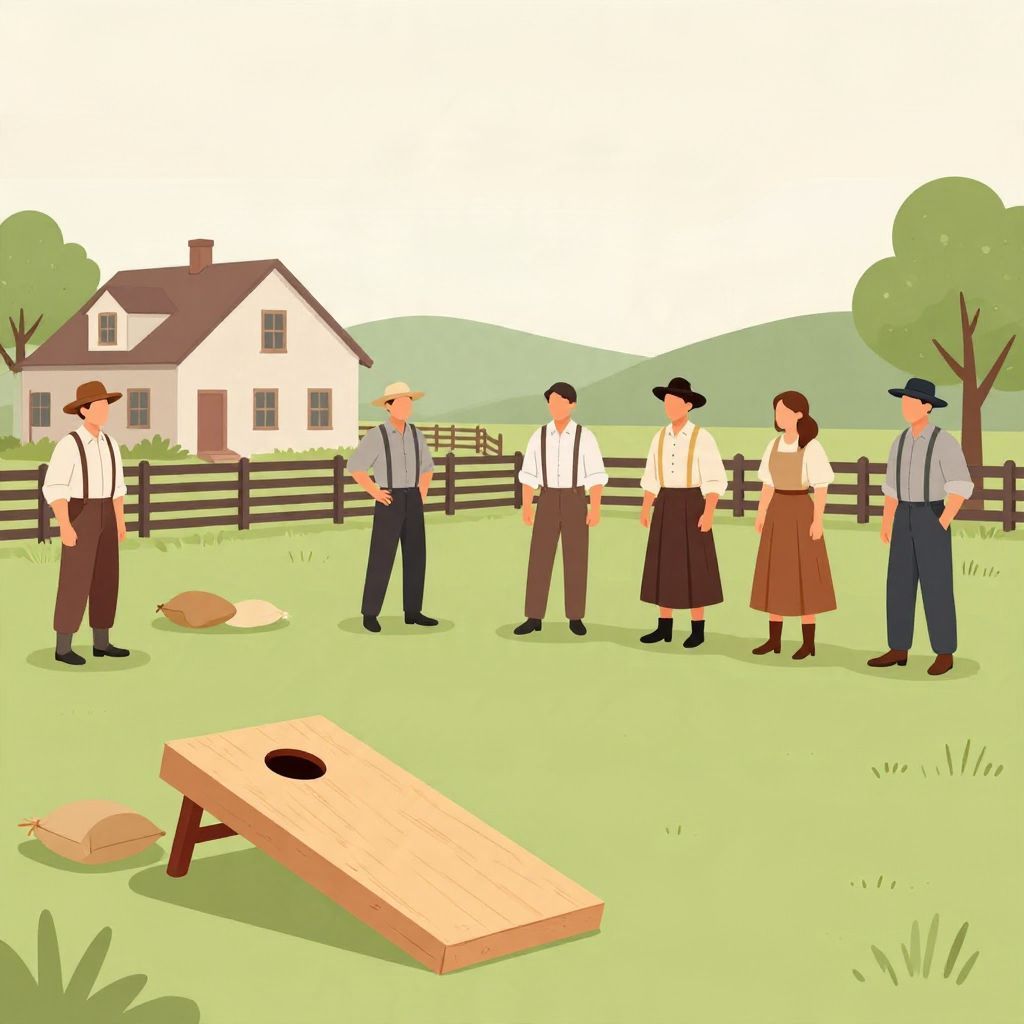
When was cornhole invented? The short answer is that the game’s exact origin is unclear, but the modern version of cornhole became widely recognizable in the late 20th century, especially in the 1970s through the 1990s. Its deeper roots may stretch back much farther, to older tossing games played in Europe and North America.
Because the evidence is mixed, historians and game historians usually separate the idea of beanbag tossing games from the standardized backyard sport now called cornhole. That distinction matters: the pastime is old, but the familiar board-and-bag format is comparatively recent.
When Was Cornhole Invented?
Cornhole was not invented on one exact date by one confirmed person. The modern game developed gradually, with recognizable rules and equipment becoming common in the late 1900s. While some stories place its origins in the 1800s or earlier, the best-supported history points to a modern standardization in the 20th century, not a single ancient invention moment.
The Historical Roots of Cornhole
Cornhole belongs to a long tradition of throwing games. People have played games involving bags, stones, rings, and targets for centuries. These older games do not prove that cornhole existed in its current form, but they help explain why the basic idea feels so familiar. Tossing objects at a target is one of the simplest and oldest forms of recreation.
Older Tossing Games and Possible Precursors
Several games have been suggested as possible ancestors of cornhole, though none can be identified as the direct source with certainty. These include folk games in which players tossed sacks, stones, or other small objects toward holes, pits, or marked areas. In some cases, the goal was to land an object in a hole; in others, it was to get closest to a target.
These similarities are important, but they do not mean cornhole has a single provable ancient lineage. Instead, cornhole likely emerged from a broader culture of informal lawn and parlor games that rewarded accuracy, hand-eye coordination, and friendly competition.
Why the “Corn” in Cornhole?
The name “cornhole” is often linked to the bags once filled with dried corn kernels. That detail is historically plausible, since corn was an inexpensive and accessible filler material in rural America. Over time, synthetic fillers replaced corn in many sets, but the name remained. The word itself may also have been used in other regional or slang contexts before it became attached to the game.
The Modern Game: How Cornhole Took Shape
The cornhole most people know today—a slanted wooden board with a hole near the top and beanbags or cloth bags thrown from a fixed distance—appears to have taken shape in the 20th century, especially in the Midwest and parts of the United States where backyard games were popular. The game’s spread was driven less by formal invention than by local custom and repeated play.
From Informal Backyard Game to Standard Rules
For a long time, cornhole existed in informal forms. Different communities used different board sizes, bag weights, distances, and scoring methods. That variety is one reason the origin question is difficult: a game can be widely played before it becomes standardized. The version now used in tournaments is the product of later rule-making, not a single original design.
As the game became more popular, players and organizers began to settle on a common setup. That standardization helped cornhole move from a casual pastime to a recognizable sport. The modern rules, equipment, and scoring system are part of this later evolution.
Regional Claims and Origin Stories
Several places have claimed to be the birthplace of cornhole, and different stories circulate about who first built the boards or popularized the game. These claims are part of the game’s folklore, but they are difficult to verify. Because of that, historians generally treat them cautiously rather than accepting any one local origin story as settled fact.
What can be said with confidence is that cornhole became strongly associated with American leisure culture in the 20th century, especially in family gatherings, tailgates, picnics, and neighborhood events. Its appeal came from being simple to learn, inexpensive to build, and suitable for all ages.
A Simple Timeline of Cornhole History
The history of cornhole is best understood as a timeline of development rather than a single invention date. Here is a careful summary of the main stages:
- Older centuries: Tossing and target games appear in many cultures, creating a broad background for cornhole-like play.
- 19th century and earlier: Folk games using bags or small objects may have influenced later forms, but direct evidence for modern cornhole is limited.
- 20th century: The board-and-bag version becomes increasingly recognizable in American informal recreation.
- Late 20th century: Rules and equipment become more standardized, helping the game spread more widely.
- Early 21st century: Cornhole grows rapidly in popularity as a backyard, bar, and tournament game.
Why Historians Avoid a Single Exact Date
People often ask when cornhole was invented because they want a clean answer, like a patent date or the name of a founder. But cornhole does not fit that model neatly. It developed through popular use, not a documented invention event. That means the historical record is shaped by memory, local tradition, and gradual change.
Informal Games Are Hard to Date
Many folk games leave few paper records. Families and communities pass them along orally or through practice, not through official documents. As a result, the earliest forms of cornhole may have existed long before anyone wrote them down. The modern game is therefore easier to describe than to pinpoint.
This is also why origin stories can vary so much. One person may remember a childhood game from the 1940s; another may know a version from the 1970s; a third may connect it to older rural traditions. All of these memories may be genuine, but they do not necessarily identify the first cornhole game ever played.
How Cornhole Became a Modern Sporting Pastime
Cornhole’s rise in popularity reflects broader changes in leisure culture. As backyard entertainment, tailgating, and casual competitive games became more common, cornhole fit perfectly. It required little space, little equipment, and no special athletic training. That made it ideal for social settings where people wanted a game that was easy to join and fun to watch.
Why the Game Spread So Quickly
- Simple setup: Two boards and eight bags are enough to play.
- Easy rules: New players can learn the basics in minutes.
- Low cost: Homemade boards made the game accessible.
- Social appeal: It works well at gatherings, festivals, and tailgates.
- Competitive flexibility: Casual and tournament play both work well.
These qualities helped cornhole move from a local pastime to a widely recognized American game. In that sense, the history of cornhole is not just about invention; it is also about how ordinary people adopted, adapted, and standardized a game over time.
What Is Historically Certain About Cornhole?
The most reliable historical conclusion is this: cornhole as a modern game was not invented in a single known moment. Its roots are older than its standardized form, and its spread was gradual. The game likely emerged from a long tradition of tossing games, then became clearly identifiable in the 20th century before exploding in popularity in the late 20th and early 21st centuries.
That means any answer to “When was cornhole invented?” should be careful. If you mean the idea of throwing bags at a target, the roots are ancient and diffuse. If you mean the modern backyard game, the best historical answer is that it took shape in the 20th century, with its current form becoming broadly established in the late 1900s.
Conclusion
Cornhole was not invented on one documented day, but its modern form developed in the 20th century and became widely standardized in the late 20th century. Its history shows how a simple folk pastime can evolve into a popular modern game through everyday use, regional tradition, and shared rules. For more on the history of leisure and everyday culture, you may also enjoy related history articles on the history of backyard games and the origins of American tailgating culture.