
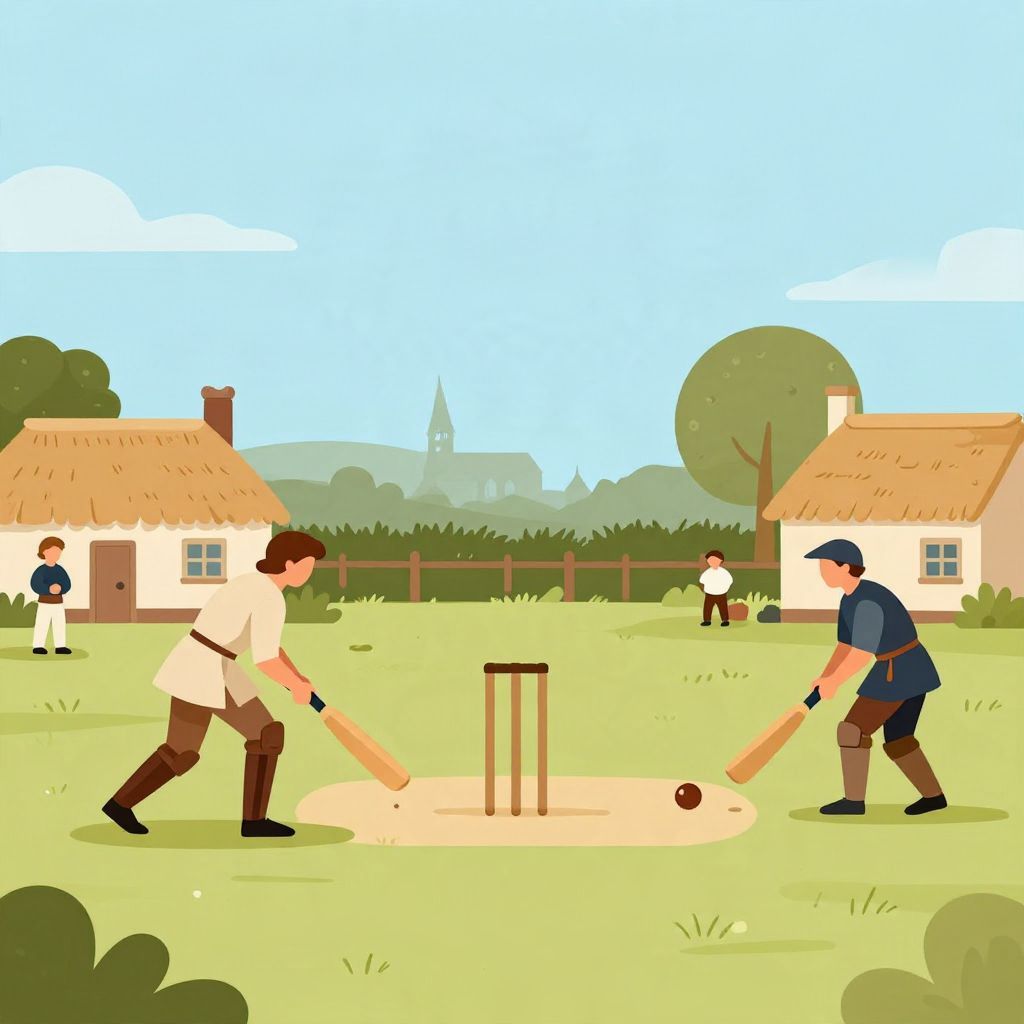
When was cricket invented? The short answer is that cricket emerged in England in the late medieval period, probably by the 1500s and certainly by the early 1600s. It was not “invented” in a single moment by one person; instead, it developed gradually from older bat-and-ball games played in rural communities.
By the 18th century, cricket had become a recognizable organized sport with written rules, clubs, and matches that drew spectators. Its origins are therefore best understood as a long evolution rather than a single date.
When Was Cricket Invented?
Cricket was likely first played in England sometime in the late 15th or 16th century, with the earliest clear documentary evidence appearing in the early 17th century. Historians generally treat cricket as an English game that evolved over time from earlier folk games rather than a sport with one exact invention date.
The Origins of Cricket in Medieval and Tudor England
Most scholars place cricket’s beginnings in southeastern England, especially Kent, Sussex, and Surrey. These counties had the social and geographic conditions that helped bat-and-ball games spread: open fields, village life, and a culture of seasonal recreation. The game likely began among children or rural workers before becoming an adult pastime.
Why historians cannot give one exact date
There is no surviving record saying, “cricket was invented on this day.” Early games were often informal and rarely documented unless they involved disputes, wagers, or local authorities. That means the evidence points to a gradual development, not a single founding event.
Some older theories once linked cricket to Saxon or even Flemish origins, but these ideas are not strongly supported by the historical record. The most widely accepted view is that cricket grew out of medieval English bat-and-ball games and took shape over several centuries.
Earliest Historical Evidence for Cricket
The first known reference to cricket appears in a legal case from 1598, where a witness mentioned playing “creckett” as a boy in Guildford, Surrey, around 1550. This is important because it suggests cricket was already established by the mid-16th century, even if it had not yet become a fully standardized sport.
Key early records
- c. 1550 — A later witness says he played cricket as a child in Guildford.
- 1598 — The earliest known written reference to cricket appears in a court case.
- 1611 — Dictionaries include cricket among recognized games, showing it was becoming familiar enough to be named in print.
- 17th century — Cricket spreads in southern England and begins to appear in betting and parish records.
These references do not prove the exact year of invention, but they do show that cricket was already known by the late 1500s and was likely older than that.
How Cricket Developed from a Folk Game into a Sport
Early cricket was probably quite different from the modern game. The pitch, bat shape, bowling style, and scoring system all changed over time. What began as a local pastime gradually became more formal as people started organizing matches, setting rules, and making wagers on outcomes.
From informal play to organized competition
In its early stages, cricket was likely played with simple equipment and flexible local customs. As the game spread, communities needed shared expectations: how to dismiss a batter, how runs were counted, and what counted as fair play. These practical needs pushed cricket toward standardization.
By the 1700s, cricket had become a serious spectator sport among both rural and elite players. Gambling money often fueled matches, and wealthy patrons helped support teams. This period is crucial because it transformed cricket from a local game into a recognizable national sport.
Cricket in the 18th Century: The Game Takes Shape
The 18th century is when cricket became more clearly identifiable as the sport we know today. Clubs formed, major matches were reported, and the Laws of Cricket began to be written down. The game also moved beyond village settings into aristocratic and urban recreational culture.
The Hambledon era and early rule-making
Hambledon Cricket Club, active in the mid-to-late 1700s, is often described as one of the most important early centers of cricket. It was not the “inventor” of cricket, but it helped shape the sport’s development and prestige. During this period, the bat became more curved and later straighter as bowling changed, and the game’s rules became more consistent.
The first known codified Laws of Cricket were written in 1744, though they were revised later. This matters because it marks the transition from a flexible folk game to a regulated sport with shared standards.
What Cricket Was Like Before Modern Rules
Modern cricket features defined overs, innings, wickets, and standardized equipment. Early cricket was looser and more varied. The ball may have been bowled underarm, and bats were adapted to the style of bowling used at the time. As techniques changed, so did the equipment and tactics.
Important changes over time
- Bat shape changed as bowlers began delivering the ball differently.
- Bowling style evolved from underarm to roundarm and eventually overarm.
- Wickets became more standardized.
- Rules were written down and revised to reduce disputes.
- Clubs and county teams helped organize regular competition.
These developments show that cricket was not a static invention. It was a living game shaped by local custom, competition, and the gradual need for uniform rules.
Did Cricket Really Begin in England?
Yes, the historical evidence strongly supports England as cricket’s place of origin. There is no reliable evidence that cricket began in India, Australia, or elsewhere and was later imported into England. Instead, the game spread outward from England through trade, empire, migration, and military networks.
That said, many cultures had earlier bat-and-ball games. Cricket belongs to a broader family of stick-and-ball pastimes, but the specific game called cricket is English in origin.
How Cricket Spread Beyond England
Cricket’s global spread came much later than its invention. During the British Empire, the game traveled with soldiers, administrators, merchants, and settlers. By the 18th and 19th centuries, cricket had taken root in places such as the Caribbean, India, South Africa, Australia, and New Zealand.
Why empire mattered
Empire created the conditions for cricket to become an international sport. British schools and clubs promoted it as part of elite education and social discipline, while local communities adapted it in their own ways. Over time, former colonies transformed cricket into a deeply local and often politically meaningful game.
This global history is important because it explains why cricket is now associated with many countries, even though its origins are English.
Common Myths About Cricket’s Invention
Several myths circulate about cricket’s beginnings. Some claim it was invented by a single person, while others suggest it is far older than the evidence supports. The historical record does not confirm either idea.
What historians can and cannot say
Historians can say that cricket existed by the mid-1500s and was clearly documented by the late 1500s. They can also say it became a formal sport in the 1700s. What they cannot say with confidence is the exact day, year, or inventor of cricket.
So if the question is “When was cricket invented?” the most careful answer is: cricket emerged in England by the 16th century, probably earlier, and became a formalized sport in the 18th century.
Timeline of Cricket’s Early History
- Late medieval period — Early bat-and-ball games appear in England.
- c. 1550 — A later witness recalls playing cricket as a child in Surrey.
- 1598 — The first known written reference to cricket appears in a legal record.
- 1611 — Cricket is mentioned in print as a recognized game.
- 1700s — Cricket becomes more organized, with clubs, patrons, and spectators.
- 1744 — The earliest known Laws of Cricket are written down.
- Late 1700s — Cricket becomes a major English sport and begins spreading more widely through the British world.
Why Cricket’s History Still Matters
Cricket’s origins reveal how sports often develop: slowly, socially, and without a single inventor. The game reflects changes in leisure, class, law, and empire. Its history also helps explain why cricket became both a national English pastime and a global sport with many regional identities.
In the end, cricket was not invented in one dramatic moment. It emerged in England during the late medieval or Tudor period, was documented by the late 1500s, and became a codified sport in the 1700s. For more historical context on the era of expanding empires and changing societies, you may also find what happened in 1803 and how imperialism led to World War I useful.