
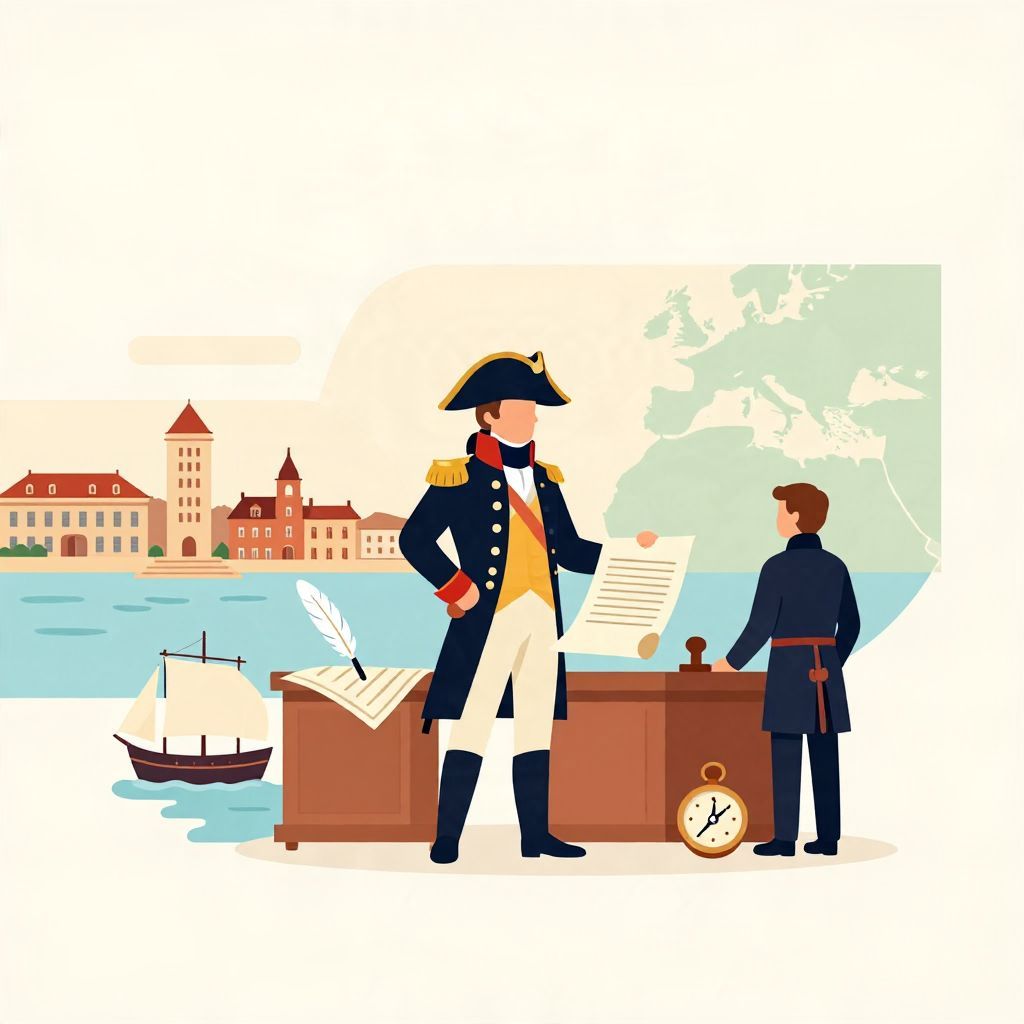
What happened in 1803? It was a year of major political change, territorial expansion, and scientific progress. In the United States, the Louisiana Purchase transformed the nation’s future. In Europe, Napoleon reshaped the map through war and state-building, while Britain and France remained locked in a wider imperial struggle.
Across the world, 1803 also saw important developments in exploration, law, and culture. It was not a single-event year, but one in which several long-running historical forces accelerated at once: empire, revolution, industrialization, and the reordering of power after the French Revolution.
What happened in 1803?
In 1803, the most famous event was the Louisiana Purchase, when the United States bought a vast territory from France. The year also marked the start of the Napoleonic Wars, the founding of the Supreme Court of Judicature in India, the publication of key scientific work by John Dalton, and major shifts in European and Atlantic politics.
Why 1803 mattered in world history
1803 mattered because it changed the balance of power in North America and Europe. The Louisiana Purchase doubled the size of the United States and opened the interior of the continent to further settlement and conflict. At the same time, Napoleon’s rise to imperial power intensified war in Europe and across the seas.
The year also reflected broader historical trends. Governments were becoming stronger and more centralized, empires were expanding, and new ideas in science and economics were beginning to reshape modern life. For that reason, 1803 is often remembered as a turning point rather than an isolated date.
Major events of 1803
The Louisiana Purchase
On April 30, 1803, the United States agreed to buy Louisiana from France for about $15 million. This enormous territory stretched from the Mississippi River to the Rocky Mountains and from the Gulf of Mexico northward into what is now Canada, though exact boundaries were not fully settled at the time.
The purchase happened because Napoleon needed money and because France’s position in North America had become difficult to defend. The Haitian Revolution and renewed war with Britain made the French empire in the Americas far less secure. For the United States, the deal solved an urgent problem: control of the port of New Orleans and access to the Mississippi River.
The acquisition was controversial. President Thomas Jefferson had long favored limited federal power, yet the Constitution did not clearly spell out the authority to buy foreign territory. Still, the political advantages were so great that the purchase went forward, becoming one of the most important land deals in history.
The Napoleonic Wars begin
In May 1803, war resumed between Britain and France after the breakdown of the Peace of Amiens. This conflict is usually treated as the beginning of the Napoleonic Wars, a long struggle that would dominate Europe until 1815.
The war grew out of deep mistrust. Britain feared French expansion under Napoleon, while France saw Britain as the main obstacle to its influence. The return to war meant renewed naval battles, economic blockades, colonial fighting, and military campaigns that would redraw borders across Europe.
For ordinary people, the resumption of war brought higher taxes, conscription, disrupted trade, and greater instability. It also helped push Britain and France into a global contest that reached the Americas, the Caribbean, Africa, and Asia.
Ohio becomes a state
On March 1, 1803, Ohio became the 17th state in the United States. Its admission marked an important step in the westward growth of the republic and in the transformation of the Northwest Territory into organized state governments.
Ohio’s statehood mattered because it showed that the United States was no longer just a coastal nation. Settlement was moving inland, and the political future of the country would increasingly depend on the balance between free and slave states, a tension that would intensify in later decades.
Scientific progress and John Dalton
In 1803, English scientist John Dalton began presenting ideas that would become the foundation of modern atomic theory. Dalton’s work on gases and chemical combinations helped explain matter in a new way, even though his theory was still developing and would be refined later.
This was part of a wider scientific shift in the early 19th century. Scholars were increasingly using measurement, experiment, and classification to understand the natural world. Dalton’s ideas would eventually become central to chemistry, physics, and scientific education.
British India and legal change
In India, 1803 was a year of major political and military change during the Second Anglo-Maratha War. British forces expanded their influence after victories over Maratha powers, helping the East India Company strengthen its control over large parts of the subcontinent.
That same year, the British administration also reorganized legal institutions in India, reflecting the growing reach of colonial governance. These changes were not simply administrative; they were part of the broader process by which the East India Company became a territorial power rather than only a trading company.
1803 in Europe: Napoleon and the reshaping of power
Napoleon consolidates authority
By 1803, Napoleon Bonaparte had already become First Consul of France after the coup of 1799. He was consolidating power at home while preparing for conflict abroad. His government promoted administrative reform, legal codification, and stronger central control.
These reforms were part of Napoleon’s effort to stabilize France after years of revolution. Many French citizens wanted order after the political turmoil of the 1790s, and Napoleon presented himself as the man who could deliver it. Yet his rise also made France more authoritarian and more aggressively expansionist.
Trade, blockades, and empire
Once Britain and France returned to war, commerce became a weapon. Naval power, colonial possessions, and trade routes all mattered more than ever. Britain’s maritime strength gave it an advantage, while France tried to pressure its enemy through alliances and continental control.
This struggle had consequences far beyond Europe. Caribbean colonies, Atlantic shipping, and overseas markets were drawn into the conflict. In this sense, 1803 was not just a European year; it was an imperial turning point.
1803 in the Americas
Expansion and Indigenous dispossession
The Louisiana Purchase is often celebrated as a triumph of American growth, but it also marked the beginning of deeper displacement for many Indigenous nations. The land was not empty; it was home to Native communities with their own political systems, trade networks, and territorial claims.
As U.S. settlers moved westward over the following decades, pressure on Indigenous lands increased sharply. The events of 1803 therefore helped set in motion a long and painful history of removal, conflict, and broken treaties.
Haiti and the Atlantic world
Another major background event of 1803 was the continuing Haitian Revolution. France’s loss of control in Saint-Domingue made Napoleon’s American strategy harder to sustain and helped convince him to sell Louisiana. The revolution in Haiti also frightened slaveholding societies throughout the Atlantic world.
Haiti’s struggle for independence was one of the most significant anti-slavery revolutions in history. Its impact reached far beyond the island itself, influencing diplomacy, imperial policy, and debates over slavery in the Americas.
Culture, literature, and everyday life in 1803
Changing intellectual life
Early 19th-century culture was shaped by the aftermath of revolution and the rise of new public institutions. Newspapers, pamphlets, scientific societies, and literary circles helped spread ideas more quickly than before. People were increasingly aware of politics, war, and discovery beyond their own region.
In Europe and North America alike, educated readers followed debates about liberty, empire, religion, and industry. The world of 1803 was still largely agrarian, but it was becoming more connected and more modern in its institutions of knowledge.
Work and technology
Industrialization was still in its early stages, but important changes were underway. Improvements in textiles, transport, and manufacturing were beginning to alter labor and commerce, especially in Britain. These changes would accelerate in the decades after 1803 and transform daily life for millions.
For most people, however, life still revolved around farming, local trade, household labor, and seasonal rhythms. The effects of 1803 were often indirect at first, but they would become more visible as the century progressed.
A brief timeline of 1803
- March 1 – Ohio becomes the 17th U.S. state.
- April 30 – The United States signs the Louisiana Purchase agreement with France.
- May – Britain and France return to war, beginning the Napoleonic Wars.
- Throughout the year – Napoleon strengthens French power and administration.
- Throughout the year – British influence expands in India during the Second Anglo-Maratha War.
- Throughout the year – John Dalton advances ideas that will become atomic theory.
Historical impact of 1803
The impact of 1803 was enormous and long-lasting. The Louisiana Purchase helped create the territorial framework for a continental United States, while also deepening the displacement of Native peoples. The renewal of war between Britain and France launched a conflict that would shape Europe for more than a decade.
At the same time, 1803 showed how interconnected the world had become. Events in France affected North America; war in Europe influenced colonial politics in India and the Caribbean; and scientific ideas were beginning to change how people understood nature itself. That is why 1803 stands out as a year of transformation.
In short, what happened in 1803 was not one event but a cluster of turning points that helped define the modern world. If you want to explore the wider background, you may also find it useful to read about the Northwest Ordinance and the Market Revolution.