
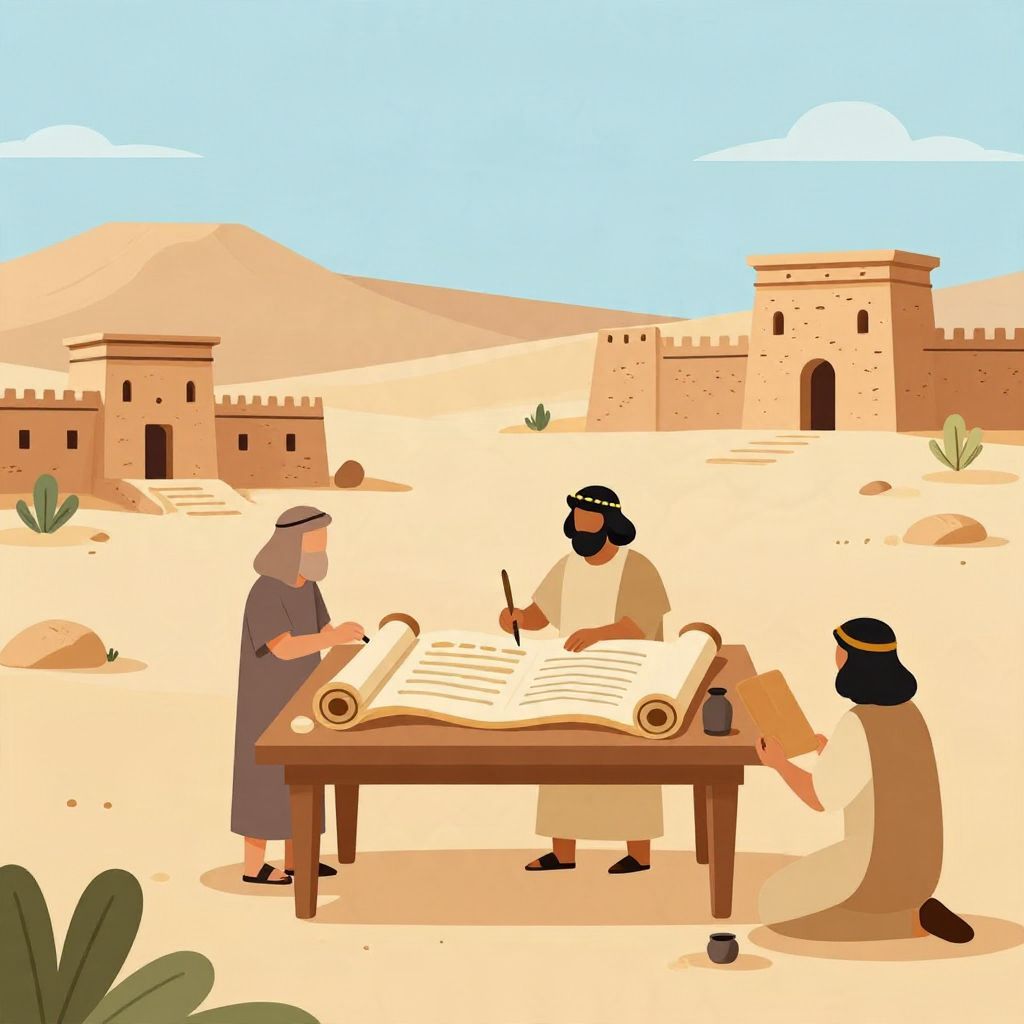
People often ask where the Bible came from because it is both a sacred text and a major historical document. The answer is not a single place or moment. The Bible emerged over many centuries in the ancient Near East, shaped by different communities, languages, and historical crises.
Its books were written, edited, copied, and collected in stages by Jewish and later Christian communities. To understand where the Bible came from, it helps to separate geography, authorship, and canon: the lands where its texts arose, the people who produced them, and the later decisions that formed the Bible as we know it today.
Where Did The Bible Come From?
The Bible came from the ancient Near East, especially the regions of ancient Israel and Judah, later expanded by Jewish communities in exile and the wider eastern Mediterranean. Its earliest texts were composed in Hebrew and Aramaic, with the New Testament written in Greek. The Bible was not produced all at once; it developed over roughly a thousand years.
The Ancient World Behind the Bible
The Bible’s historical setting is the world of the ancient Near East, a region that included modern-day Israel, Palestine, Lebanon, Syria, Jordan, Egypt, and Mesopotamia. This was a crossroads of empires, trade routes, and migrations. The Bible reflects that world through its laws, poetry, royal histories, prophecies, and letters.
Israel, Judah, and the Hebrew Bible
The oldest parts of the Hebrew Bible, also called the Tanakh by Jewish tradition, are associated with the kingdoms of Israel and Judah. These texts grew out of local religious and political life, especially from the monarchic period onward, roughly the 10th to 6th centuries BCE, though many passages likely preserve older oral traditions.
Scholars generally agree that the Bible’s earliest material did not appear in a single archive or city. Instead, it circulated among priests, scribes, prophets, and storytellers in different settings: temples, royal courts, villages, and later exile communities. Jerusalem became especially important because it was the religious center of Judah and the location of the First and Second Temples.
Exile and the shaping of tradition
A major turning point came in the 6th century BCE, when the Babylonian Empire conquered Judah and destroyed Jerusalem in 586 BCE. This catastrophe forced many Judeans into exile. In response, religious leaders and scribes preserved traditions, reinterpreted national history, and emphasized covenant, law, identity, and hope. Many biblical books took shape or were edited in this period and afterward.
The return from exile under Persian rule in the late 6th and 5th centuries BCE helped further organize Jewish religious life. Temple rebuilding, legal traditions, and scribal activity all contributed to the collection and editing of texts that eventually became the Hebrew Bible.
How the Bible Was Written and Collected
The Bible was not written by one author or in one sitting. It is a library of books created over centuries. Different books served different purposes: some told national history, some preserved laws, some offered poetry and wisdom, and others recorded visions, sermons, or letters. Over time, communities decided which writings were authoritative.
Oral tradition before written texts
Long before many biblical books were written down, stories were likely transmitted orally. Oral tradition was common in the ancient world and helped preserve genealogies, heroic tales, laws, and sacred memories. These traditions were later written, revised, and combined with other materials.
This means that the Bible’s origins are both oral and written. A story might begin as a spoken tradition, become a written source, and then be edited into a larger work. That layered process is one reason the Bible sometimes contains repeated episodes, different styles, or overlapping perspectives.
Scribes, editors, and compilation
Scribes played a central role in the Bible’s formation. In the ancient world, scribes were trained writers who copied texts, preserved records, and sometimes edited older material. Biblical books often show signs of compilation rather than single authorship. For example, the Pentateuch, the first five books of the Bible, appears to draw on multiple traditions and editorial layers.
Modern scholarship does not treat the Bible as a simple one-author book. Instead, it sees many texts as the result of long development. That does not make them less important historically; it helps explain why they reflect different time periods, concerns, and literary voices.
What Languages Was the Bible Written In?
The Bible was written mainly in Hebrew, with some portions in Aramaic, and the New Testament in Greek. Hebrew was the principal language of ancient Israelite and Jewish literature. Aramaic became widely used in the Near East during the later first millennium BCE, especially under imperial rule. Greek dominated the eastern Mediterranean after Alexander the Great.
Hebrew in the Hebrew Bible
Most of the Hebrew Bible is in biblical Hebrew, a Northwest Semitic language related to Phoenician and Moabite. This language was used in ancient Judah and Israel and remained important in Jewish religious and literary life long after everyday spoken usage shifted.
Aramaic passages
Some biblical sections are in Aramaic, including parts of Daniel and Ezra. Aramaic became a common administrative and spoken language across the Near East under the Assyrian, Babylonian, and Persian empires. Its presence in the Bible reflects the broader imperial and cultural environment of the time.
Greek and the New Testament
The New Testament was written in Koine Greek, the common Greek of the Hellenistic and Roman periods. Greek was the language of communication across much of the eastern Mediterranean, making it suitable for texts intended for diverse communities. This is one reason the Christian Bible spread so widely beyond Judea.
How the Christian Bible Came Together
For Christians, the Bible includes the Old Testament and the New Testament. The Old Testament corresponds closely to the Jewish scriptures, though its exact contents vary among Jewish, Catholic, Orthodox, and Protestant traditions. The New Testament was written in the first century CE and centers on Jesus and the early Christian movement.
The first-century Christian movement
Jesus lived and taught in Roman-ruled Judea and Galilee, in the early first century CE. After his death, his followers spread his message throughout the Roman Empire. The earliest Christian writings were letters, especially those associated with Paul, written in the 50s CE. The Gospels were composed later, generally between about 70 and 100 CE, though exact dating remains debated.
These texts were written in communities trying to explain Jesus’s significance, preserve teachings, and respond to internal disagreements and external pressures. They were not written as a single coordinated project, but they later became part of one scriptural collection.
Which books were included?
The process of deciding which books belonged in the Christian Bible is called canon formation. This happened gradually. Different Christian communities accepted different books at different times, especially in the case of the Old Testament and a few New Testament writings. By late antiquity, many of the core New Testament books were widely recognized, though the canon was not fixed everywhere at once.
- Hebrew Bible: formed over many centuries in ancient Israel and Judah.
- Old Testament: the Jewish scriptures as received in Christian tradition, with variation by denomination.
- New Testament: first-century Christian writings in Greek.
- Canon: the list of books a religious community regards as authoritative.
Where Was the Bible Put Together?
There is no single “birthplace” of the Bible. Its texts arose in several places: ancient Israel and Judah, Babylon during exile, Persian-period Judea, and later Jewish and Christian communities across the eastern Mediterranean. Jerusalem was especially important for the Hebrew Bible, while cities such as Antioch, Corinth, Ephesus, and Rome mattered for early Christianity.
Some biblical traditions were preserved in priestly circles near the Temple, while others developed among prophets, royal scribes, or diaspora communities living outside the land of Judah. The New Testament likewise emerged from a network of communities rather than one center. This geographic spread is one reason the Bible became so influential across different cultures.
What Is Historical and What Is Traditional?
It is important to distinguish historical evidence from faith claims. Historians can study when texts were written, how they were edited, what languages they used, and how communities received them. Faith traditions, by contrast, may attribute the Bible’s ultimate authority to divine inspiration. That belief is central to religion, but it is not something historical method can prove or disprove.
Likewise, popular ideas about the Bible sometimes simplify its origins. It was not dropped into history fully formed, nor was it invented by one ruler or council. The evidence points to a long process involving many writers, editors, and communities over centuries.
Why the Bible’s Origins Matter
Knowing where the Bible came from helps explain why it contains so many voices, genres, and historical layers. It also shows how ancient people used writing to preserve identity during conquest, exile, and cultural change. The Bible is therefore both a religious text and a record of long historical memory.
Its formation also shaped later history. Jewish and Christian traditions, law, art, literature, and politics were deeply influenced by the Bible’s collection of texts. Understanding its origins makes it easier to see why it has remained central for so many communities across the world.
In short, the Bible came from the ancient Near East, especially ancient Israel and Judah, and was assembled over centuries by Jewish and Christian communities using Hebrew, Aramaic, and Greek. If you want to explore the Bible’s broader background, you may also find what language the Bible was originally written in and what the first religion in the world was useful starting points.