
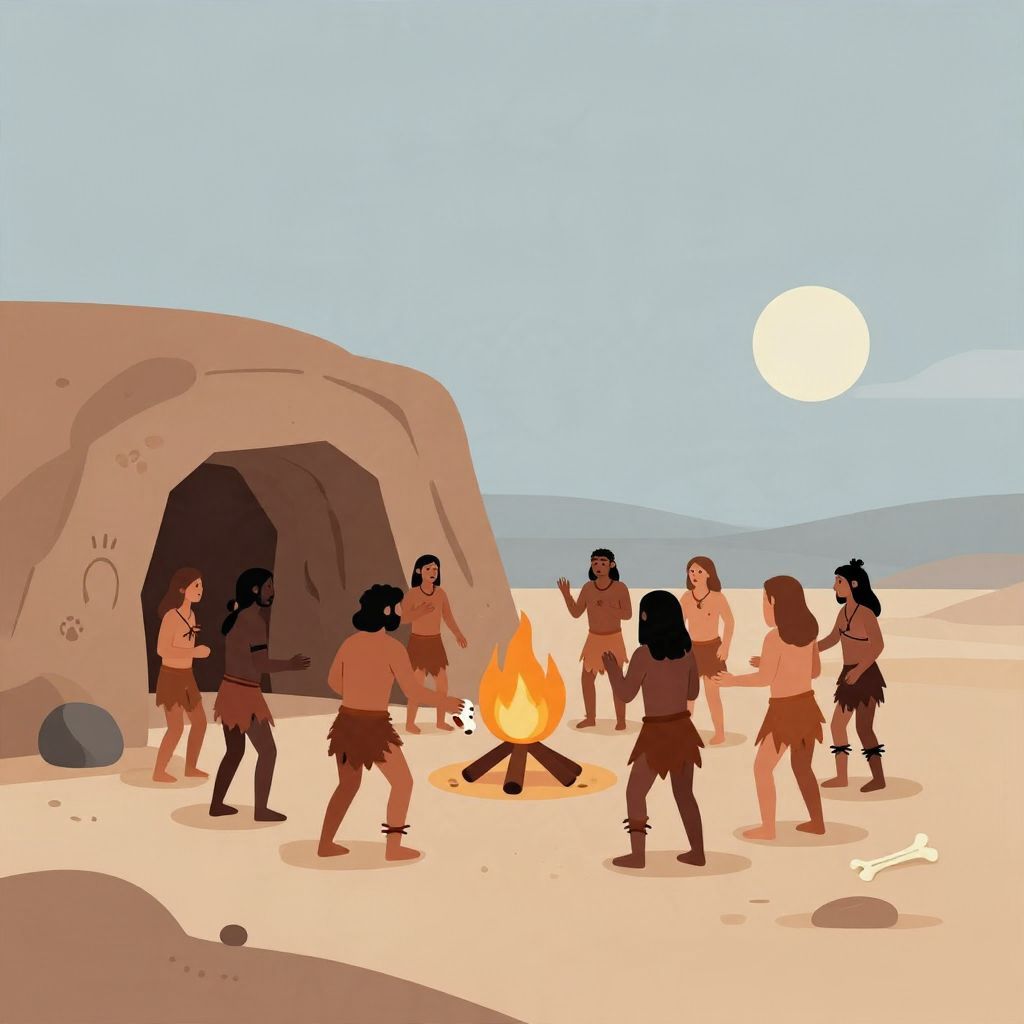
What was the first religion in the world? The honest historical answer is that no single “first religion” can be identified with certainty. Religion likely began long before written records, in prehistoric communities that left behind burials, ritual objects, and signs of belief in spirits, ancestors, or an afterlife.
What historians can say is that the oldest known religions were polytheistic and ritual-based, emerging in the ancient Near East, Egypt, South Asia, and elsewhere as early societies developed agriculture, cities, and writing. The question is less about one starting point than about how human beings first organized sacred ideas.
What Was The First Religion In The World?
There is no universally agreed “first religion” because religion predates writing and probably predates civilization itself. The earliest evidence suggests small prehistoric groups practiced animism, ancestor veneration, and ritual burial. The oldest clearly documented organized religions appear in the ancient world, especially Mesopotamian, Egyptian, and later Vedic traditions.
Why historians cannot name one single first religion
Religion in the deepest sense is older than the historical record. Before writing, people may have believed in spirits, sacred places, or forces tied to animals, ancestors, and nature, but those beliefs rarely leave direct evidence. Archaeology can show ritual behavior, not the full theology behind it.
What counts as a religion?
That question matters. If religion means a formal system with scriptures, priests, temples, and doctrines, then the earliest examples come from ancient civilizations. If religion means any shared sacred belief or ritual, then its origins are much older and far harder to date. Scholars therefore avoid naming a single “first” religion as if it were a documented invention.
Prehistoric belief systems
Long before cities, humans buried their dead with care, used symbolic objects, and sometimes decorated caves with images that may have had ritual meaning. These practices suggest that spiritual thought developed gradually. Many scholars describe these early patterns as animism, the idea that animals, plants, places, or natural events possess spiritual power or presence.
The earliest known religious traditions in recorded history
Once writing appeared, religion becomes easier to study. The oldest recorded traditions were not single-faith systems in the modern sense, but complex mixtures of gods, rituals, myths, and local customs. They were deeply tied to kingship, agriculture, and the order of the cosmos.
Mesopotamian religion
In ancient Mesopotamia, from roughly the 4th millennium BCE onward, city-states worshipped many gods associated with fertility, weather, war, wisdom, and justice. Temples stood at the center of civic life, and priests helped manage offerings and rituals. This is among the earliest clearly documented religious systems in the world.
Ancient Egyptian religion
Ancient Egyptian religion also emerged very early, with evidence from the late 4th millennium BCE and onward. Egyptians believed the gods maintained cosmic balance and that proper ritual preserved harmony between the human world and the divine. Burial customs, pyramids, and tomb texts reflect a strong concern with the afterlife.
The Vedic tradition in South Asia
In South Asia, the Vedic tradition developed from the second millennium BCE, based on hymns later compiled in the Vedas. This tradition emphasized sacrifice, sacred speech, and the authority of ritual specialists. Over time it evolved into what is now broadly called Hinduism, though that modern label covers a long and diverse history.
What the archaeological evidence really shows
Archaeology does not give us a neat birthday for religion, but it does reveal a long history of symbolic and sacred behavior. The evidence points to gradual development rather than a single founding moment. Human beings seem to have created religion as part of their social and imaginative lives.
Burials and the afterlife
Intentional burials are one of the strongest clues. When people place the dead carefully in graves, sometimes with tools, ornaments, or food, it suggests belief that death was not the end. Such practices appear in prehistoric contexts across different regions, though their exact meaning varied widely.
Ritual, art, and sacred space
Cave paintings, figurines, altars, and arranged stone structures may have served ritual purposes. Sites such as Göbekli Tepe, dating to around the 10th millennium BCE, show that large-scale ceremonial activity existed before farming was fully established. That does not prove a single religion, but it does show that organized sacred behavior is very ancient.
How religion likely began
Historians and anthropologists have proposed several explanations for why religion emerged. None is certain on its own, but together they help explain why sacred systems became so widespread in human societies.
- Explaining the unknown: early people used spiritual ideas to make sense of death, weather, illness, and natural forces.
- Social bonding: shared rituals strengthened group identity and cooperation.
- Authority and order: leaders often used religion to legitimize power and organize society.
- Meaning and memory: beliefs about ancestors and the afterlife helped communities preserve continuity across generations.
These functions do not reduce religion to mere utility. They show why sacred traditions could endure and expand. Religion was not simply an add-on to civilization; in many early societies, it helped shape civilization itself.
Was animism the first religion?
Many scholars think animism is the best broad description of the earliest religious outlooks, but it is not a single religion with a founder, scripture, or fixed doctrine. It is a category used to describe spiritual beliefs in which the world is alive with unseen forces or beings. That makes it likely, but not provable, as one of humanity’s oldest religious patterns.
Why animism is hard to document
Because animistic beliefs are often local and flexible, they leave fewer clear traces than later temple-based religions. A burial or figurine may suggest spirit belief, but it cannot tell us exactly what people believed. For that reason, historians treat animism as a plausible early pattern rather than a definitive answer to the “first religion” question.
How the first religions changed over time
As societies grew larger, religion became more formal. Priests, temples, calendars, and sacred texts turned fluid traditions into more organized systems. Gods were linked to cities, rulers, and empires, and myths were written down. This process produced the classical religions of the ancient world.
From local spirits to state religions
Early communities may have honored local ancestors or nature spirits. In urban civilizations, those beliefs were often absorbed into broader pantheons. A city might have one chief deity while still recognizing many others. Religion became more centralized as states needed shared rituals to support political unity.
The rise of ethical and philosophical religion
By the first millennium BCE, some traditions began emphasizing moral conduct, salvation, or liberation in more explicit ways. This period saw important developments in traditions such as Buddhism, Jainism, and later philosophical schools in Greece and elsewhere. These were not the first religions, but they show how religious thought evolved beyond sacrifice and temple worship.
Why “oldest religion” claims are often disputed
Popular discussions often ask which religion is oldest and expect a single answer. But that depends on whether one means the oldest surviving tradition, the oldest written tradition, or the oldest belief system. Different religions can be “oldest” in different senses.
Examples of different meanings
- Oldest belief system: prehistoric spiritual practices, which cannot be named precisely.
- Oldest recorded religion: Mesopotamian and Egyptian traditions among the earliest documented.
- Oldest surviving major tradition: often discussed in relation to Hinduism, though its origins are complex and gradual.
This is why careful historians avoid oversimplified rankings. A tradition may be ancient, but its present form may be much later than its earliest roots.
The historical significance of religion’s beginnings
The origins of religion matter because they reveal something fundamental about human history. Religion helped people explain the world, structure communities, and imagine life beyond death. It became one of the most powerful forces in politics, art, law, and identity.
From prehistoric burials to the temple cities of Mesopotamia and Egypt, the evidence suggests that religion emerged gradually as part of human culture, not as a single invention. So the best answer to “What was the first religion in the world?” is that we do not know one exact first religion, but the earliest known religious behavior was likely prehistoric, animistic, and ritual-based.
If you want to explore the question further, you may also find it useful to read about which religion is the oldest and the historical context around when Buddha was born.