
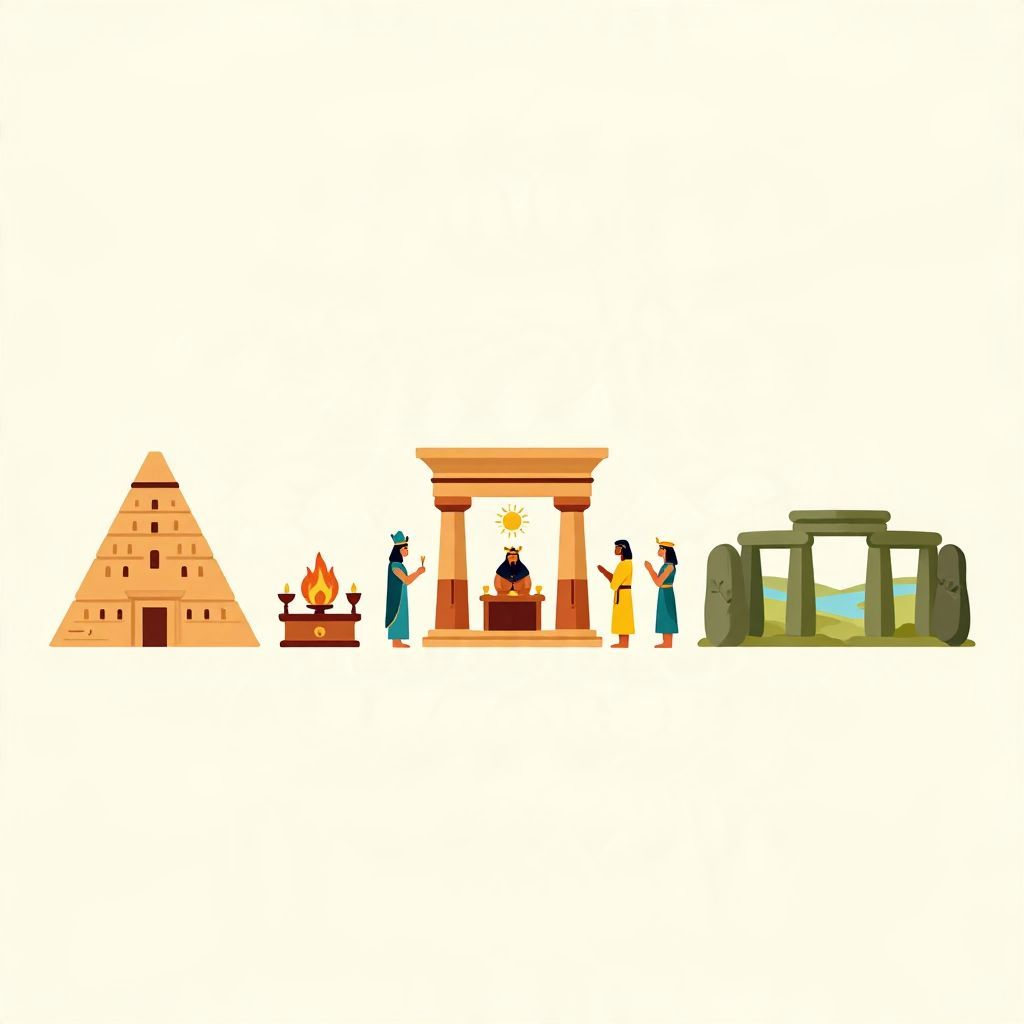
When people ask which religion is the oldest, they are usually looking for a single, simple answer. History is more complicated: religions developed gradually, and the oldest surviving traditions do not have a single founding date.
The answer depends on how “oldest” is defined. If you mean the earliest known religious practices, then prehistoric spirituality is the oldest. If you mean the oldest living organized religion, many scholars point to Hinduism, though its roots stretch across a long and evolving tradition rather than one moment of origin.
Which religion is the oldest?
The oldest religion depends on the definition. The earliest evidence of religion comes from prehistoric burial customs and ritual behavior tens of thousands of years ago, but those beliefs cannot be tied to a named religion. Among surviving major religions, Hinduism is often considered the oldest, with roots in the ancient Vedic traditions of South Asia, roughly from the second millennium BCE.
Why there is no single “oldest religion”
Religion did not begin as a single invention. It emerged gradually as human societies developed language, symbolic thought, burial rituals, sacred spaces, and ideas about spirits, ancestors, and divine powers. Because of that, historians distinguish between religious behavior and organized religions. The first is prehistoric; the second can sometimes be traced through texts, institutions, and communities.
Prehistoric religion: the earliest evidence
Archaeologists have found signs of ritual and symbolic behavior in Paleolithic societies long before written history. These include burials with grave goods, cave art, and possible ritual objects. Such evidence suggests that humans were asking spiritual questions very early, but it does not identify a specific religion in the modern sense.
Written traditions vs. ancient practice
Some religions are old in practice but younger in written form. A tradition may exist for centuries before it is recorded in texts. That is why dating a religion can mean dating its earliest beliefs, its first scriptures, or its first clearly identifiable community. Different answers are possible depending on the criterion used.
Hinduism and the oldest surviving religious tradition
Hinduism is widely regarded as the oldest surviving major religion because it developed from ancient South Asian religious traditions that can be traced back to the Vedic period, roughly 1500–500 BCE. It was not founded by one person and did not begin as a single unified faith; rather, it grew over centuries from many beliefs, rituals, and philosophical schools.
The Vedic roots
The earliest layers of Hindu tradition are associated with the Vedas, a body of sacred texts composed in Sanskrit and transmitted orally for generations before being written down. These texts reflect a ritual culture centered on sacrifice, cosmic order, and divine powers such as Agni, Indra, and Varuna. Over time, later texts and traditions expanded that religious world into the diverse faith known today as Hinduism.
How Hinduism changed over time
Hinduism is not one fixed system. It absorbed local deities, philosophical ideas, devotional movements, and regional practices. Concepts such as karma, dharma, rebirth, and liberation became central in different ways across centuries. This long evolution is one reason historians avoid giving Hinduism a single “founding date.”
Other ancient religions that shaped world history
Several other religions are extremely old and historically important, even if they are not usually labeled the “oldest.” Some are no longer practiced in their original form, while others remain alive today. Their histories overlap with the rise of early states, writing systems, and empires.
Judaism
Judaism is one of the oldest monotheistic religions. Its origins are traditionally linked to the ancient Israelites and the religious traditions of the Levant. The Hebrew Bible preserves memories of early figures and events, but historians treat many of these narratives cautiously because they combine history, theology, and later literary shaping. Judaism took recognizable form over the first millennium BCE.
Zoroastrianism
Zoroastrianism emerged in ancient Iran and is associated with the prophet Zoroaster, whose life is difficult to date precisely. Scholars often place him somewhere between the second and first millennium BCE. The religion became influential in the Persian world and introduced ideas about cosmic struggle, moral choice, and final judgment that affected later religious thought.
Ancient Egyptian religion
Ancient Egyptian religion is among the oldest documented religious systems, with evidence extending back to the early dynastic period, around 3100 BCE and earlier. It was not a single creed but a complex set of local cults, myths, temples, and funerary beliefs. Although it no longer exists as a continuous living religion, it is crucial to the history of religion.
Mesopotamian religions
The religions of Mesopotamia, including Sumerian and Babylonian traditions, are also very ancient. They are known from cuneiform texts, temple records, myths, and rituals dating back to the third millennium BCE. These traditions influenced later Near Eastern religious cultures, including ideas about kingship, sacred law, and divine order.
A simple timeline of the oldest religious developments
Because “oldest religion” can mean different things, it helps to separate broad stages in religious history. The sequence below is approximate, not absolute, and reflects current historical understanding rather than a single origin point.
- Prehistoric era — Ritual behavior, burials, and symbolic practices appear tens of thousands of years ago.
- c. 4000–3000 BCE — Early state religions develop in Mesopotamia and Egypt with temples, priests, and written records.
- c. 1500–500 BCE — Vedic religion develops in South Asia, forming the roots of Hinduism.
- c. 1200–500 BCE — Israelite religion develops, eventually becoming Judaism in recognizable form.
- c. 1200–600 BCE — Zoroastrian traditions emerge in ancient Iran.
- First millennium CE — Major world religions spread across large regions through trade, conquest, preaching, and migration.
Why historians are careful with origin claims
Claims about the “first” religion are often oversimplified. Ancient people did not usually see themselves as inventing a religion from nothing. Instead, they inherited rituals, adapted myths, and reinterpreted older practices. Historical evidence is also uneven: some societies left written records, while others are known only through archaeology.
Myth, legend, and history
Religious traditions often preserve sacred origin stories about prophets, sages, or divine revelations. These stories are historically meaningful, but they are not always the same as verifiable history. A historian may study the development of a tradition without confirming every sacred narrative as literal fact.
Continuity matters
Another reason Hinduism is often called the oldest surviving religion is continuity. Some ancient religions disappeared or transformed so completely that they no longer exist as continuous living traditions. Hinduism, by contrast, has endured and adapted across millennia, even though its beliefs and practices have changed substantially.
Historical significance of the oldest religions
The oldest religions shaped the earliest cities, laws, calendars, art, and political authority. Temples were economic centers as well as sacred spaces. Priests preserved knowledge, and rulers often claimed divine approval. Religious ideas also helped people explain suffering, death, seasons, fertility, and the moral order of society.
Religion and the rise of civilization
In many ancient societies, religion was intertwined with government and daily life. Kings ruled with divine sanction, festivals organized communal time, and sacred texts preserved social values. The history of religion is therefore also the history of how human communities built meaning and authority.
Lasting influence today
Ancient religious traditions continue to shape modern life through ethics, rituals, art, pilgrimage, and identity. Even when a religion changes over time, its oldest layers can still be visible in scripture, ceremony, and philosophy. That long continuity is part of what makes the question so historically interesting.
So, which religion is the oldest?
If you mean the earliest religious behavior, then religion itself is prehistoric and predates written history by many millennia. If you mean the oldest surviving major religion, Hinduism is the most common historical answer, though it developed gradually rather than being founded at one exact moment. Other ancient religions, including Judaism, Zoroastrianism, Egyptian religion, and Mesopotamian traditions, are also extremely old and historically significant.
The best historical answer is therefore nuanced: there is no single oldest religion in a strict sense, but Hinduism is generally regarded as the oldest living organized religious tradition. For related history, you may also want to read about how Islam spread and when Moses was born.