
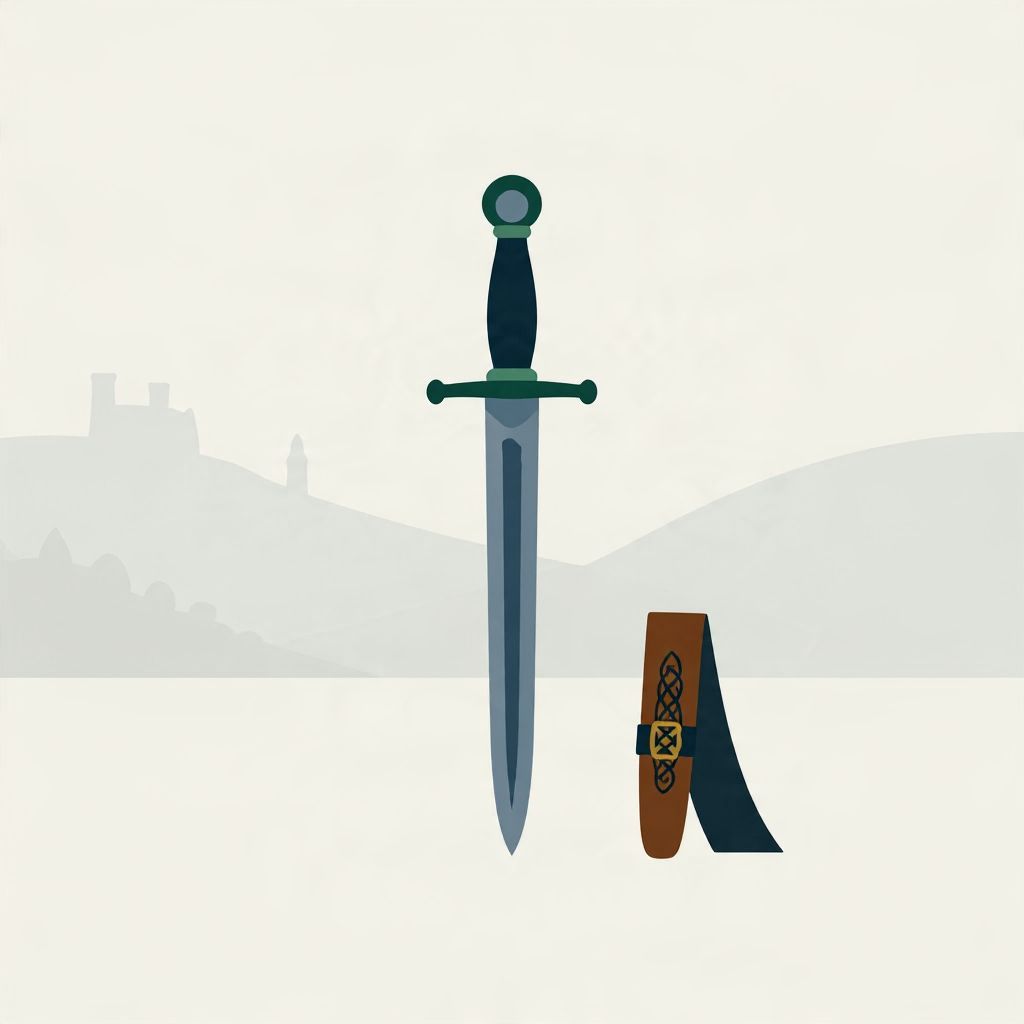
What is a dirk? In historical terms, a dirk is a long thrusting dagger, especially associated with Scotland and with naval or military use in the early modern and modern periods. It was not simply a small knife: the dirk was a sidearm, a status object, and in some settings a practical weapon for close combat.
Its meaning changed over time. The word has been used for different kinds of daggers, but the best-known dirk is the Scottish Highland dirk, which developed from earlier regional blades and became part of Highland dress and identity.
What Is a Dirk?
A dirk is a dagger with a relatively long blade, designed mainly for thrusting rather than cutting. Historically, the term most often refers to the Scottish Highland dirk, a traditional sidearm carried by Highland men from the early modern period onward. It also appears in naval and military contexts, where similar long daggers were used as utility weapons and symbols of rank.
Origins and Meaning of the Word “Dirk”
The word dirk is generally understood as a later English form connected to older Germanic terms for a dagger or short blade, though its exact linguistic path is not perfectly certain. By the 17th and 18th centuries, English writers were using “dirk” for a particular kind of long dagger, especially in Scotland and at sea.
From generic dagger to specific weapon
In older usage, many words for knives and daggers overlapped. “Dirk” did not always mean exactly the same thing in every place or period. Over time, however, it became strongly associated with a long, narrow blade carried at the belt. That association is what gives the dirk its historical identity today.
The Scottish Highland Dirk
The most famous dirk emerged in the Scottish Highlands, where it developed as part of a broader culture of personal arms. It was not invented at one single moment. Instead, it evolved from earlier medieval and early modern daggers and from the practical needs of Highland society, where carrying weapons was common among armed retainers, warriors, and later clan members.
How the Highland dirk developed
By the 17th century, the dirk had become a recognizable Highland sidearm. It typically had a long blade, often around 12 to 20 inches, though sizes varied. Some examples were simple and functional; others were richly decorated with carved hilts, silver mounts, and ornamented scabbards. The dirk was both useful and expressive, signaling status, martial identity, and regional belonging.
Relationship to the broadsword and sgian-dubh
The dirk was usually carried alongside other blades. The Highland broadsword was the principal fighting weapon, while the dirk served as a secondary weapon for close quarters or as a backup if the sword was lost. The smaller sgian-dubh, worn in the stocking, was a utility knife and personal side blade. Together, these weapons formed part of Highland male dress and self-presentation.
What Was a Dirk Used For?
The dirk was designed primarily for thrusting, which made it useful in close combat. Its long, narrow blade could penetrate armor gaps or be used in confined spaces where a sword was unwieldy. In everyday life, however, it could also serve practical purposes such as cutting food, preparing materials, or performing camp tasks. Like many historical weapons, it was both tool and symbol.
Combat role
- Close-range fighting: useful when space was tight or combat became hand-to-hand.
- Backup weapon: carried when a larger sword or firearm was also in use.
- Personal defense: a visible deterrent in a society where armed men were common.
Social and ceremonial role
In Scotland, the dirk gradually took on ceremonial importance. By the 18th and 19th centuries, especially after the decline of traditional Highland warfare, it became a marker of cultural identity. In later Highland dress, the dirk was often worn with formal attire, turning a once-practical weapon into a symbol of heritage.
Dirks in Scottish History
The dirk’s history is closely tied to the political and military changes that transformed the Highlands. During the 17th and early 18th centuries, Highland society was shaped by clan warfare, shifting alliances, and conflict with the centralizing British state. Weapons like the dirk were part of that world.
The Jacobite era
The dirk is often associated with the Jacobite risings of 1715 and 1745, when Highland soldiers fought for the Stuart cause. It is important not to romanticize this too much: not every Highlander was a Jacobite, and not every dirk was used in battle. Still, the weapon became strongly linked in later memory with Highland martial culture and resistance.
After Culloden
After the defeat of the Jacobites at Culloden in 1746, the British government moved to suppress aspects of Highland culture, including weapons bearing and traditional dress. The famous Dress Act restricted Highland clothing for a time, though the details and enforcement varied. In this context, the dirk shifted from a common sidearm toward a more symbolic object, especially as Highland identity was later reimagined in the 19th century.
Dirks in Naval and Military Use
Outside Scotland, “dirk” was also used for long daggers carried by sailors and officers. These were often practical tools as much as weapons. On ships, a dagger could be useful for cutting rope, opening containers, or defending oneself in a fight. Naval dirks also became part of uniform tradition in some forces.
Why sailors carried dirks
Life at sea required versatile equipment, and a dagger was a useful companion to a sailor’s work. Naval dirks could be simpler than Scottish examples, but they shared the same basic idea: a long blade meant for stabbing and utility. In some cases, the dirk became a badge of rank or service rather than a weapon used frequently in action.
What Did a Dirk Look Like?
There was no single standard form, but most dirks shared a few features. They had a long blade, usually straight or only slightly tapering, and a hilt designed for a firm grip. Some Highland dirks had carved wooden handles, while others used antler, bone, or metal fittings. The scabbard was often decorated and could include smaller companion knives.
Common features
- Long blade: longer than an ordinary knife, shorter than a sword.
- Thrusting design: optimized for stabbing rather than slashing.
- Distinctive hilt: often shaped for control and grip.
- Scabbard and fittings: sometimes highly ornamented, especially in ceremonial examples.
Dirk vs. Dagger: Is There a Difference?
In everyday language, a dirk is a kind of dagger, but not every dagger is a dirk. The term usually implies a longer, more specialized blade, especially in Scottish or naval contexts. “Dagger” is the broader category; “dirk” is a more specific historical and cultural form within that category.
Why the distinction matters
Historians and collectors care about the distinction because it helps identify function, period, and cultural setting. A medieval dagger, a Renaissance poniard, a Scottish dirk, and a naval dirk may all be related, but they belong to different traditions. The word “dirk” therefore tells us not just about shape, but about use and identity.
The Dirk in Later Tradition and Popular Culture
By the 19th century, the dirk had become part of romanticized Highland imagery. Writers, artists, and later tourist culture helped turn it into a symbol of Scotland. This was not purely invented, but it was simplified. Real historical dirks varied widely, and the weapon’s role in daily life was more practical and less theatrical than later images sometimes suggest.
A symbol as much as a weapon
Today, the dirk is often seen in ceremonial dress, museums, or historical reenactment. It remains important in Scottish military and cultural traditions, especially in formal Highland attire. Its survival in these settings shows how a weapon can outlive its battlefield purpose and become an emblem of memory, identity, and heritage.
Why the Dirk Matters in History
The dirk matters because it reveals how weapons can carry social meaning beyond combat. It shows the connection between material culture and identity: a blade could be a tool, a sidearm, a sign of rank, and a marker of regional belonging all at once. The dirk also illustrates how historical objects change meaning as societies change around them.
In short, a dirk is a long dagger, best known as a Scottish Highland sidearm, with a history that stretches from practical weapon to cultural symbol. If you want more context on related historical topics, you may also find what a merchant marine was and what political ideology means useful for understanding the wider historical world in which such traditions developed.