
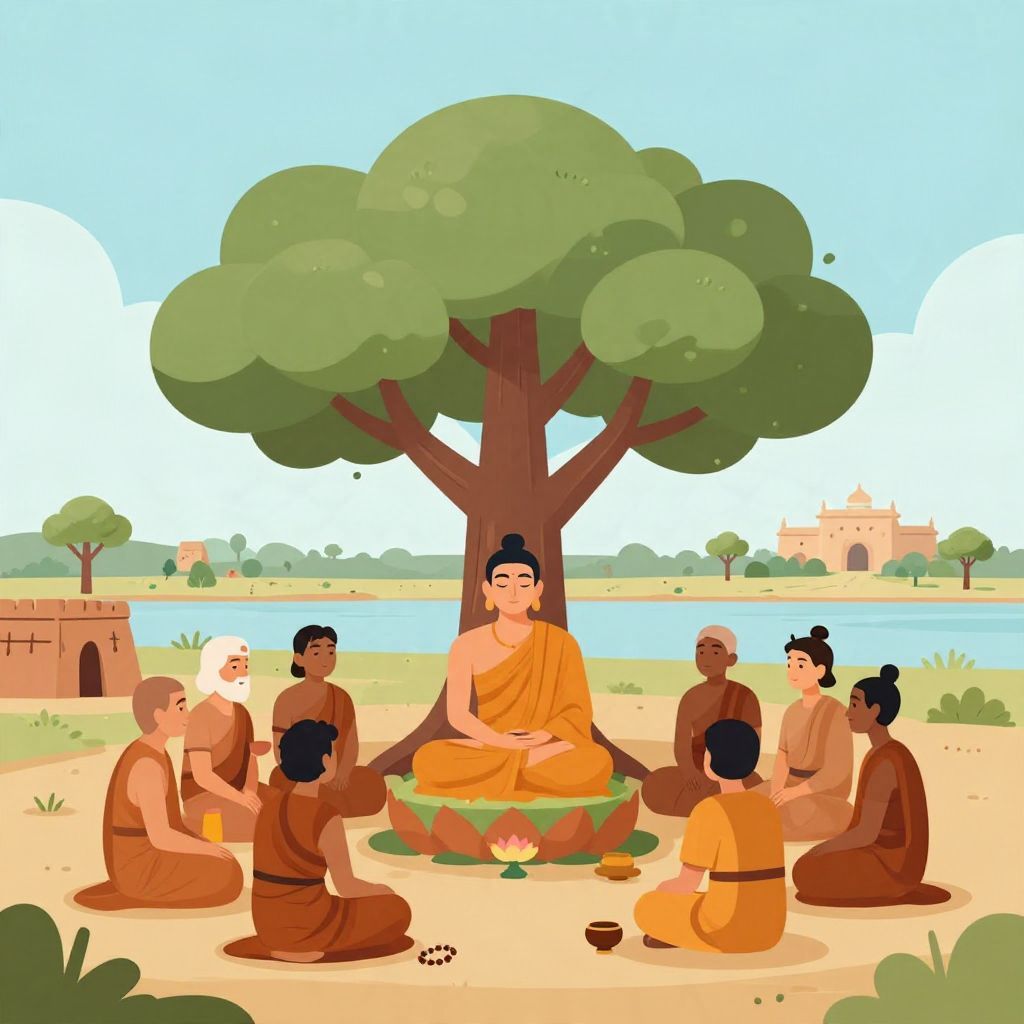
When was Buddha born? The short answer is that historians generally place the birth of Siddhartha Gautama, the Buddha, in the 5th or early 4th century BCE, though the exact year is disputed. Traditional Buddhist sources give different dates, and modern scholarship usually treats his lifetime as approximate rather than certain.
What is clear is that the Buddha lived in ancient northern India, in the region of the Shakya republic near present-day Nepal and India. His life and teachings later shaped Buddhism, one of the world’s major religions, but the historical details of his birth come from traditions written down long after his death.
When was Buddha born?
Most historians date the Buddha’s birth to roughly c. 563 BCE to c. 480 BCE, though some scholarship places him later, around c. 480 BCE to c. 400 BCE. The uncertainty comes from the fact that no contemporary birth record survives, and Buddhist traditions preserve different chronologies.
Why the date is uncertain
The Buddha did not leave behind inscriptions or documents from his own lifetime. Instead, later Buddhist communities preserved accounts of his life in oral tradition and in texts compiled centuries afterward. These sources are valuable, but they are not precise historical records in the modern sense.
Different Buddhist traditions also counted years differently, especially when linking the Buddha’s life to kings, dynasties, and later religious calendars. As a result, historians work backward from later evidence and compare traditions rather than relying on a single fixed date.
The most commonly cited traditional date
In many older popular accounts, the Buddha is said to have been born around 563 BCE and died around 483 BCE. This timeline became widely repeated in modern writing, but many scholars now regard it as too early. A later chronology is often considered more plausible.
What do historians think today?
Modern historians usually agree on a broad range rather than a single year. The Buddha probably lived for about 80 years, but whether he was born in the mid-6th century BCE or the late 5th century BCE remains debated. The safest answer is that he was born sometime between the 6th and 5th centuries BCE.
The debate matters because it affects how scholars reconstruct the early history of Buddhism and its relationship to other movements in ancient India. Even so, the exact year of his birth is less important historically than the broader setting in which his teachings emerged.
Two major chronological models
- Earlier chronology: Birth around 563 BCE, death around 483 BCE.
- Later chronology: Birth around 480 BCE, death around 400 BCE.
The later chronology has gained support in much modern scholarship because it fits better with certain historical and archaeological benchmarks. Still, not all historians agree, and the evidence does not allow a final, universally accepted date.
Where was Buddha born?
Tradition places the Buddha’s birth in Lumbini, in the foothills of the Himalayas, near the border of present-day Nepal and India. This location is strongly associated with Buddhist memory and pilgrimage, and it is widely accepted as the traditional birthplace.
The Buddha was born as Siddhartha Gautama into the Shakya clan, a small political community in the ancient Ganges plain. His father is traditionally named Śuddhodana, and his mother Queen Maya. The family was part of a ruling elite, though not of a large empire or kingdom in the later sense.
How the birthplace became part of Buddhist history
Lumbini became important not only because of the Buddha’s birth but also because later rulers and pilgrims identified it as a sacred site. The most famous early material evidence is the Ashoka pillar, associated with Emperor Ashoka in the 3rd century BCE, which helped confirm the site’s long-standing religious significance.
Timeline of the Buddha’s early life
The Buddha’s early life is known through a mix of tradition, biography, and later religious storytelling. Some details are symbolic, but the broad outline is consistent across many sources.
- Birth at Lumbini: Siddhartha Gautama is born into the Shakya clan.
- Royal upbringing: He grows up in relative privilege and receives an elite education.
- Encounter with suffering: Traditions describe his exposure to sickness, old age, death, and renunciation.
- Leaving home: He abandons household life in search of liberation from suffering.
- Enlightenment: After years of ascetic practice, he attains awakening and becomes the Buddha, “the Awakened One.”
These events belong to religious biography, but they also reflect a real historical setting: a period of social change, urban growth, and philosophical experimentation in northern India.
The historical world into which Buddha was born
Buddha’s birth took place in a time of significant transformation. Northern India was moving from small clan-based polities toward larger states, while new ideas about ritual, ethics, and personal liberation were circulating among religious teachers.
This was the age of the Second Urbanization, when towns, trade routes, and political competition helped create conditions for new intellectual movements. Buddhism emerged alongside other traditions, including Jainism and various schools of Brahmanical thought.
Why this context matters
The Buddha’s teachings did not appear in isolation. Questions about suffering, rebirth, karma, and liberation were already being debated. His historical importance lies partly in how he reinterpreted these concerns and offered a path centered on ethical conduct, meditation, and insight.
What sources tell us about Buddha’s birth?
The main sources for Buddha’s life are later Buddhist texts, including biographies, monastic traditions, and collections of sayings. These sources preserve important historical memory, but they also include miracle stories and devotional elements that should not be read literally without caution.
Historical evidence versus devotional tradition
- Historical evidence: The Buddha likely existed as a teacher in ancient northern India, and Buddhism developed from his teachings and early disciples.
- Traditional biography: Accounts of his miraculous conception, extraordinary birth signs, and prophetic predictions belong to religious tradition.
- Scholarly reconstruction: Historians compare texts, inscriptions, and archaeological evidence to estimate his lifetime.
This distinction is important. It is historically reasonable to say the Buddha was born in ancient India and lived sometime between the 6th and 5th centuries BCE. It is not historically certain to say exactly which year or to treat every later story as literal fact.
How Buddha’s birth date affects Buddhist history
Pinning down the Buddha’s birth date helps historians understand the early spread of Buddhism, the formation of monastic communities, and the chronology of major Buddhist councils and rulers. But the religion’s development did not depend on one exact birthday.
Instead, Buddhism grew through teaching, patronage, travel, and institutional organization over generations. The Buddha’s life became the starting point for a much larger historical process that eventually spread across South Asia and far beyond.
Lasting significance of the birth tradition
For Buddhists, the Buddha’s birth is not merely a historical question. It is also a moment of sacred memory, celebrated in many traditions as part of the Buddha’s life story. The historical uncertainty does not reduce its religious importance; it simply means historians approach the date with caution.
So, when was Buddha born?
The most accurate historical answer is that Buddha was probably born sometime in the 6th or 5th century BCE, with many scholars favoring a date around 480 BCE rather than the older traditional date of 563 BCE. The exact year cannot be proven with certainty.
What can be said confidently is that Siddhartha Gautama was born in ancient northern India, likely at Lumbini, and that his life set in motion a religious tradition that would shape Asian history for more than two millennia. If you want to compare other foundational birth traditions, you may also find When Was Abraham Born and When Was Moses Born useful for historical context.