
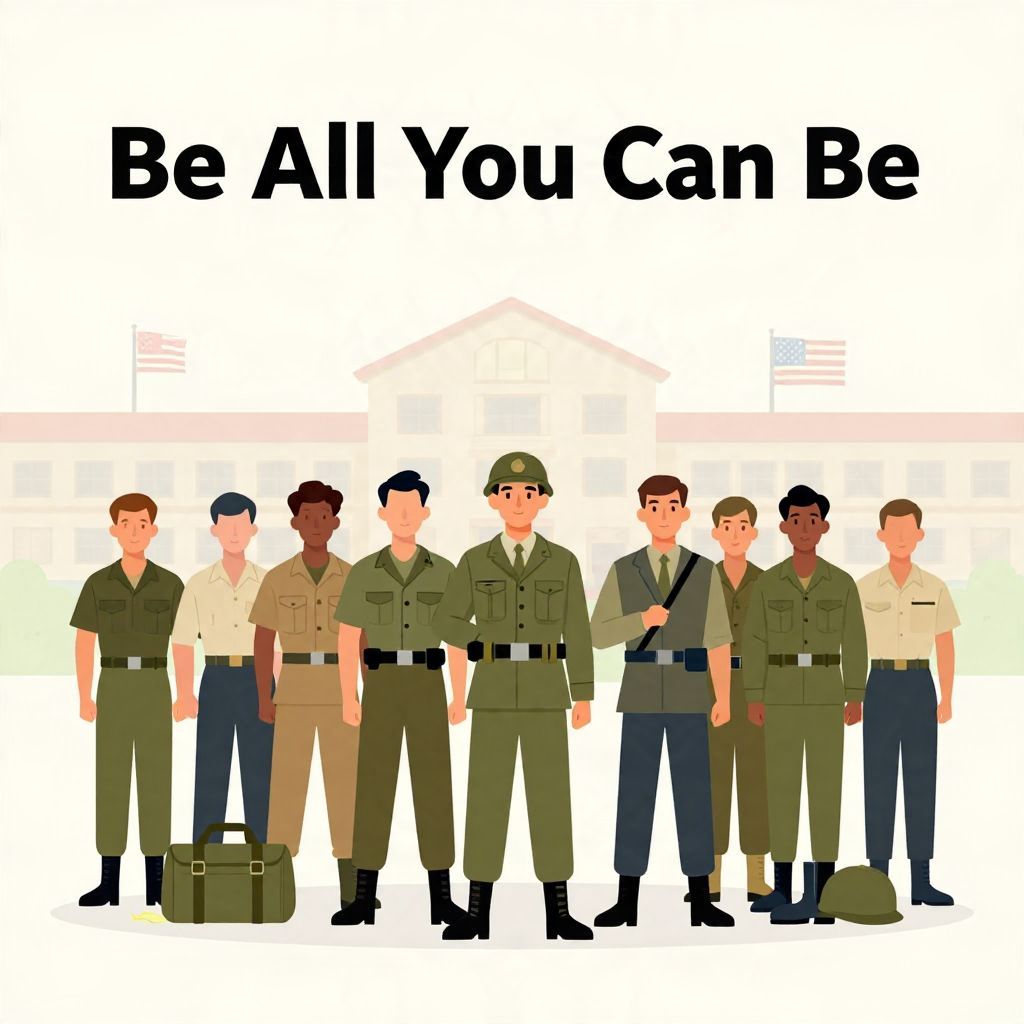
The phrase “Be All You Can Be” is one of the most recognizable slogans in modern American military history. Most people associate it with the U.S. Army, but its meaning goes beyond advertising: it reflected a broader effort to present military service as a path to self-improvement, opportunity, and personal achievement.
Its history reveals how the Army adapted to changing social attitudes after the draft era, how it recruited volunteers in a competitive labor market, and how a short slogan became part of American popular culture for decades.
What does “Be All You Can Be” mean, and where did it come from?
“Be All You Can Be” was the U.S. Army’s long-running recruiting slogan, introduced in 1980 and used prominently until 2001. It was designed to appeal to young Americans by framing Army service as a way to gain education, discipline, skills, and purpose. The slogan emerged after the end of the draft, when the Army had to persuade volunteers to enlist in a highly competitive environment.
The historical origins of the slogan
The slogan did not appear in a vacuum. It was created during a period of major change in American military recruitment. The United States had ended the draft in 1973, shifting the armed forces to an all-volunteer model. That change forced the Army to compete for recruits with colleges, employers, and other branches of the military.
By the late 1970s, the Army faced serious recruiting and retention problems. Public confidence in the military had been damaged by the Vietnam War, and many young people were skeptical of military life. The Army needed a message that was less about duty alone and more about personal growth, opportunity, and modern professionalism.
“Be All You Can Be” answered that need. It suggested that enlistment was not simply sacrifice; it was also a chance to develop one’s character and future. The slogan fit the era’s language of self-fulfillment, while still serving a traditional military purpose.
Why the Army chose this message
- To attract volunteers after the end of conscription
- To improve the Army’s public image after Vietnam
- To emphasize training, education, and advancement
- To make military service sound compatible with personal ambition
How the slogan fit the all-volunteer Army
The all-volunteer force was one of the most important military transformations in modern U.S. history. Once the draft ended, the Army could no longer rely on compulsory service. It had to market itself like an employer and a training institution. “Be All You Can Be” became the public face of that strategy.
The slogan worked because it was broad. It did not promise wealth or glory. Instead, it implied that the Army could help a recruit become stronger, more capable, and more disciplined. That message appealed to people looking for structure, job training, or a way forward after high school.
In practice, the slogan supported a recruiting system built around benefits such as technical training, educational assistance, and career advancement. The Army was not only selling patriotism; it was selling a future.
What the slogan emphasized
- Personal development
- Leadership and responsibility
- Technical and vocational skills
- Opportunity for advancement
- A sense of belonging and purpose
Timeline: the rise and evolution of “Be All You Can Be”
The slogan’s history can be understood through a simple chronology:
- 1973 — The U.S. ends the draft and moves to an all-volunteer military.
- Late 1970s — The Army struggles with recruitment and public image.
- 1980 — “Be All You Can Be” is introduced as the Army’s recruiting slogan.
- 1980s–1990s — The slogan becomes widely known through television, print, and other advertising.
- 1991 — The Gulf War helps renew public attention to the military, though the slogan remains fundamentally a recruiting message.
- 2001 — The Army replaces it with “An Army of One.”
- 2006 — The Army later returns to “Be All You Can Be,” showing the slogan’s lasting appeal.
This timeline matters because it shows that the slogan was not just a piece of marketing. It was tied to the Army’s changing identity in the post-draft era. Its long use also suggests that it resonated with both recruits and the broader public.
Why the slogan became so effective
“Be All You Can Be” succeeded because it was flexible and emotionally appealing. Unlike slogans that focus narrowly on combat or patriotism, it could speak to many different motivations. A recruit might hear a promise of education, adventure, discipline, financial stability, or a fresh start.
The phrase also had a distinctly American sound. It echoed the idea that individuals can improve themselves through effort and opportunity. That made it especially effective in a society where military service had to compete with civilian paths to success.
At the same time, the slogan reflected the Army’s own institutional needs. The service wanted recruits who would stay, train, and advance. A slogan about becoming your best self fit that objective neatly.
Reasons it connected with audiences
- It was short and easy to remember
- It sounded optimistic rather than coercive
- It matched the values of self-improvement and upward mobility
- It could be adapted to different campaigns and media formats
Historical significance beyond advertising
Although it was a recruiting slogan, “Be All You Can Be” is historically significant because it captures a major shift in American military culture. Earlier military appeals often emphasized duty, sacrifice, and national service. This slogan added another layer: self-development.
That change reflected broader social developments in the late twentieth century. Americans increasingly expected institutions to offer personal benefits as well as collective purpose. The Army responded by presenting itself not only as a fighting force but also as a place to learn, grow, and build a career.
The slogan also illustrates how language can shape public understanding of military service. It helped normalize the idea that enlistment could be a practical life choice, not just a patriotic obligation. In that sense, it influenced how a generation thought about the Army and about service itself.
Its place in U.S. military history
- It marked the post-draft recruiting era
- It helped define the Army’s public image for more than two decades
- It showed how military institutions adapted to consumer-style advertising
- It remains one of the best-known slogans in American institutional history
How it compares with later Army slogans
The replacement of “Be All You Can Be” in 2001 with “An Army of One” showed that the Army continued to experiment with its message. That newer slogan tried to emphasize individuality and modern professionalism, but it was often criticized for sounding too individualistic for a collective military institution.
The later return to “Be All You Can Be” in 2006 is telling. It suggests that the older slogan had a stronger emotional balance: it combined personal aspiration with service to something larger than oneself. The Army appears to have recognized that recruits responded better to a message of growth than to one that sounded purely individualistic.
This back-and-forth also shows that recruiting slogans are not trivial. They reflect real debates about what military service means and how an institution should present itself to the public.
Common misconceptions about “Be All You Can Be”
One common misconception is that the slogan was simply a catchy phrase with no deeper meaning. In fact, it was part of a major institutional response to the end of conscription and the challenges of the volunteer era.
Another misconception is that it was only about combat readiness. While military training was central, the slogan deliberately highlighted broader themes such as education, leadership, and career development. Its power came from that wider promise.
It is also worth noting that the slogan should not be treated as a literal historical claim about every recruit’s experience. Like most advertising, it presented an idealized message. The actual Army experience varied widely depending on occupation, era, rank, and circumstance.
Lasting legacy of the slogan
Decades after its introduction, “Be All You Can Be” remains memorable because it captured a specific historical moment with unusual clarity. It reflected the transition from the draft army to the volunteer army, the rise of modern recruitment advertising, and the growing importance of personal advancement in public messaging.
Its endurance also shows that slogans can become historical artifacts. They are brief, but they preserve the values and anxieties of the time that produced them. In this case, the slogan tells us as much about late twentieth-century America as it does about the Army itself.
In historical terms, “Be All You Can Be” was more than a recruiting line: it was a statement about opportunity, service, and the changing relationship between citizens and the military. If you’re interested in how public messaging shapes history, you may also enjoy the history behind “Failure Is Not an Option” and how Martin Luther King Jr. changed the world.