
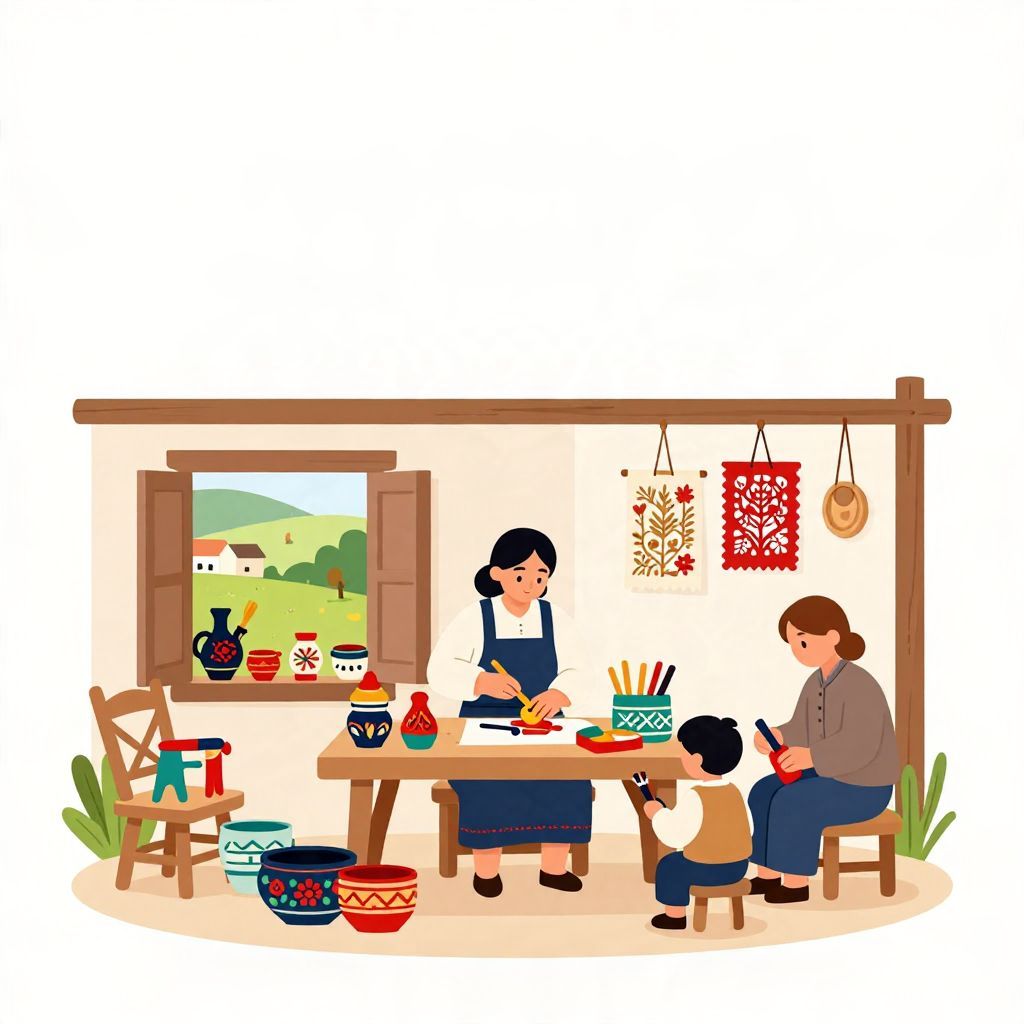
What is folk art? At its simplest, folk art is art created within everyday communities rather than in elite academies or formal art markets. It usually reflects local traditions, shared beliefs, practical life, and inherited skills passed across generations.
Because the term has changed over time, folk art is best understood as both a historical category and a living cultural practice. It can include painting, carving, textiles, pottery, music-related objects, decoration, and household items shaped by community memory as much as by individual creativity.
What Is Folk Art?
Folk art is art made by or for ordinary people, often outside formal training and professional institutions. It typically grows from local customs, regional materials, and communal traditions. Rather than aiming at elite taste, folk art usually serves daily life, ceremony, identity, memory, or practical use.
The Origins of Folk Art
Folk art did not begin at one single moment. People have decorated tools, homes, clothing, and ritual objects since ancient times. The idea of “folk art,” however, is much newer. It emerged as a modern term in the 19th and early 20th centuries, when scholars, collectors, and museum curators began separating rural or popular traditions from academic “fine art.”
From everyday craft to historical category
Before the modern era, the distinction between art and craft was often less rigid than it is today. A carved wooden chest, painted ceramic bowl, embroidered garment, or festival mask could be both useful and beautiful. The label “folk art” was later applied to such works when observers wanted to identify art rooted in community tradition rather than elite training.
Why the term became popular
In the 19th century, industrialization, urbanization, and nationalism changed how people thought about culture. Many intellectuals began to value rural customs as a source of national identity. At the same time, museums and collectors sought objects they believed represented “authentic” local life. This interest helped define folk art as something traditional, handmade, and culturally distinctive.
What Counts as Folk Art?
There is no single universal list, but folk art often includes objects made in traditional styles for domestic, religious, ceremonial, or communal use. The category is broad and sometimes debated, because different societies classify art, craft, and design in different ways.
Common forms of folk art
- Textiles such as embroidery, quilting, weaving, and dyeing
- Pottery and ceramics made with regional shapes, glazes, or painted motifs
- Woodwork including carving, furniture, toys, and architectural decoration
- Painting and drawing on paper, walls, signs, or household objects
- Metalwork and ornament used in tools, jewelry, or ritual items
- Festival and religious objects such as masks, altarpieces, banners, and figurines
How folk art differs from fine art
Fine art is usually associated with formal training, galleries, individual authorship, and critical theory. Folk art is more often linked to inherited practice, local use, and community meaning. That said, the boundary is not absolute. Many artists move between folk, craft, and fine-art traditions, and some works are valued in more than one category.
Historical Development of Folk Art
The history of folk art is tied to the history of communities themselves. Its forms changed as people migrated, traded, worshipped, and adapted to new materials and social conditions. What we call folk art today often preserves older visual habits even when the objects themselves are relatively recent.
Pre-modern roots
In pre-industrial societies, most visual production was local and handmade. Villagers, artisans, and household makers produced objects for use in farming, trade, religion, and family life. Many of these works were anonymous, not because their makers lacked skill, but because communal function mattered more than individual fame.
18th and 19th centuries: collecting and classification
As museums, academies, and ethnographic collections expanded in Europe and North America, scholars began to document regional traditions. Some collectors admired folk art as evidence of national character or “popular genius.” Others treated it as material culture from the past, something to preserve before industrial production displaced it. This period shaped the modern meaning of the term.
20th century: revival, nationalism, and tourism
In the 20th century, folk art was often revived or reinterpreted for national identity, heritage preservation, and tourism. Governments, cultural institutions, and local communities promoted traditional crafts as symbols of continuity. At the same time, market demand sometimes changed the objects themselves, encouraging makers to produce items for sale rather than for original domestic or ritual use.
Why Folk Art Matters Historically
Folk art is important because it reveals how ordinary people expressed identity, belief, and skill in everyday life. It helps historians study communities that left few written records and shows how traditions survive through practice rather than formal institutions. Folk art can also reveal changes in trade, religion, migration, and technology.
A record of local life
Unlike court art or state monuments, folk art often reflects the concerns of households and neighborhoods. A painted chest might show marriage customs; a quilt might preserve family memory; a decorated shrine might reveal local religious devotion. These objects are historical evidence, but they must be interpreted carefully, since meanings can shift over time.
Identity and continuity
Folk art often carries regional or ethnic identity. Patterns, colors, motifs, and techniques may signal belonging to a village, religious group, language community, or diaspora. In this sense, folk art is not just decorative. It is a way communities remember who they are and how they want to be seen.
Folk Art Around the World
Folk art exists in every region, but its forms vary widely. The term is global, yet it should not be used as if all traditions are the same. What one society calls folk art, another may call craft, heritage, ritual practice, or simply art.
Europe
European folk art includes painted furniture, wood carving, embroidery, ceramics, and festival traditions. Many of these forms were shaped by village life, religious calendars, and local guild practices. In the 19th century, they were often collected as symbols of rural national culture.
The Americas
In the Americas, folk art reflects Indigenous traditions, colonial encounters, African diasporic creativity, and immigrant communities. Examples include carved figures, devotional art, textiles, pottery, and painted domestic objects. In many places, folk art developed through cultural exchange and adaptation rather than isolation.
Asia, Africa, and the Middle East
Across Asia, Africa, and the Middle East, handmade traditions have long shaped domestic, religious, and ceremonial life. Examples include painted scrolls, calligraphy-based decoration, woven cloth, beadwork, masks, ceramics, and wooden architecture. These traditions are often deeply tied to ritual and social status, and they may not fit neatly into Western museum categories.
Folk Art, Craft, and Popular Culture
Folk art overlaps with craft and popular culture, but the terms are not identical. Craft usually emphasizes skill and utility. Popular culture often refers to mass-produced or widely shared styles. Folk art sits somewhere in between: it is typically handmade, rooted in tradition, and shaped by communal rather than purely commercial values.
Why the boundaries are debated
Historians and curators debate these labels because they can reflect power as much as description. Calling something “folk” may honor tradition, but it can also imply that the makers are outside the main story of art history. For that reason, modern scholarship often pays closer attention to the makers themselves and the social worlds in which they worked.
How Folk Art Changes Over Time
Folk art is not frozen in the past. Traditions evolve when people adopt new materials, respond to markets, or adapt inherited forms to new circumstances. A design may remain recognizable even as its meaning, purpose, or audience changes.
Adaptation rather than disappearance
Industrialization did not simply destroy folk art. In many places, it altered it. Makers began using factory-made pigments, new tools, or commercial fabrics while preserving older patterns and techniques. Some traditions declined, but others survived by becoming part of heritage festivals, tourist markets, or revival movements.
Contemporary folk art
Today, folk art can be found in community workshops, religious celebrations, street markets, and digital spaces. Some artists consciously preserve inherited forms; others blend old and new styles. Contemporary folk art may address migration, memory, politics, or identity while still drawing on local tradition.
How Historians Study Folk Art
Historians study folk art through objects, oral histories, archives, photographs, and community knowledge. Because many works were not signed or formally documented, interpretation often depends on context: where the object was made, how it was used, who made it, and how traditions were transmitted.
What evidence can and cannot show
Folk art can reveal patterns of daily life, but it does not speak for itself. A motif may have religious meaning in one setting and decorative meaning in another. A museum label may simplify a tradition that was more complex in practice. Careful historical study therefore combines material evidence with local testimony and broader social history.
So, What Is Folk Art in Historical Terms?
Historically, folk art is the handmade visual and material expression of everyday communities, especially traditions passed through family, neighborhood, or regional practice rather than formal art schools. The term itself is modern, but the practices behind it are old. Folk art matters because it preserves how ordinary people shaped beauty, identity, and meaning in daily life.
Seen this way, folk art is not a lesser form of art; it is a different historical tradition with its own values, audiences, and purposes. If you want to explore how culture is preserved through objects and traditions, see what cultural preservation means in architecture and how political ideology shapes public life.