
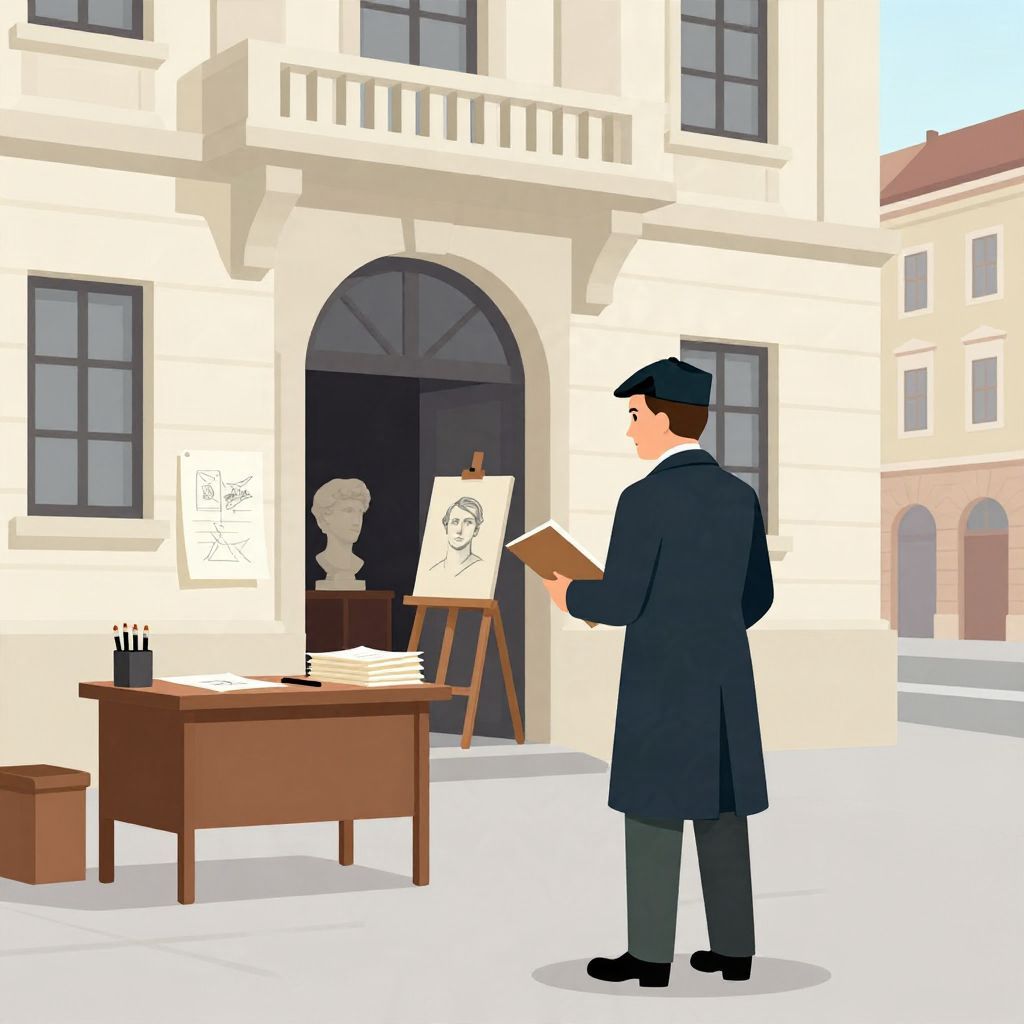
Why was Hitler rejected from art school? The short answer is that his work did not meet the standards of the Vienna Academy of Fine Arts, especially in figure drawing and composition. He applied twice, in 1907 and 1908, and was turned away both times after examiners judged his artistic ability insufficient for admission.
The rejection mattered because it helped shape the direction of his life in Vienna, where he drifted into poverty, frustration, and political radicalization. The story has often been simplified into a neat explanation for later events, but the historical record shows a more complicated mix of artistic weakness, institutional judgment, and personal failure.
Why Was Hitler Rejected From Art School?
Hitler was rejected because the Academy of Fine Arts in Vienna believed he lacked the technical skill required for serious art training. His surviving application drawings suggest competence in architectural subjects and buildings, but weakness in human figures, perspective, and creative composition. In 1907 and again in 1908, the academy concluded that he was not ready for admission.
What Happened in 1907 and 1908?
Hitler arrived in Vienna as a young man hoping to become a professional artist. He had left Linz and believed he had talent, especially for drawing buildings and city scenes. In 1907 he sat for the entrance examination at the Academy of Fine Arts and was rejected. He tried again in 1908 and was rejected once more, this time after a brief review that confirmed the earlier judgment.
The first rejection
In 1907, the academy’s examiners reportedly found that Hitler’s submitted work did not show enough ability in the required areas, particularly figure drawing. Entrance to the academy was competitive, and applicants were expected to demonstrate broad artistic competence, not just an eye for architecture or detail.
The second rejection
After the first failure, Hitler tried again the next year. By then, the academy had little reason to change its assessment. He was again judged unqualified, and this second rejection effectively closed off his hoped-for path into formal art education.
What Did the Academy Want?
The Vienna Academy of Fine Arts was not looking for hobbyists or students with narrow strengths. It wanted applicants who could draw the human body accurately, understand proportion, and show imaginative control over composition. Hitler’s surviving drawings indicate that he had some ability, but not the full range expected of successful candidates.
Figure drawing was the key weakness
One of the most important skills in academic art training was drawing people. This was essential because artists were expected to paint historical scenes, religious subjects, and portraits. Hitler’s work is often described by historians and art critics as better at buildings than at people, which likely hurt his chances.
Architectural interest, not fine art mastery
Hitler was especially drawn to architecture. He liked rendering facades, streets, and urban structures. That interest was real, but it did not amount to the broader artistic skill set the academy demanded. In practical terms, he may have been more suited to architectural drafting than to fine-art painting.
Was Hitler Actually Talented?
Historically, the answer is mixed. He was not untalented in every respect, but he was not strong enough to succeed at a top art academy. Some of his watercolors and sketches show patience and attention to detail. Yet many experts judge them as technically limited, especially when compared with the work of applicants who were admitted.
What the surviving artwork suggests
Hitler’s surviving pieces are mostly small-scale works of buildings, streets, and postcard-like scenes. They are neat and sometimes commercially appealing, but they often lack vitality in human subjects and show weak spatial handling. That helps explain why examiners did not see him as ready for advanced training.
Why later myths can mislead
Because Hitler later became one of history’s most destructive political leaders, people sometimes search for a dramatic artistic “what if.” That can lead to exaggerated claims that he was a misunderstood genius. The evidence does not support that. He was a disappointed applicant whose work fell short of institutional standards.
How Did His Background Shape the Rejection?
Hitler’s early life helps explain why he pursued art and why rejection hit him hard. He had a difficult relationship with authority, experienced family loss, and struggled to find a stable direction after moving to Vienna. The art-school failure did not create his later politics by itself, but it did deepen a period of uncertainty and resentment.
Vienna as a difficult environment
Vienna in the early 1900s was a large imperial city with sharp social divisions. It offered cultural opportunity, but also intense competition. A young man without steady income or credentials could fall into hardship quickly. After the rejection, Hitler lived precariously and spent years in poverty before the First World War changed his life.
Not a single cause, but part of a larger pattern
Historians generally avoid treating the art-school rejection as the direct cause of Hitler’s later rise. It was one episode among many. Still, it mattered because it confirmed his exclusion from the artistic world he wanted to enter and may have reinforced his sense of grievance and self-justification.
Did the Rejection Turn Him Toward Politics?
Not immediately, and not in a simple straight line. After the rejection, Hitler did not instantly become a political extremist. He remained in Vienna, struggled to survive, and only gradually absorbed the nationalist, antisemitic, and populist ideas circulating in the city and later in Germany. The failure at art school was a setback, not a political conversion on its own.
The long road from failure to radicalization
His political development came through a combination of personal frustration, ideological exposure, wartime experience, and postwar turmoil. The art-school rejection belongs in that story because it left him outside the professional path he wanted, but it should not be treated as the sole explanation for Nazism or the Holocaust.
What Do Historians Say About the Rejection?
Most historians agree on the basic facts: Hitler applied to the Vienna Academy of Fine Arts, was rejected in 1907 and 1908, and was judged inadequate for admission. Where interpretation differs is in how much importance to give the event. Some see it as a revealing early disappointment; others caution against overstating its significance in explaining later history.
Evidence versus speculation
The evidence supports the rejection itself and the general reasons for it. What cannot be proven is a dramatic psychological chain from that moment to his later dictatorship. It is reasonable to say the failure contributed to his sense of frustration, but not to claim it determined his entire future.
Why the Story Still Matters
The question remains popular because it connects a famous historical figure to an apparently ordinary turning point. People are drawn to the idea that history might have changed if one institution had admitted him. But the deeper lesson is less about destiny than about contingency: many people face rejection, yet only a few go on to shape history in catastrophic ways.
A caution against oversimplification
Hitler’s rejection from art school is best understood as a real but limited event. It reveals something about his ambitions, his abilities, and the frustrations of his early adult life. It does not, by itself, explain his later ideology, his rise to power, or the crimes of the Nazi regime.
In the end, Hitler was rejected from art school because the Vienna Academy judged his work insufficient, especially in figure drawing and composition. The episode mattered because it blocked one possible career and contributed to a difficult period in his life, but it should be seen as one factor among many in a much larger historical tragedy. For broader context on artistic movements and institutions, see what Bauhaus design was and the difference between modern and contemporary art.