
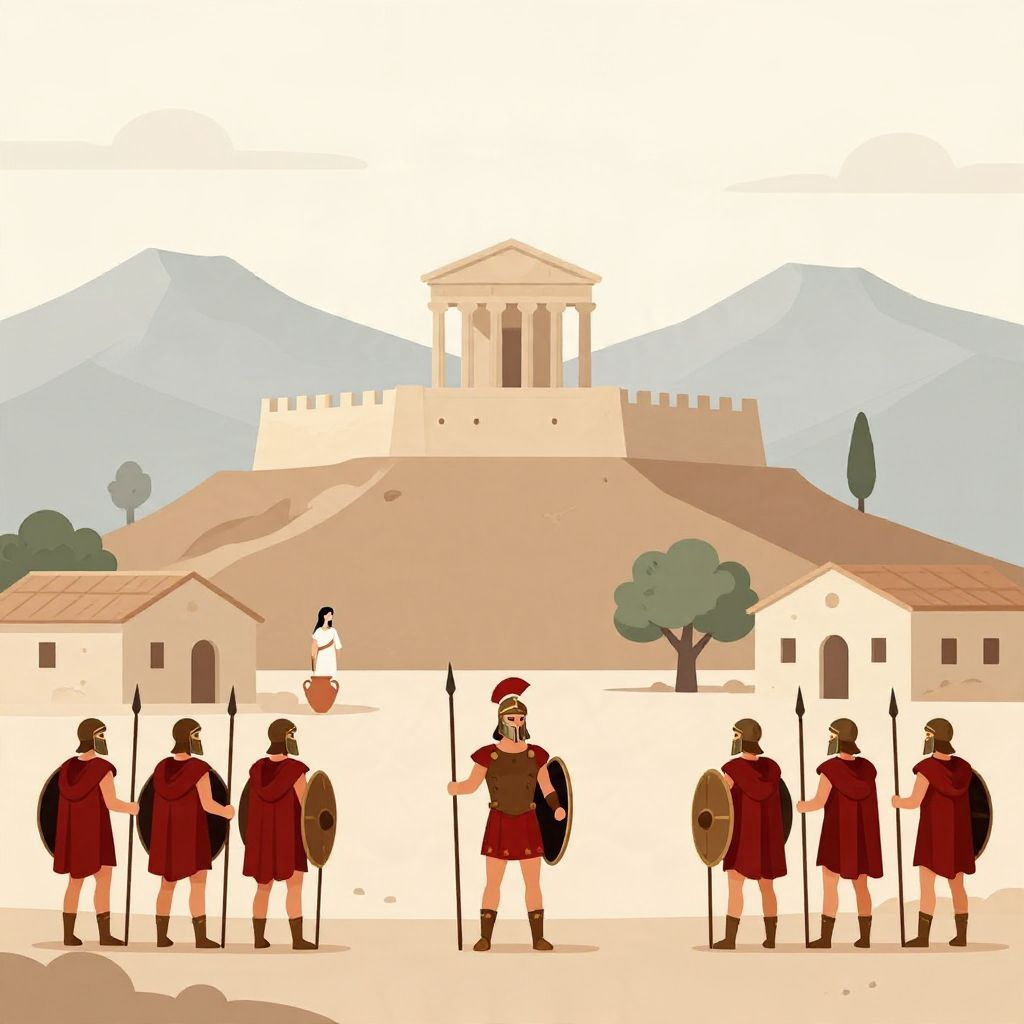
What is Sparta? Sparta was an ancient Greek city-state, or polis, located in the region of Laconia in the southern Peloponnese. It became famous for its disciplined military society, strict social order, and powerful role in Greek history, especially during the Persian Wars and the rivalry with Athens.
But Sparta was more than a warrior legend. It was a real community with a government, economy, religion, family life, and a large dependent population. Its history stretches from the early Iron Age to its decline under Macedonian and later Roman power.
What Is Sparta?
Sparta was an ancient Greek city-state in southern Greece, centered on the Eurotas River valley in Laconia. It was known for its militarized citizen society, dual kingship, and control over a large enslaved population called helots. In historical terms, Sparta was both a city and a state, not just a place.
Where Was Sparta Located?
Sparta lay in the southeastern Peloponnese, in a fertile valley surrounded by mountains. Unlike many Greek poleis, it did not develop around a dense urban center with massive walls. Ancient writers often contrasted Sparta’s open settlement with the heavily fortified cities of other states.
The Geography of Laconia
The region’s landscape shaped Spartan development. The mountains helped protect the area, while the valley supported agriculture. At the same time, the surrounding terrain made expansion difficult and encouraged Sparta to dominate nearby communities and labor systems rather than rely on trade or seaborne empire in its early history.
How Did Sparta Begin?
Sparta emerged gradually from the early Greek world after the collapse of Mycenaean palace civilization around 1200 BCE. By the 8th and 7th centuries BCE, it had become one of the leading powers in Greece. Its rise is tied to settlement patterns, conquest, and the formation of a tightly organized citizen body, though early details remain partly uncertain.
Origins and Myth
Ancient tradition linked Sparta to the Dorians, a Greek-speaking people said to have migrated into the Peloponnese. This “Dorian invasion” is still debated by historians and archaeologists, and it should be treated cautiously. Sparta’s own origin stories also included legendary kings and heroic ancestors, but these are not reliable as literal history.
The Formation of the Spartan State
By the Archaic period, Sparta had absorbed or subordinated neighboring communities in Laconia and later conquered Messenia to the west. The subjugation of Messenia, probably in the 8th or 7th century BCE, was crucial. It created a large dependent population and allowed Spartan citizens to focus on military training and political control.
Why Was Sparta So Militarized?
Sparta became famous for its military culture because its ruling citizens depended on the labor of helots, a conquered population that worked the land. To maintain control, Spartans built a society centered on discipline, collective training, and readiness for war. Military organization was therefore tied directly to social stability.
The Agoge
Spartan boys entered the agoge, a state-supervised training system, at a young age. It emphasized endurance, obedience, physical fitness, and group loyalty. Ancient sources describe harsh discipline, but modern historians note that some details may be exaggerated. Still, the system clearly aimed to produce loyal soldiers and citizens.
Helots and Perioikoi
Spartan society rested on three main groups:
- Spartiates — full citizens who formed the ruling military elite
- Perioikoi — free non-citizens living in surrounding communities, often involved in trade and craft production
- Helots — state-controlled dependent laborers, especially in Messenia, who worked the land for Spartan citizens
This structure made Sparta powerful, but it also created constant tension. Fear of helot revolt shaped Spartan politics and military policy for centuries.
How Was Sparta Governed?
Sparta had an unusual political system that mixed monarchy, oligarchy, and elements of communal decision-making. It is often described as a mixed constitution, though the balance of power was not democratic in the Athenian sense. The system was designed to limit instability and preserve elite control.
The Two Kings
Sparta had two hereditary kings from separate royal lines. They led religious rituals and sometimes commanded armies in war. Their power was real but limited by other institutions. Dual kingship was unusual in Greece and became one of Sparta’s most distinctive features.
Other Institutions
Important bodies included the Gerousia, a council of elders, and the Ephors, five annually elected magistrates with broad oversight powers. The citizen assembly, or Apella, could vote on proposals but had limited initiative. In practice, Spartan politics favored experienced elites and institutional restraint.
What Made Sparta Different from Athens?
Sparta and Athens are often presented as opposites, and in some respects they were. Athens developed a more open commercial culture and later democracy, while Sparta emphasized discipline, austerity, and military cohesion. Yet both were Greek city-states shaped by local conditions, competition, and imperial ambition.
Two Different Greek Worlds
Athens relied heavily on maritime trade, naval power, and political participation among citizens. Sparta relied on land control, social hierarchy, and military readiness. Neither was “modern” in a simple sense; each was a product of ancient Greek politics. Their rivalry helped define the classical Greek world.
What Was Daily Life Like in Sparta?
Daily life in Sparta depended on status and gender. Male citizens lived under strict expectations of discipline and service, while women in Sparta had somewhat more public visibility and economic influence than women in many other Greek city-states. Most labor, however, was performed by non-citizens and helots.
Spartan Women
Spartan women are often remembered for greater freedom of movement, physical training, and property rights compared with women elsewhere in Greece. They were not politically equal to men, but they appear to have had more social presence and economic importance. Ancient authors noticed this difference, sometimes approvingly and sometimes critically.
Food, Housing, and Simplicity
Sparta cultivated an image of simplicity and restraint. The famous black broth associated with Spartan dining may be partly symbolic in later tradition, but it reflects the broader ideal of plain living. This reputation should not be confused with poverty; Sparta was a powerful state, not a poor backwater.
What Was Sparta’s Role in Greek History?
Sparta played a major role in the Persian Wars and in later Greek conflicts. Its hoplite army became one of the most respected military forces in the Greek world. Sparta’s influence peaked in the 5th and early 4th centuries BCE, when it shaped alliances, wars, and political settlements across Greece.
The Persian Wars
Sparta is most famous for its resistance to Persia, especially at Thermopylae in 480 BCE, where King Leonidas and his force became symbols of sacrifice. The battle was militarily limited in scale, but it gained enormous cultural significance. Sparta also helped lead Greek resistance at Plataea and in the wider war effort.
The Peloponnesian War
During the Peloponnesian War (431–404 BCE), Sparta led a coalition against Athens. The conflict ended with Athenian defeat and temporarily expanded Spartan influence. However, victory did not solve Sparta’s deeper structural problems. Its dependence on a narrow citizen body and a large coerced workforce made long-term dominance difficult.
Why Did Sparta Decline?
Sparta declined because its social system was rigid and its citizen population shrank over time. Earthquakes, warfare, political strain, and inequality among citizens weakened its power. The loss of Messenia’s security and repeated conflicts with Thebes and other Greek states further reduced Spartan strength in the 4th century BCE.
From Hegemony to Weakness
After the Peloponnesian War, Sparta struggled to maintain control over Greece. Its harsh rule alienated allies, and its military superiority proved less durable than its reputation suggested. The defeat at Leuctra in 371 BCE, where Thebes shattered Spartan land power, marked a turning point. Sparta never fully recovered its earlier dominance.
Under Macedonian and Roman Power
Later Greek and Roman rulers treated Sparta with a mix of admiration and curiosity. The city retained cultural prestige, but its political independence was limited. By the Hellenistic and Roman periods, Sparta was more a symbol of ancient discipline than a great power in its own right.
What Is the Meaning of Sparta Today?
Today, “Sparta” often means toughness, austerity, or military discipline. That modern usage comes from the city’s ancient reputation, but it can oversimplify the historical reality. Sparta was not only a warrior society; it was a complex state built on conquest, hierarchy, and political control.
Sparta in Memory and Myth
Later generations, especially in Europe and America, turned Sparta into a symbol of stoicism and martial virtue. Popular culture often strips away the social costs of that system, especially the oppression of helots and the limits placed on citizens themselves. The historical Sparta was impressive, but also deeply unequal.
So, What Is Sparta in Historical Terms?
Sparta was an ancient Greek city-state that became famous for its disciplined military culture, unusual political system, and domination of neighboring peoples. Its history helps explain how power, fear, and social organization shaped one of the most influential states in classical Greece.
Understanding Sparta means seeing both the legend and the reality: a society admired for endurance and feared for its severity, whose legacy still shapes how people imagine ancient history. For broader context, you may also want to explore what the Holy Roman Empire was and what the first war was.