
When were matches invented? The short answer is that the first practical friction matches appeared in the early 19th century, with key breakthroughs around 1826 in England. But the story begins much earlier, with centuries of experiments in chemicals, fire-making, and portable ignition.
Matches did not emerge from a single moment of invention. They were the result of gradual experimentation, dangerous chemistry, and the growing demand for a cheap, reliable way to make fire in everyday life.
When Were Matches Invented?
Modern matches were invented in the early 1800s, with the first widely recognized friction match created by John Walker in 1826 in England. Earlier chemical fire starters existed, but Walker’s match was the first practical version that ordinary people could strike to produce flame.
The Long Road to a Portable Flame
For most of human history, fire was made by sparks, flint, tinder, or carefully preserved embers. These methods worked, but they were slow and inconvenient. The invention of matches answered a very old problem: how to create fire quickly, cheaply, and without specialized tools.
Before matches: ancient and early modern fire-making
Long before the 19th century, people used materials such as flint and steel, fire drills, and tinder boxes. These methods could be effective, but they required practice and patience. In homes, a fire might be kept alive for long periods rather than started from scratch each time.
By the 18th century, chemists were exploring substances that could ignite more easily than ordinary tinder. This scientific curiosity, combined with urban life and commercial demand, set the stage for the match.
The First Match-Like Inventions
Several early inventions came before the modern match. These were important steps, but they were often unreliable, expensive, or dangerous. The history of matches is therefore a chain of improvements rather than one isolated discovery.
Early chemical ignition devices
In the late 18th and early 19th centuries, inventors experimented with chemicals that burst into flame when exposed to friction or other triggers. Some devices used glass tubes, sulfuric acid, or mixtures that were difficult to handle safely. These were more scientific curiosities than everyday household items.
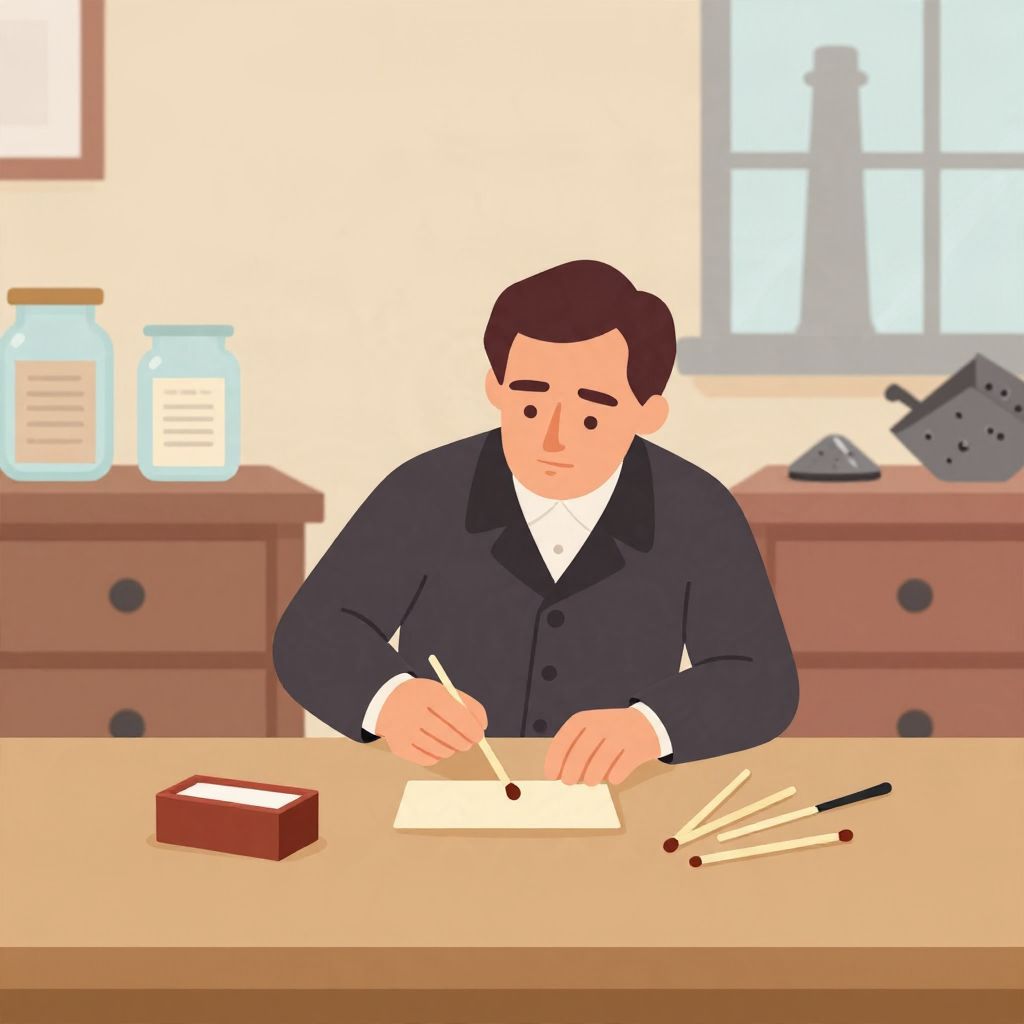
One important precursor was the work of John Walker, a British chemist and pharmacist from Stockton-on-Tees. In 1826, he accidentally discovered that a chemical mixture on a wooden stick could ignite when scraped across a rough surface. This was a major turning point because it made fire portable and easy to produce.
John Walker and the First Practical Friction Match
John Walker’s 1826 invention is usually treated as the birth of the practical match. His “friction lights,” later called matches, were sold commercially and could be lit by striking them. They were not perfect, but they were usable, affordable, and far more convenient than earlier fire-starting methods.
How Walker’s matches worked
Walker’s early matches used a chemical coating that ignited when rubbed against a rough surface. The exact composition varied, but the key innovation was the combination of a wooden stick and a friction-sensitive head. This made the match small enough to carry and simple enough for ordinary use.
Walker did not patent his invention, which helped the idea spread quickly. Other manufacturers soon copied and improved the design, turning matches into a commercial product rather than a laboratory novelty.
Why the 1820s Matter in Match History
The 1820s were the decisive decade because they brought together chemistry, manufacturing, and market demand. The Industrial Revolution created larger urban populations, more shops, more lighting needs, and more households looking for convenience. A reliable match fit perfectly into that world.
From experiment to mass product
Once the basic idea existed, inventors and manufacturers worked to make matches safer, cheaper, and easier to produce. This led to rapid changes in the 1830s and 1840s, especially in Britain and continental Europe. The match became an everyday consumer item rather than a scientific novelty.
Important Developments After 1826
Although Walker’s match was the breakthrough, later improvements made matches much more practical. Some of the most important advances involved better chemicals, more reliable ignition, and safer handling.
- 1826: John Walker creates the first practical friction match in England.
- 1830s: Match production expands, and new chemical formulas improve performance.
- 1840s: “Lucifer” matches become common, though they are often smoky, smelly, and hazardous.
- Mid-19th century: Safer and more standardized designs spread across Europe and North America.
- Late 19th century: Safety matches become dominant in many markets.
The problem with early matches
Early matches could be unpleasant and dangerous. Some used white phosphorus, a substance that ignited easily but posed serious health risks to workers. Factories that made these matches were associated with severe illness, including the notorious condition known as “phossy jaw,” a debilitating disease caused by phosphorus exposure.
These dangers pushed inventors to develop safer alternatives. The result was the safety match, which separated the reactive chemicals and reduced the risk of accidental ignition.
The Rise of the Safety Match
The safety match was a major improvement because it lit more predictably and was less dangerous to manufacture and store. In this design, the match head and the striking surface were made to work together, rather than allowing the match to ignite from almost any rough surface.
Why safety matches mattered
Safety matches changed everyday life. They made fire easier to control in homes, kitchens, workshops, and factories. They also improved public safety by reducing accidental fires and lowering the risks faced by workers in match factories.
By the late 19th century, safety matches had become the standard in many countries. Their success shows how an invention can evolve over decades through practical refinement, not just one brilliant moment.
Were Matches Invented in One Place?
The modern match is most closely associated with England, especially because John Walker’s 1826 invention was the first practical commercial friction match. However, the broader history of ignition technology was international. Chemists and inventors in several countries contributed to the development of safer and more effective matches.
England’s key role
England’s importance comes from timing and commercialization. Walker’s invention appeared at just the right moment, and the British industrial economy helped spread it. That said, later improvements were made elsewhere, and the match became a global product through international manufacturing and trade.
How Matches Changed Daily Life
The invention of matches may seem small compared with steam engines or telegraphs, but its impact was enormous in everyday life. A match made it easier to light candles, lamps, stoves, fireplaces, and later gas burners and cigarettes. It reduced dependence on stored embers and cumbersome fire-starting tools.
Practical consequences
- Households could start fires quickly and more conveniently.
- Travelers could carry a compact fire source.
- Workers and craftsmen gained easier access to flame for practical tasks.
- Urban life became less dependent on communal fire sources.
Because matches were cheap and portable, they helped normalize instant ignition. That seems ordinary today, but it was a major shift in daily routines during the 19th century.
Why the History of Matches Matters
The invention of matches illustrates how technology often develops through small, cumulative steps. It also shows the relationship between science and society: a chemical discovery becomes truly important only when it can be manufactured safely, sold widely, and used by ordinary people.
Matches also reveal the costs of progress. Early versions were useful but hazardous, and the move toward safer matches was driven partly by public health concerns and labor conditions. In that sense, the story of matches is not only about invention, but also about improvement, regulation, and industrial responsibility.
So, When Were Matches Invented?
Matches were invented in the early 19th century, with the first practical friction match created by John Walker in 1826. Earlier chemical fire starters existed, but Walker’s invention made matches usable in everyday life. Later improvements in the 1830s and beyond turned them into the safe, mass-produced household item we recognize today.
In historical terms, the match is a small invention with a large legacy. It transformed a basic human necessity—making fire—into something quick, portable, and widely accessible. If you are interested in related everyday innovations, you may also enjoy reading about the history of candles and the broader story of the Industrial Revolution.