
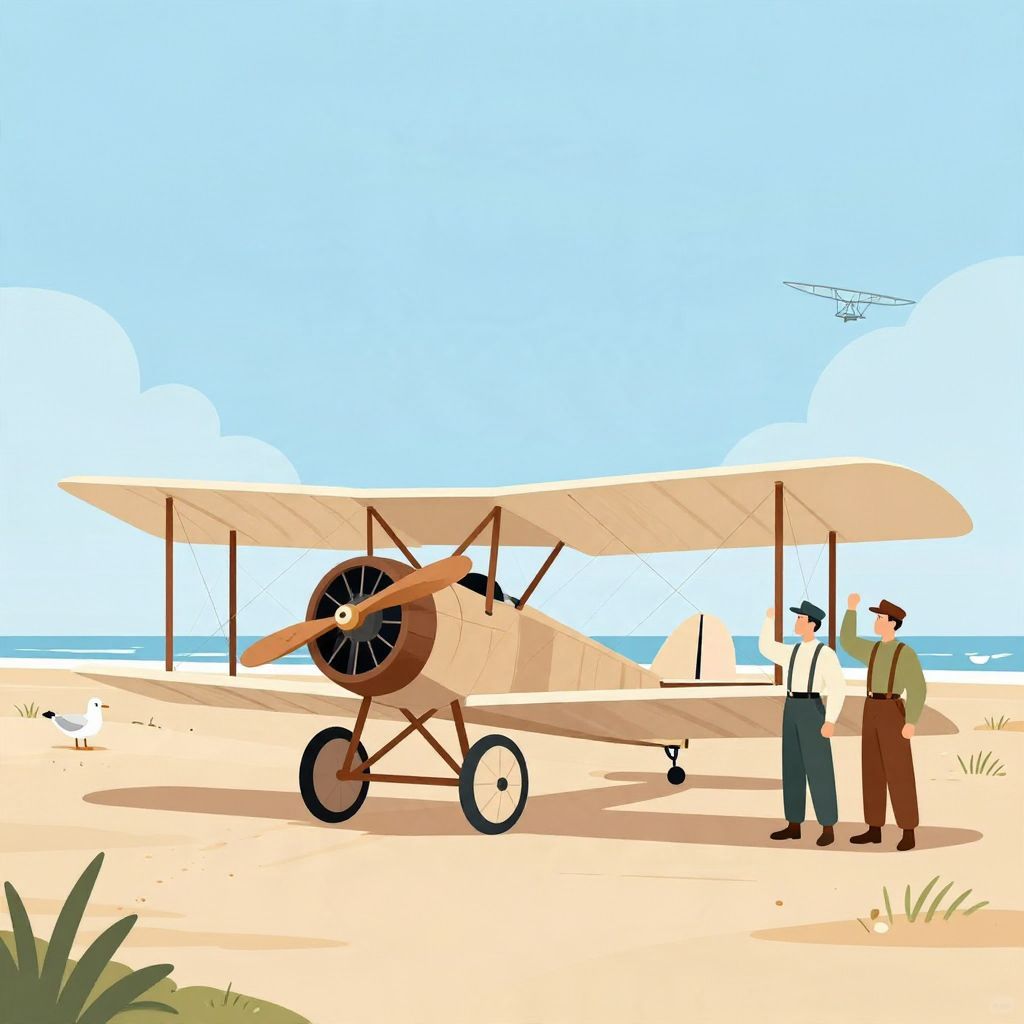
When were planes invented? The short answer is that powered airplanes were invented in the early 20th century, most famously in 1903, when the Wright brothers achieved the first sustained, controlled flight of a powered heavier-than-air machine. But the story begins much earlier, with centuries of ideas, experiments, gliders, and attempts to understand how humans might fly.
So the invention of the airplane was not a single moment so much as a long historical process. Ancient myths, Renaissance sketches, scientific study, and 19th-century engineering all helped make powered flight possible, and the first successful airplane emerged only after many failed efforts and technical breakthroughs.
When were planes invented?
Planes were invented in the modern sense in 1903, when Orville and Wilbur Wright flew the Wright Flyer at Kitty Hawk, North Carolina. Their aircraft was the first powered, heavier-than-air machine to make a sustained, controlled flight. Earlier gliders and experimental aircraft existed, but they did not combine power, control, and sustained flight in the same way.
The long road to the airplane
The airplane did not appear out of nowhere. Its invention depended on centuries of curiosity about flight, plus advances in mathematics, physics, materials, engines, and control systems. Long before the Wright brothers, inventors and dreamers understood that wings, lift, and balance mattered, even if they did not yet know how to solve the engineering problems.
Early dreams of flight
Human beings have imagined flight for thousands of years. Myths such as the Greek story of Icarus show how powerful the idea was, though these are legends rather than historical evidence of real aircraft. In the medieval and early modern worlds, inventors sketched flying machines, but most lacked the science or materials needed to make them work.
One important early figure was Leonardo da Vinci, who studied bird flight and drew designs for flying machines in the late 15th and early 16th centuries. His notebooks were brilliant, but they were not airplanes in the modern sense. They were conceptual studies, not practical machines that could sustain powered flight.
Balloons came first, but they were not airplanes
Before airplanes, humans achieved flight with balloons. In 1783, the Montgolfier brothers in France launched the first successful manned hot-air balloon flight. This was a major milestone in aviation history, but balloons float with the wind; they do not have the wings and controlled propulsion that define airplanes. Still, ballooning proved that human flight was possible.
Why the Wright brothers are credited with inventing the airplane
The Wright brothers are credited with inventing the airplane because they solved three essential problems together: lift, control, and power. Their 1903 machine could take off under its own power, remain airborne, and be steered by the pilot. Earlier inventors had achieved parts of this challenge, but not the full combination.
What made their breakthrough different?
Many 19th-century experimenters built gliders, tested wing shapes, and tried engines. Yet an airplane is more than a machine with wings and a motor. It must be stable enough to fly, controllable enough to steer, and powerful enough to sustain movement through the air. The Wright brothers’ key innovation was not just the engine; it was their understanding of flight control.
They used wind-tunnel testing and careful experimentation to improve wing design and control surfaces. Their aircraft could be balanced and directed in flight, which made their achievement historically decisive. This is why 1903 is usually treated as the birth of the airplane.
A brief timeline of airplane invention
The history of planes is best understood as a sequence of breakthroughs rather than a single invention date. The following milestones show how aviation developed over time:
- Ancient and medieval eras: Myths and sketches of flying machines reflect early human fascination with flight.
- 15th–16th centuries: Leonardo da Vinci studies flight and designs conceptual flying machines.
- 1783: The Montgolfier brothers launch the first successful manned hot-air balloon.
- 19th century: Engineers such as George Cayley study aerodynamics and build gliders.
- 1890s: Otto Lilienthal makes influential glider flights and helps establish practical aviation research.
- 1903: The Wright brothers complete the first sustained powered flight.
- 1905: The Wright Flyer III becomes a genuinely practical controlled airplane.
- 1908–1909: Public demonstrations and European flights help spread aviation worldwide.
Important predecessors before 1903
Several pioneers helped create the conditions for powered flight. They did not invent the airplane in the final sense, but their work mattered enormously. Aviation history is full of partial successes that paved the way for the Wright brothers.
George Cayley and the science of flight
The English engineer George Cayley is often called a father of aeronautics. In the early 19th century, he identified the basic forces of flight and designed gliders with fixed wings, tail surfaces, and separate lift and thrust. His ideas were foundational because they treated flight as an engineering problem rather than a magical one.
Otto Lilienthal and glider experimentation
The German aviation pioneer Otto Lilienthal made hundreds of glider flights in the 1890s. His work showed that controlled flight was possible and provided valuable data on wing shapes and stability. He died in a gliding accident in 1896, a reminder that early aviation was dangerous and poorly understood.
Samuel Langley and the limits of early powered flight
In the United States, Samuel Pierpont Langley experimented with powered aircraft and launched test machines in 1903. His efforts were important, but his full-size aircraft failed to achieve practical flight. Langley’s work illustrates how close the world was to powered aviation before the Wrights finally succeeded.
What happened at Kitty Hawk in 1903?
On December 17, 1903, near Kitty Hawk, North Carolina, the Wright brothers flew their airplane four times. The first flight lasted only seconds, but it was powered and controlled. This was the key historical moment that answers the question “when were planes invented” in the modern sense.
The site mattered because it offered strong winds, open space, and soft sand for landing. The brothers had spent years testing gliders and refining their control system. Their success was not luck alone; it was the result of methodical experimentation and engineering discipline.
Why the first flight was still a beginning, not an end
The 1903 Flyer was fragile and difficult to operate. It was not a practical passenger aircraft, and it did not immediately transform transportation. Even so, it proved the principle of powered controlled flight. That proof changed history because it showed that heavier-than-air flight was no longer just a dream.
Did anyone else invent the airplane?
This question comes up often because aviation history involves many contributors. Some inventors built early aircraft or claimed first flights, and different countries have sometimes emphasized their own pioneers. But historians generally distinguish between attempts at flight and the first successful powered, controlled airplane.
That is why the Wright brothers remain the standard answer. Other figures contributed important ideas, and some later aircraft were more practical or more publicized, but the Wrights are credited with the first true airplane because their machine met the essential criteria of powered heavier-than-air flight.
Why definitions matter
Different definitions can produce different “firsts.” For example, one might ask about the first glider, the first balloon, the first powered aircraft, the first practical airplane, or the first public flight. These are not the same thing. The historical answer depends on which milestone is being measured.
How airplane invention changed the world
The invention of the airplane transformed warfare, travel, commerce, and global connections. At first, aircraft were military curiosities and experimental machines. Within a few decades, however, they became central to modern life. The speed of travel changed how people moved, how armies fought, and how nations projected power.
Military impact
Airplanes were quickly adapted for reconnaissance and combat during World War I. By World War II, they had become decisive weapons, used for bombing, air superiority, transport, and supply. Aviation changed the scale and pace of warfare in ways earlier centuries could hardly imagine.
Civil aviation and everyday life
In peacetime, airplanes eventually reshaped passenger travel and global trade. Long-distance journeys that once took weeks by ship or rail could be completed in hours or days. Air mail, commercial airlines, and later jet travel made the world feel smaller and more connected.
Why the invention of planes matters historically
The airplane is one of the defining inventions of the modern age because it compressed distance. It changed how people understood geography, time, and national borders. It also depended on modern science in a way that earlier inventions did not: the airplane was built from theory, testing, and engineering precision.
That makes its history especially important. The airplane was not simply invented by a lone genius in one instant. It emerged from centuries of human curiosity and a concentrated burst of scientific problem-solving in the late 19th and early 20th centuries. The Wright brothers’ 1903 flight marks the decisive turning point.
So, when were planes invented?
Planes were invented in 1903, when the Wright brothers made the first sustained, controlled powered flight at Kitty Hawk. But the full story stretches back much further, through balloons, gliders, scientific study, and failed experiments. The airplane was both a sudden breakthrough and the result of a long historical journey.
For readers interested in the broader history of modern technology, aviation sits alongside other major turning points in industrial and scientific change. You may also enjoy exploring related topics such as the Industrial Revolution and World War I history.