
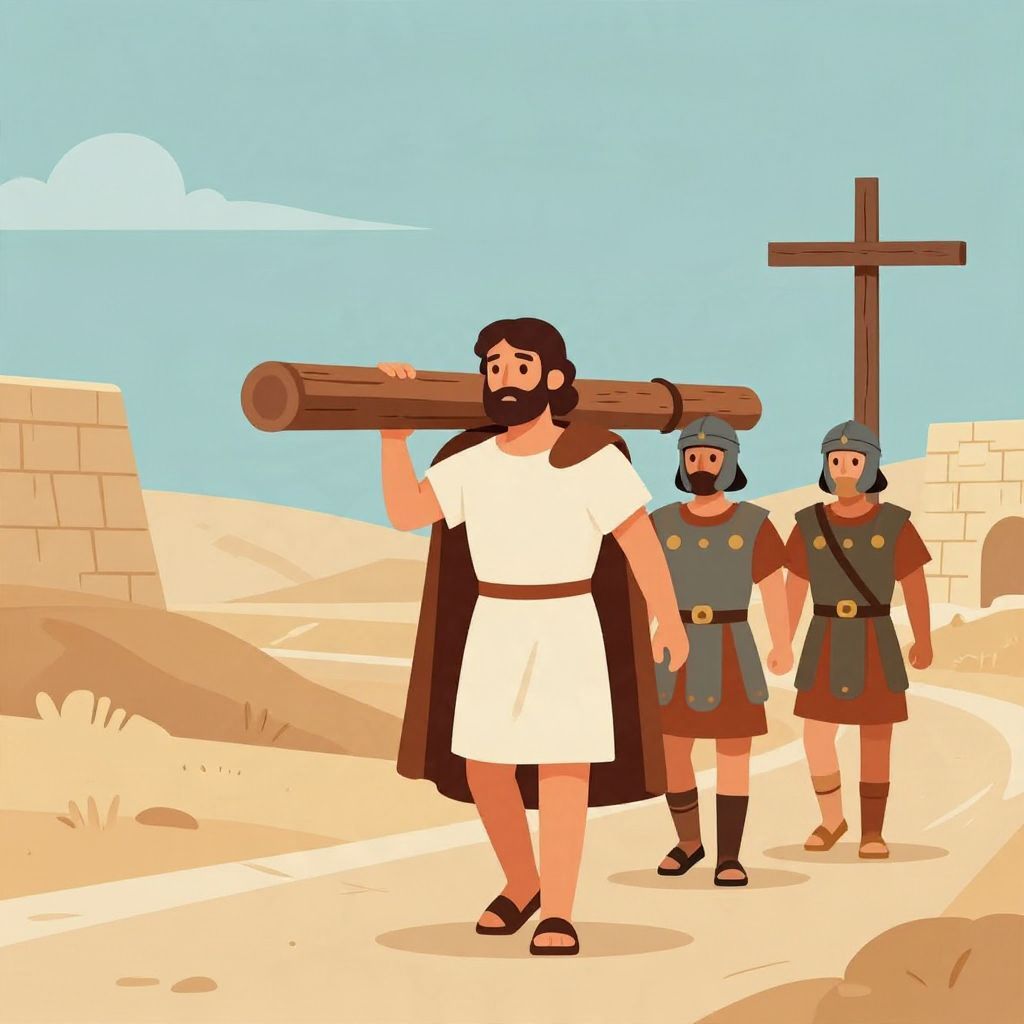
How heavy was the cross Jesus carried? It is one of the most asked questions about the crucifixion narrative, but the historical answer is more cautious than popular images suggest. The Gospels say Jesus carried a cross, yet they do not give a weight, and historians must rely on what is known about Roman execution practices.
In practice, Jesus most likely carried only the crossbeam, not a full wooden cross. That beam could have weighed roughly 30 to 50 pounds, though estimates vary. The full instrument of crucifixion was usually assembled at the execution site, and the exact weight would have depended on the wood, the design, and the soldiers’ methods.
How heavy was the cross Jesus carried?
The best historical estimate is that Jesus probably carried the patibulum, the horizontal beam, rather than the entire cross. Scholars commonly place its weight somewhere around 30 to 50 pounds, though some estimates go higher. The full cross would have been much heavier, but Roman practice makes that less likely.
What the historical evidence actually says
The New Testament accounts describe Jesus being led to crucifixion and carrying the cross, but they do not specify its size or weight. In the Gospel of John, Jesus carries the cross himself; in the Synoptic Gospels, Simon of Cyrene is compelled to help. Those differences matter because they show the tradition focuses on the event’s meaning, not on engineering details.
Roman crucifixion was a public, humiliating punishment used across the empire for slaves, rebels, and others judged especially dangerous or dishonorable. The condemned person was often made to carry the crossbeam to the execution site, where the upright post may already have been fixed in place. This was efficient for the soldiers and added to the victim’s shame.
Why historians think it was likely the crossbeam
In Roman execution practice, the vertical post, or stipes, was often left standing at the site of crucifixion. The condemned carried the patibulum, which was attached to the post after arrival. This arrangement is supported by ancient descriptions of Roman punishment and by practical considerations: a full cross would have been unwieldy and difficult to transport through crowded streets.
That does not mean every crucifixion was identical. Roman authorities adapted punishments to local conditions, available materials, and the message they wanted to send. But when historians discuss the weight Jesus carried, they usually mean the beam, not a complete cross-shaped structure.
How much would that beam have weighed?
A reasonable estimate for a wooden crossbeam is about 30 to 50 pounds, or roughly 14 to 23 kilograms. Some reconstructions suggest a heavier beam, especially if the wood was dense or the beam was unusually large. Others argue for a lighter piece if the beam was cut to a practical size and intended only for one execution.
Why there is no exact number
No surviving source gives the dimensions of Jesus’ crossbeam. Wood type, moisture content, craftsmanship, and local Roman practice all affected weight. Even the route to the execution site matters: a short distance over level ground is different from a long, steep, or crowded path. Because of that, any precise number would be speculation.
What can be said with confidence is that the burden was severe enough to exhaust a man who had already been beaten. Roman scourging often weakened prisoners before crucifixion, making even a moderate load difficult to bear. So while the beam may not have been extraordinarily heavy by modern standards, it would have been punishing in context.
Why the question matters in history
People often ask about the cross’s weight because it helps make the ancient scene more concrete. The question also reveals how much later Christian art and devotion have shaped popular imagination. Paintings and films often show a large, fully formed cross, but historical reconstruction points to a more practical Roman instrument of execution.
The exact weight is less important than what the act represented. Carrying the crossbeam was part of the public ritual of Roman power: the condemned were made to participate in their own humiliation before death. In the Christian tradition, this moment later became a symbol of suffering, obedience, and sacrifice.
The timeline of the crucifixion journey
The historical chronology is not known minute by minute, but the sequence is broadly understood from the Gospel narratives and Roman practice.
- Arrest and trial — Jesus is arrested and brought before local authorities.
- Scourging — Roman soldiers likely flog him, weakening him physically.
- Carrying the beam — He is led toward the execution site with the crossbeam, or is assisted when he can no longer continue.
- Crucifixion — The beam is attached to the upright post, and Jesus is nailed or bound to the cross.
- Death and burial — After death, the body is removed and placed in a tomb.
This sequence helps explain why Simon of Cyrene appears in some accounts. If Jesus had been severely weakened by scourging and loss of blood, assistance would have been plausible and historically consistent with the physical demands of the punishment.
What the Gospels emphasize instead of weight
The Gospel writers were not trying to preserve a technical description of the cross’s mass. Their focus was theological and narrative: Jesus’ suffering, the fulfillment of prophecy, the actions of bystanders, and the meaning of the crucifixion for early believers. That is why the texts highlight the journey, the crowd, and the final death more than the carpentry of the cross.
For historians, this means the weight question must be answered indirectly. We can compare Roman customs, consider the likely materials, and read the texts carefully, but we cannot produce a definitive measurement. The most responsible answer is approximate, not absolute.
Popular images versus historical reconstruction
In art and devotional tradition, Jesus is often shown carrying a large, complete cross on his shoulders. That image is powerful, but it reflects later Christian symbolism more than Roman logistics. A full cross would likely have been too heavy and awkward for a condemned man to carry far, especially after scourging.
Historical reconstructions usually depict a simpler arrangement: the condemned man carries the beam, while the upright post remains at the site of execution. This model fits Roman efficiency and the evidence we have better than the familiar full-cross image.
Common misconceptions
- Myth: Jesus carried a complete, assembled cross the whole way.
- Likely historical reality: He carried only the crossbeam.
- Myth: The weight is known exactly.
- Likely historical reality: The exact weight is unknown and can only be estimated.
- Myth: The Gospels provide a technical description of the object.
- Likely historical reality: They describe the event’s meaning, not its measurements.
Historical significance of the cross
The cross became one of the most important symbols in world history because of the Christian interpretation of Jesus’ death. What began as an instrument of Roman execution was transformed into a sign of faith, redemption, and suffering. That transformation is central to the history of Christianity and to Western art, ritual, and memory.
Understanding the likely weight of the crossbeam helps ground the story in the realities of the ancient world. It reminds us that crucifixion was not a symbolic drama invented later, but a brutal Roman punishment with physical, political, and social dimensions. The burden Jesus carried was real, even if its exact pounds cannot be known.
So, how heavy was the cross Jesus carried? Most likely, he carried a crossbeam weighing about 30 to 50 pounds, though the exact figure is uncertain. The broader historical significance lies not in the number itself, but in what Roman crucifixion meant and how later Christians remembered it. For related context, see how old Jesus was when he was crucified and where Jesus’ tomb is believed to be.