
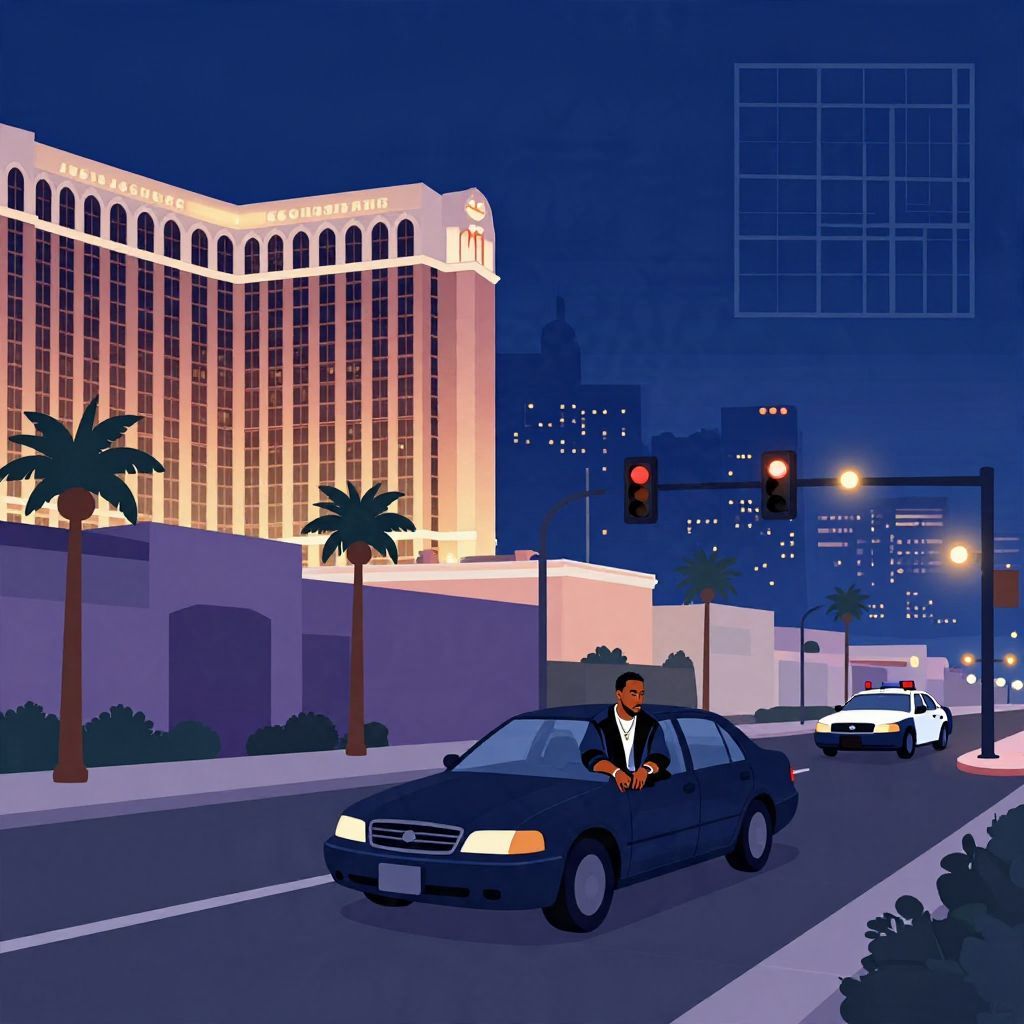
Where was Tupac shot? The most direct answer is that Tupac Shakur was shot in Las Vegas, Nevada, on the evening of September 7, 1996, while riding in a car after attending a boxing match at the MGM Grand. He was struck by gunfire near the intersection of East Flamingo Road and Koval Lane, in the area of the Las Vegas Strip.
The shooting became one of the most famous unsolved crimes in modern American popular culture, and it remains central to the history of 1990s hip-hop. Understanding the location helps explain not only what happened that night, but also why the case has continued to attract public attention for decades.
Where Was Tupac Shot?
Tupac Shakur was shot in a car on East Flamingo Road near Koval Lane in Las Vegas, Nevada. The shooting happened shortly after midnight on September 7, 1996, after he had attended the Mike Tyson vs. Bruce Seldon fight at the MGM Grand. He was in a black BMW driven by Death Row Records executive Suge Knight when gunfire came from a white Cadillac alongside the vehicle.
The exact setting: Las Vegas Strip area
The attack took place in the busy resort corridor east of the Las Vegas Strip, not inside the MGM Grand itself. Tupac had left the hotel-casino after the fight and was heading toward a nightclub. The shooting occurred at a red light in a public street setting, which is part of why witnesses, traffic, and the surrounding nightlife all became important to later investigations.
What happened to Tupac that night?
According to the widely accepted account, Tupac was hit multiple times by gunfire while seated in the passenger seat. He was rushed to University Medical Center of Southern Nevada, where he underwent treatment for several days before dying on September 13, 1996. The location of the shooting and the route taken afterward became key details in the criminal investigation and in later retellings of the event.
The Historical Background of the Shooting
The 1996 Las Vegas shooting did not happen in isolation. It unfolded during a period of intense conflict in American hip-hop, especially amid the East Coast-West Coast rivalry that shaped music, media coverage, and public perception in the mid-1990s. Tupac was one of the era’s most visible and controversial figures, known both for his artistic influence and for the conflicts surrounding him.
Tupac Shakur’s place in 1990s hip-hop
By 1996, Tupac was already a major cultural figure. He was admired for his lyrical skill, political urgency, and ability to speak about poverty, racism, violence, and vulnerability. At the same time, his public image was shaped by legal troubles, media scrutiny, and his association with Death Row Records, which placed him at the center of a volatile music industry environment.
Why Las Vegas mattered that night
Las Vegas was not the center of the hip-hop industry, but it became the site of the shooting because Tupac was there for a major boxing event. Large sporting events often drew celebrities, promoters, bodyguards, and entourages into the same crowded urban space. In this case, the combination of nightlife, traffic, and a high-profile public appearance created the conditions in which the attack occurred.
Chronology of the Night of September 7, 1996
The sequence of events is important because the shooting is often discussed in fragments. A clearer timeline shows how quickly the situation developed and why the location became so well known.
- Evening: Tupac attended the Mike Tyson fight at the MGM Grand.
- After the fight: A confrontation involving members of Tupac’s group and another man in the hotel lobby was widely reported and later became part of the broader context of the night.
- Late night: Tupac left the hotel in a car with Suge Knight.
- On East Flamingo Road: A white Cadillac pulled alongside the BMW and shots were fired.
- Aftermath: Tupac was taken to the hospital, where he remained until his death six days later.
This sequence matters because it shows that the shooting was not a random roadside incident. It was tied to a specific social setting, a public event, and a tense atmosphere that had been building for some time.
Why the Case Became So Famous
The question “Where was Tupac shot?” persists because the shooting became a landmark event in American cultural history. It was not only the death of a famous rapper; it was also a moment that symbolized the dangers of celebrity violence, the pressures of the music business, and the unresolved tensions of the 1990s.
A public crime with lasting uncertainty
One reason the case remains so discussed is that it long stood as an unsolved murder. Over the years, investigators, journalists, fans, and conspiracy theorists have debated the evidence, motives, and possible suspects. That uncertainty has added to the historical importance of the Las Vegas location, turning a city street into a site of memory and speculation.
The role of media and myth
Because Tupac was already a larger-than-life figure, the shooting quickly entered the realm of myth as well as fact. Some stories about the event have been exaggerated or distorted over time. The reliable historical core, however, is straightforward: the shooting happened in Las Vegas, near the Strip, after the boxing match, and it led to Tupac’s death less than a week later.
What We Know About the Location
The most commonly cited location is the intersection of East Flamingo Road and Koval Lane, just east of the Las Vegas Strip. The car was stopped at a traffic light when the shooting occurred. This is the best-supported answer to the question of where Tupac was shot, even though different reports may describe the spot in slightly different ways depending on whether they emphasize the exact intersection, the roadway, or the broader Strip area.
Why exact location details can vary
In public memory, people sometimes refer loosely to “the Las Vegas Strip” or “near the MGM Grand.” Those descriptions are broadly correct but not as precise as the intersection itself. Historians and journalists usually prefer the more exact street location because it helps distinguish the shooting from the hotel fight that preceded it and from the hospital where Tupac later died.
How the site is remembered today
The intersection is not a major monument or memorial in the way some historic sites are, but it remains significant in cultural memory. For fans of hip-hop history, the place marks a turning point in the story of Tupac’s life and in the broader narrative of 1990s rap. It is remembered less as a tourist landmark than as a location tied to a tragic and consequential event.
The Aftermath and Historical Significance
Tupac’s shooting had consequences far beyond one night in Las Vegas. It intensified public concern about violence in and around the music industry, deepened the mythic status of Tupac after his death, and helped shape how later generations understood the East Coast-West Coast conflict. The event also became part of a larger national conversation about fame, guns, and urban violence.
Impact on hip-hop culture
After Tupac died, his music and image took on even greater influence. Albums released after his death expanded his legacy, while the circumstances of the shooting gave his life story a tragic ending that shaped how he was remembered. The location in Las Vegas became inseparable from that legacy because it marked the final public chapter of his life.
Impact on criminal investigation and public memory
For years, the case remained unresolved in the public eye, which encouraged endless theories and renewed interest in the details of the night. In that sense, the location of the shooting became more than a street corner: it became evidence, memory, and symbol all at once. The historical record is strongest when it stays close to the documented facts rather than the rumors that grew up around them.
Answer in Brief
Tupac Shakur was shot in Las Vegas, Nevada, near East Flamingo Road and Koval Lane, shortly after midnight on September 7, 1996. He was attacked while riding in a car after leaving the MGM Grand following a boxing match. He died six days later from his wounds.
That is the clearest historical answer to where Tupac was shot. For readers interested in famous deaths and public tragedies in history, you may also want to read about what happened to John Lennon and the broader cultural memory surrounding public figures.