
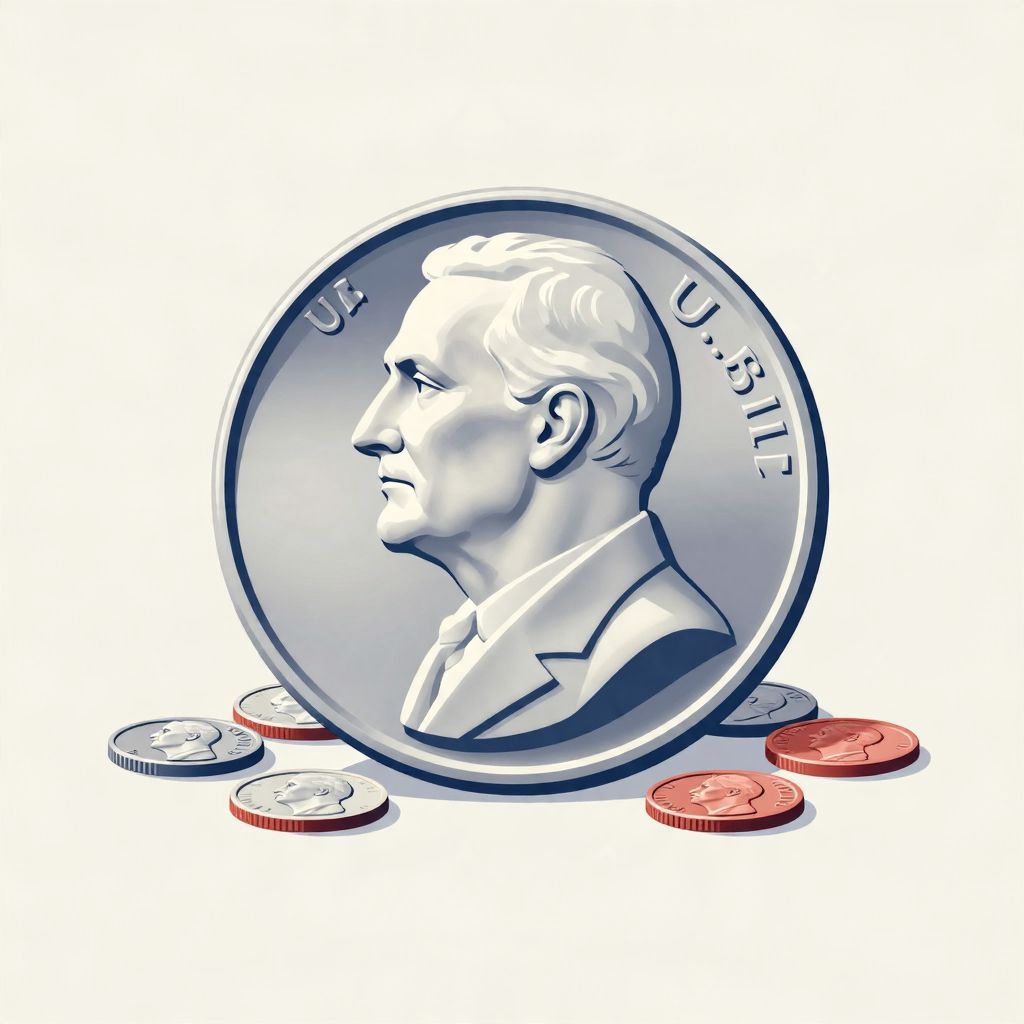
Which president is on the dime? The answer is Franklin D. Roosevelt, the 32nd president of the United States. His portrait has appeared on the dime since 1946, replacing the earlier “Mercury” dime design after his death in 1945.
The choice was not random: Roosevelt had strong ties to the March of Dimes, and the coin became a lasting memorial to his leadership during the Great Depression and World War II.
Which President Is on the Dime?
Franklin D. Roosevelt is the president on the U.S. dime. His profile has been used on the coin since 1946, and it remains the standard design today. The dime’s current obverse honors Roosevelt’s legacy, while the reverse design has changed over time to reflect different national symbols and commemorations.
Why Franklin D. Roosevelt Was Chosen
Roosevelt was selected soon after his death in April 1945. The U.S. Treasury moved quickly to replace the long-running Winged Liberty Head dime, commonly called the “Mercury” dime, with a new design honoring the late president. The decision reflected both national mourning and Roosevelt’s close association with the fight against polio.
Roosevelt had helped inspire the March of Dimes, a fundraising campaign that supported polio research and treatment. Because of that connection, placing his portrait on the dime was especially fitting. The coin’s small size also made it an appropriate tribute to a president associated with public service and national recovery.
The March of Dimes connection
The March of Dimes began as a public campaign to raise money for polio research and patient care. Roosevelt, who had contracted polio in 1921, became a powerful symbol for the cause even though he was not the sole founder. The dime’s new design gave the coin a memorial role that ordinary Americans encountered every day.
A Brief Timeline of the Dime’s Presidential Portrait
The dime’s Roosevelt design emerged from a specific historical moment, but the coin itself has a longer story. Here is the basic sequence:
- 1796 – The dime appears in early U.S. coinage as a silver coin worth one-tenth of a dollar.
- 1916 – The Mercury dime, designed by Adolph A. Weinman, enters circulation.
- 1945 – Franklin D. Roosevelt dies in office at the end of World War II.
- 1946 – The Roosevelt dime is introduced.
- 1965 – The dime changes from 90% silver to a copper-nickel clad composition for circulation.
This timeline shows that Roosevelt’s appearance on the dime was not part of the nation’s earliest coinage tradition. Instead, it was a mid-20th-century memorial choice shaped by wartime memory, public health advocacy, and the Treasury’s desire for a timely redesign.
The Dime Before Roosevelt
Before Roosevelt, the dime featured a different image altogether. From 1916 to 1945, the coin showed Liberty wearing a winged cap. Many Americans mistook the figure for the Roman god Mercury, which is how the coin got its popular nickname. In fact, the design was meant to represent liberty and freedom of thought.
The Mercury dime was admired for its artistry and became one of the most beloved U.S. coin designs. Yet after Roosevelt’s death, the Treasury chose to honor him instead. The change was also practical: the dime was one of the most widely used coins in everyday commerce, so it offered a visible and meaningful place for a national tribute.
Why not another coin?
Roosevelt could have been placed on another denomination, but the dime was the obvious choice because of the March of Dimes connection. That association gave the coin a symbolic link to his personal history and to the public health cause most closely tied to his memory.
How the Roosevelt Dime Was Designed
The Roosevelt dime was designed by Mint Chief Engraver John R. Sinnock. His portrait of Roosevelt first appeared in 1946. Sinnock’s initials, “JS,” appear on the coin, and for a time they became the subject of conspiracy rumors, including false claims that they referenced Joseph Stalin. Those claims were baseless and reflected Cold War suspicion rather than historical fact.
The original reverse of the dime featured a torch, an olive branch, and an oak branch. These elements represented liberty, peace, and strength. That symbolism made the coin more than just a portrait piece; it also carried a message about postwar America and the values the nation wanted to project.
The first Roosevelt dime
The first Roosevelt dime entered circulation in 1946, the year after Roosevelt’s death. Its release was a significant moment in U.S. coinage because it marked the first time a president appeared on the dime. Until then, presidents more commonly appeared on larger denominations such as the penny, nickel, quarter, and half dollar only in later periods of U.S. coin history.
The Historical Significance of Putting Roosevelt on the Dime
Roosevelt’s image on the dime matters because it reflects how Americans remember presidents through everyday objects. Coins are small, ordinary, and widely circulated, which makes them powerful tools of public memory. A coin in pocket change can carry a national story into daily life.
In Roosevelt’s case, the dime also linked political leadership with social welfare. His presidency was defined by the New Deal, the Great Depression, and World War II, but the coin also reminds us of his role as a figurehead for polio awareness. That combination of statecraft and public health gives the dime unusual historical depth.
Roosevelt’s broader legacy
Roosevelt served from 1933 until his death in 1945, leading the country through economic crisis and global war. His administration expanded the federal government’s role in American life through relief programs, financial reforms, and wartime mobilization. The dime’s portrait is therefore not just a memorial to one man, but a reminder of the era he shaped.
Changes to the Dime After 1946
Although Roosevelt’s portrait has remained on the front of the dime, the coin itself has changed over time. One major change came in 1965, when the United States removed silver from most circulating dimes because rising silver prices made the old composition too costly. Since then, the dime has been made of a copper core with a copper-nickel outer layer.
The reverse design also changed. In 2001, the U.S. Mint introduced a new reverse for the dime featuring a torch, olive branch, and oak branch, replacing the earlier fasces-and-branches design used for decades. These updates show that while Roosevelt’s portrait has endured, the coin’s artistic presentation has evolved with the times.
Common Questions About the Dime
Is Roosevelt the only president on the dime?
Yes. Franklin D. Roosevelt is the only president ever featured on the dime’s standard circulating design.
Was the dime always a Roosevelt coin?
No. The dime existed long before Roosevelt’s portrait was added in 1946. Earlier versions featured Liberty rather than a president.
Why is the dime smaller than the penny?
The dime’s size reflects its historical value as one-tenth of a dollar. Its small diameter is a legacy of earlier U.S. coinage standards, not a sign of its importance today.
Why This Answer Still Matters
Knowing which president is on the dime is a simple fact, but it opens a window into U.S. history. The coin reflects how the nation honors leaders, how public memory is shaped, and how everyday objects can preserve political and cultural meaning across generations.
So the answer is straightforward: Franklin D. Roosevelt is on the dime. If you want to compare U.S. coin portraits and presidential symbolism, you may also enjoy reading about who is on the dime coin and what president is on the nickel.