
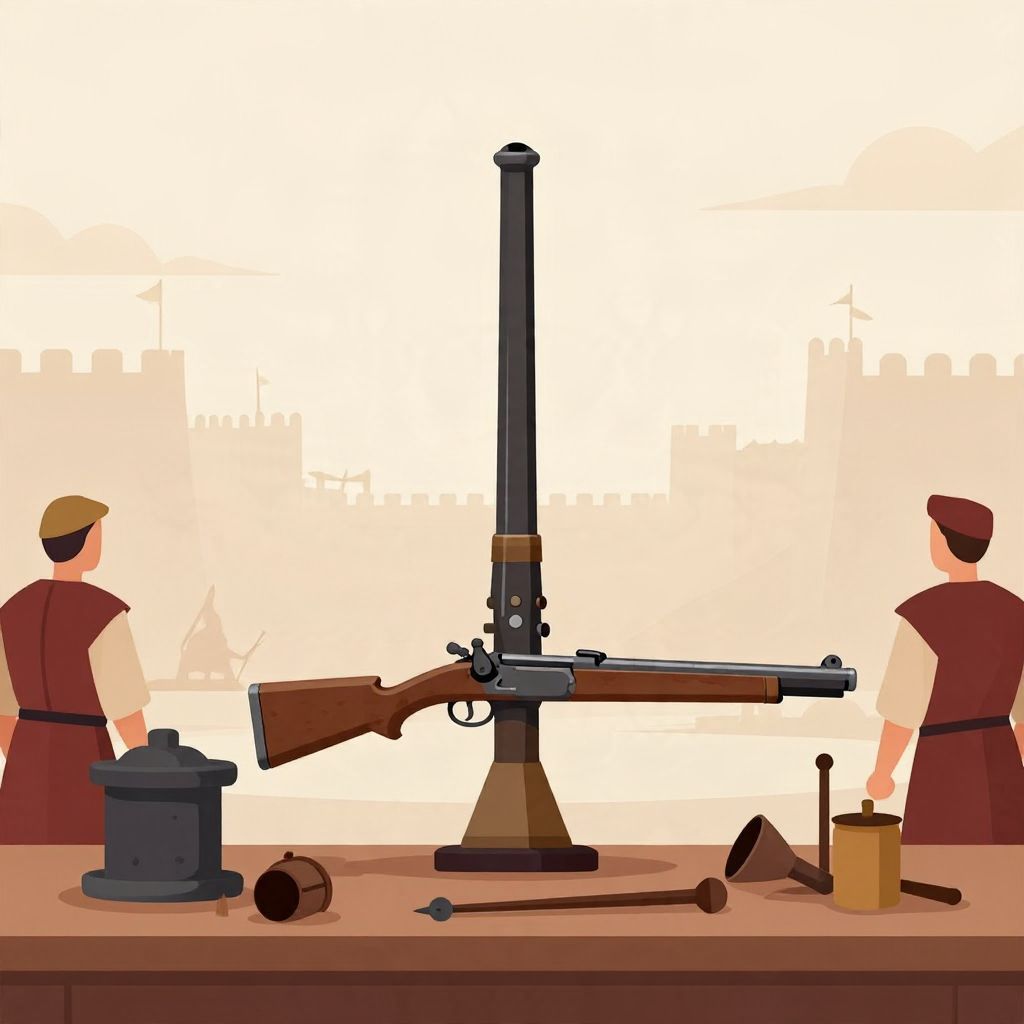
When was the gun invented? The short answer is that the earliest gunpowder firearms appeared in China in the late 9th to 10th century, with the first clearly documented handguns and gun-like weapons emerging in the 13th century. There was no single “inventor” of the gun; it developed gradually from gunpowder experiments, fire lances, and early cannon.
Because the word “gun” can mean different things, the answer depends on whether you mean the first gunpowder weapon, the first handheld firearm, or the later modern gun. Historians usually trace the origin of guns to medieval China, then follow their spread across Asia, the Middle East, and Europe.
When Was the Gun Invented?
The gun was invented gradually, not in one exact year. Gunpowder itself was developed in China by the 9th century, and weapons using it appeared soon after. The earliest firearm-like devices likely date to the 10th to 12th centuries, while the first unmistakable handguns and metal-barreled guns are documented in the 1200s.
The Origins of Gunpowder in China
To understand when the gun was invented, it helps to begin with gunpowder. Chinese alchemists experimenting with saltpeter, sulfur, and charcoal discovered explosive mixtures during the Tang dynasty. By the late 800s, texts were describing incendiary and explosive substances, though these were not yet guns in the modern sense.
From alchemy to weapons
Early gunpowder was first used for fire-based weapons, signals, and bombs. Over time, Chinese military engineers adapted it for warfare. The key breakthrough was not just making gunpowder, but finding a way to direct its force through a tube or barrel.
The First Gun-Like Weapons
The earliest gun-like weapons were probably fire lances, which combined a spear with a tube that shot flames, smoke, or fragments. These appeared in China by the 10th century and are important because they represent the transition from incendiary weapon to firearm. In some versions, the tube eventually fired projectiles instead of just flame.
What was a fire lance?
A fire lance was a pole weapon fitted with a bamboo or metal tube filled with gunpowder. When lit, it produced a burst of flame and sometimes expelled pellets or shrapnel. This made it a crucial step toward the gun because it used combustion to launch material forward from a tube.
The First True Guns and Handguns
By the 13th century, Chinese sources and surviving artifacts show weapons that are much closer to what most people mean by “guns.” These included metal-barreled hand cannons and early cannon used in sieges. One of the most famous surviving examples is the Heilongjiang hand cannon, usually dated to 1288, which is among the clearest early examples of a handheld firearm.
Why 1288 matters
The 1288 date is important because it gives historians a firm, material example of an early firearm. It does not mean guns suddenly appeared that year; rather, it shows that by the late 1200s, handheld gunpowder weapons were already established enough to leave surviving evidence.
How Did Guns Develop?
Guns evolved through a series of practical improvements. Early tubes were often made of bamboo or bronze, then iron and other metals. As craftsmen learned to make stronger barrels, they could contain more pressure and fire heavier projectiles. This changed warfare by making weapons more powerful, more portable, and eventually more reliable.
Key stages in development
- 9th century: Gunpowder is discovered in China.
- 10th century: Fire lances and similar weapons appear.
- 13th century: Hand cannons and early guns are documented.
- 14th–15th centuries: Guns spread widely and become more standardized in Eurasia.
- 16th century onward: Firearms become central to armies and states.
Did One Person Invent the Gun?
No single person is known to have invented the gun. This was a cumulative technological development, shaped by many unnamed craftsmen, soldiers, and experimenters over generations. Unlike a modern patented invention, the gun emerged through gradual refinement of gunpowder, metalworking, and battlefield experimentation.
Why the inventor is unknown
Medieval inventors were rarely recorded in the way modern inventors are. Texts often describe devices, not creators. As a result, historians can identify where and when guns emerged, but not a single founder with certainty.
How Guns Spread Beyond China
Gun technology moved westward through trade, warfare, and cultural exchange across Eurasia. By the 13th and 14th centuries, gunpowder weapons were appearing in the Islamic world and then in Europe. The Mongol Empire likely helped accelerate this transfer by linking large regions and facilitating the movement of military knowledge.
Arrival in the Islamic world and Europe
In the Middle East, gunpowder weapons were experimented with in the 1200s and 1300s. In Europe, references to gunpowder and firearms appear in the 14th century, and by the 1400s guns were becoming increasingly important in siege warfare. Early European guns were often clumsy, but they quickly improved.
From Early Firearms to Modern Guns
The “gun” of medieval history is not the same as the modern pistol or rifle. Early firearms were slow to load, inaccurate, and often used more for intimidation or siege warfare than for precision shooting. Over centuries, innovations such as the matchlock, wheellock, flintlock, and later percussion cap made guns far more practical.
Major later developments
- Matchlock: One of the earliest practical firing mechanisms, common in the 15th and 16th centuries.
- Flintlock: More reliable and widespread from the 17th century.
- Rifling: Spiral grooves improved accuracy.
- Cartridges and repeating firearms: These transformed gun use in the 19th century.
Why the Invention of the Gun Changed History
Guns reshaped warfare, politics, and state power. Fortifications had to change because cannon could destroy older castle walls. Armies became more dependent on training, supply chains, and gunpowder production. Over time, states that could manufacture and organize firearms gained major military advantages.
Broader historical consequences
Firearms helped transform medieval warfare into early modern warfare. They influenced the decline of some feudal military systems, strengthened centralized states, and changed naval combat, colonial expansion, and personal self-defense. Their spread also had devastating consequences, making warfare deadlier and more destructive.
Common Misunderstandings About the Gun’s Origin
Several misconceptions often appear in popular accounts. First, the gun was not invented in Europe, though Europe played a major role in improving it. Second, the first gun was not a modern pistol or musket. Third, there is no exact “birthday” for the gun, because it emerged through a long technological process.
Gun, cannon, and firearm are not identical terms
In historical writing, “gun” can refer to a broad family of gunpowder weapons. A cannon is a large gun mounted for siege or naval use, while a firearm is a handheld weapon that uses gunpowder to propel a projectile. Early history often blurs these categories because the technology developed step by step.
So, What Is the Best Answer?
If you want the clearest historical answer to when was the gun invented, it is this: gunpowder weapons originated in China, with the earliest developments in the 9th and 10th centuries, and the first clearly documented firearms appearing in the 13th century. The gun was not invented all at once, but evolved from fire lances and early cannon into true firearms.
The history of the gun is really the history of experimentation, adaptation, and military change. If you want to place it in a single timeline, the safest answer is that the gun emerged in medieval China and became recognizable as a firearm by the late 1200s. For related context, you may also want to read about what the first war was and what a buccaneer was.