
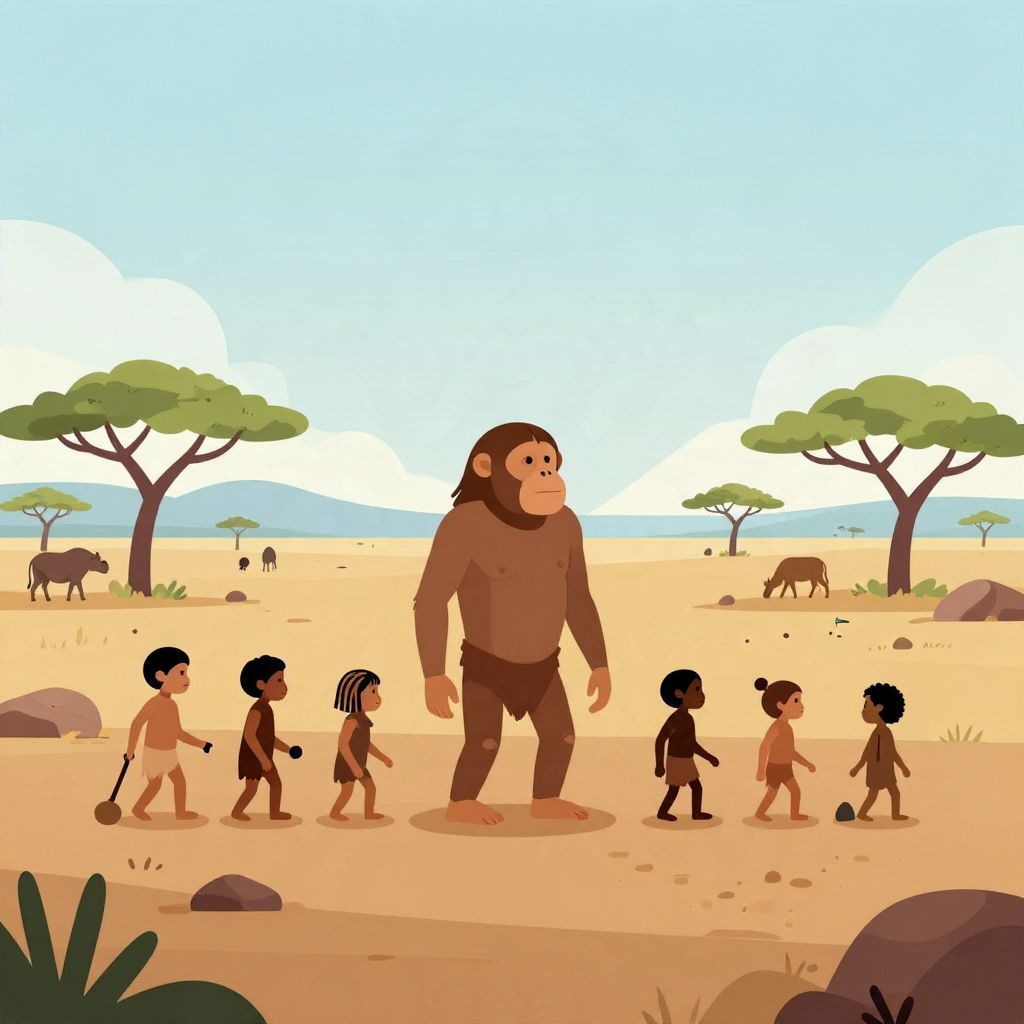
“Who was the first person on Earth?” is a question that sounds simple, but history and science do not support a single named answer. Human beings evolved gradually over hundreds of thousands of years, so there was no exact moment when one “first person” appeared in the way a legend might suggest.
The best historical answer is that the first Homo sapiens emerged in Africa over a long evolutionary process, and all living humans are part of that shared origin. In other words, there was no one first person in the modern sense—only early populations of humans whose descendants spread across the world.
Who Is The First Person On Earth?
There is no historically verifiable “first person on Earth” with a known name, date, or birthplace. Humans evolved gradually from earlier hominin ancestors, and the species Homo sapiens emerged in Africa roughly 300,000 years ago. The first humans were not a single individual but an evolving population.
Why There Is No Single First Human
The idea of one first person assumes that human beings began at a clear dividing line, but evolution works differently. Populations change over many generations, with small biological shifts accumulating over time. At some point, a group that was not fully modern became recognizably human, yet no one individual can be identified as the exact “first.”
Evolution does not work like a birth certificate
In historical and scientific terms, species do not appear all at once. Parents and children are usually very similar, so the “first” member of a new species would be nearly indistinguishable from the last member of the older one. That makes the search for a single first human more philosophical than factual.
What scientists mean by “human”
When scholars discuss the earliest humans, they usually mean members of the species Homo sapiens. Before that were earlier hominins such as Homo erectus, Homo habilis, and other ancestral groups. These were part of the broader human family tree, but not modern humans in the strict biological sense.
The Earliest Known Humans
Current evidence suggests that Homo sapiens emerged in Africa around 300,000 years ago. Fossil discoveries in places such as Jebel Irhoud in Morocco have pushed back the timeline for early modern humans. These finds show a long, complex origin rather than a sudden appearance of one first person.
African origins
The strongest scientific consensus is that modern humans originated in Africa. From there, populations gradually spread into the Middle East, Europe, Asia, Australia, and eventually the Americas. This is often called the “Out of Africa” model, though it involved multiple migrations and interactions over time.
What the fossils tell us
Fossils, stone tools, and genetic evidence help reconstruct early human history. They do not reveal a single named individual, but they do show how anatomy, behavior, and culture changed over time. Early humans developed more complex tools, social cooperation, symbolic thought, and eventually language and art.
Could Adam and Eve Be the First People?
Many people ask this question from a religious perspective. In the Abrahamic traditions, Adam and Eve are often understood as the first humans or the first parents of humanity. That is a matter of religious belief and theology, not historical verification. Historians distinguish between sacred narrative and evidence-based reconstruction.
Religious tradition versus historical method
Religious origin stories answer questions about meaning, morality, and human purpose. History asks what can be supported by evidence from the past. Because of that difference, Adam and Eve cannot be confirmed as historical individuals in the same way that later rulers or documented people can.
Why the story remains important
Even without historical proof, the Adam and Eve narrative has shaped art, theology, and cultural ideas about human beginnings for centuries. It remains one of the most influential origin stories in world history, especially in Jewish, Christian, and Islamic traditions.
What About the First Named Human Being?
If the question is changed from “first person” to “first named person,” the answer is also uncertain. The earliest written records from Mesopotamia and Egypt preserve names of rulers, officials, and ordinary people, but writing began only around the late fourth millennium BCE. That is far too late to identify the first human being.
Writing begins, history becomes visible
Before writing, people lived in prehistory, a vast period known through archaeology rather than texts. Once writing appeared, human lives became more visible in the record, but only for a small part of humanity and only in certain regions. The first named person in surviving records is not the first person on Earth.
Names are not the same as origins
A name in an ancient text marks the beginning of documentation, not the beginning of humanity. This is why historians are careful not to confuse the earliest recorded individual with the earliest human. The two are separated by an enormous stretch of time.
How Human Origins Are Reconstructed
Because no one witnessed the first human, researchers use several kinds of evidence to understand our origins. Each source adds a piece to the puzzle, but none can identify a single original person.
- Fossils show physical traits and evolutionary change.
- Archaeology reveals tools, shelters, burials, and art.
- Genetics traces ancestry and population movement.
- Comparative anatomy helps distinguish humans from earlier hominins.
Together, these sources show that humanity emerged through a long process of adaptation, migration, and cultural development. The record is rich, but it does not point to one identifiable “first person.”
Why the Question Still Matters
Asking who the first person on Earth was leads to deeper questions about what it means to be human. Are we defined by biology, language, culture, self-awareness, or social life? Different fields answer differently, which is why the question remains interesting even though it has no single factual name attached to it.
Humanity as a shared story
The most accurate historical answer is collective rather than individual. Every living person belongs to a long chain of ancestors stretching back through early Homo sapiens and earlier hominins. Instead of one first person, there was a population, and from that population came all later humans.
Final Answer: There Was No Single First Person
The historical and scientific conclusion is clear: there was no one identifiable first person on Earth. Modern humans evolved gradually in Africa, probably beginning around 300,000 years ago, and the earliest humans were part of a population, not a lone individual. If you want to explore related origin stories, you may also like this history article on early beginnings.