
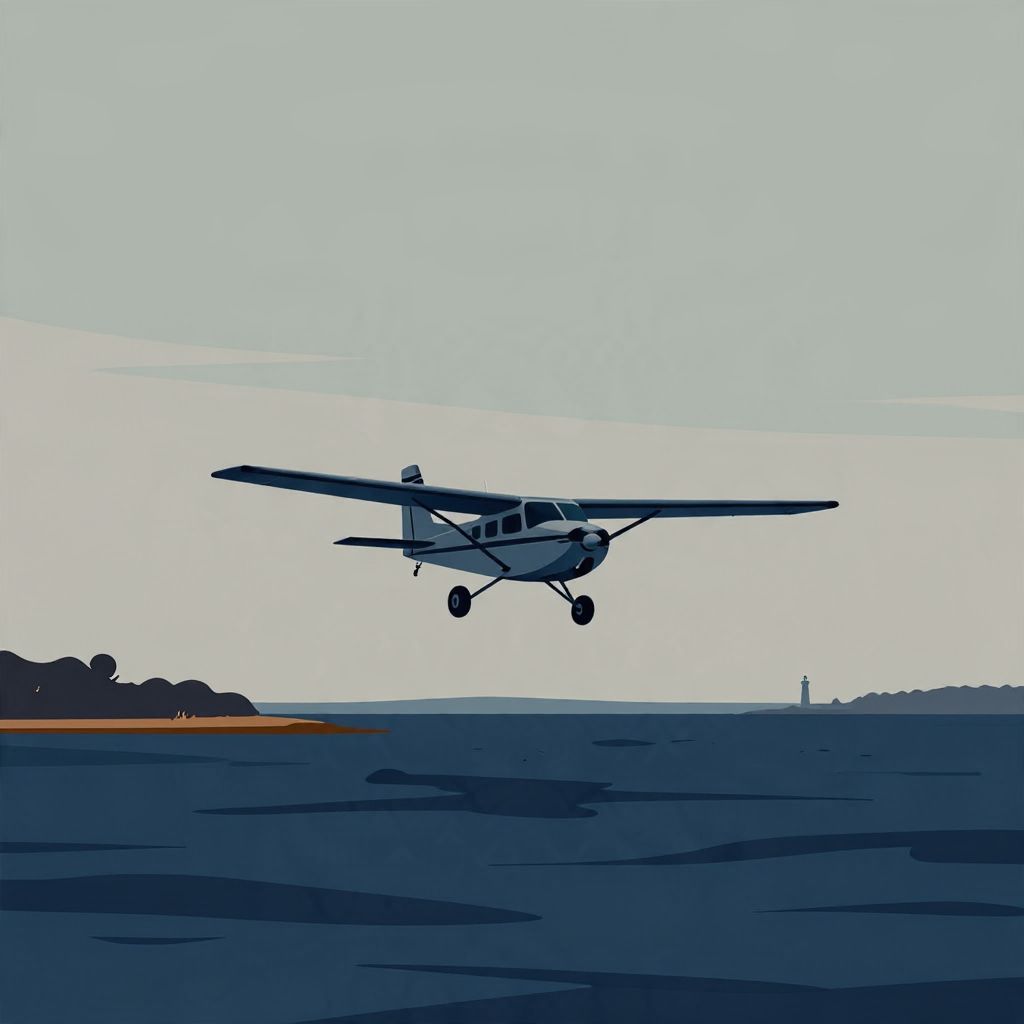
Why did JFK Jr. plane crash? The short answer is that John F. Kennedy Jr.’s aircraft crashed because he became disoriented while flying at night over water, likely lost control in poor visibility, and the plane descended into the Atlantic near Martha’s Vineyard on July 16, 1999. The National Transportation Safety Board concluded that the probable cause was pilot error, not mechanical failure.
The crash ended the lives of Kennedy, his wife Carolyn Bessette Kennedy, and her sister Lauren Bessette. Because of the Kennedy family’s public prominence, the accident quickly became a national tragedy and a subject of intense speculation, but the historical record is clear on the main causes.
Why did JFK Jr. plane crash?
JFK Jr.’s plane crashed because he likely lost situational awareness during a night flight over water, became spatially disoriented, and descended into the ocean. Investigators found no evidence of a catastrophic mechanical failure. The accident is widely understood as a tragic case of a relatively inexperienced instrument-rated pilot flying in conditions that demanded more precision than visual cues could safely provide.
The flight on July 16, 1999
On the evening of July 16, 1999, Kennedy piloted a Piper Saratoga from New Jersey toward Martha’s Vineyard, Massachusetts, where he planned to drop off his wife and sister-in-law before continuing to a family event. The flight took place after sunset, and weather conditions included haze and reduced visibility over the water. That combination mattered: over land, pilots can often orient themselves using roads, lights, and the horizon; over dark water, those visual references can disappear.
Kennedy was not a novice pilot, but he was also not a highly experienced instrument-only pilot. In aviation, that distinction is crucial. A pilot flying at night can become dependent on instruments when outside visual cues are weak or misleading. If the pilot is not fully comfortable relying on those instruments, spatial disorientation can occur quickly.
What investigators concluded
The National Transportation Safety Board (NTSB) determined that the probable cause of the crash was Kennedy’s failure to maintain control of the airplane during descent over the ocean, due to spatial disorientation. In practical terms, this means he likely could not accurately sense the aircraft’s attitude, altitude, or direction once visual references were lost. The plane then entered a steep descent and struck the water.
Investigators did not find evidence that the aircraft suffered a sudden engine failure or that a hidden technical defect caused the accident. The most important factor was the human one: a pilot in difficult conditions, with limited external visibility, making a fatal navigation and control error.
What is spatial disorientation?
Spatial disorientation happens when a pilot’s body and senses give false information about the aircraft’s position or motion. At night, especially over featureless terrain or open water, the inner ear can create the illusion that the plane is level when it is turning, or that it is climbing when it is actually descending. Pilots must then trust their instruments rather than their senses.
This is one reason aviation training emphasizes instrument flying. A pilot who cannot reliably interpret the instruments, or who becomes distracted or overloaded, can quickly lose control without realizing it. In JFK Jr.’s case, the conditions were especially hazardous because the flight was conducted at night over the Atlantic, where there were few external visual cues.
Why night over water is so dangerous
- Few visual references: Open water provides little sense of height or direction.
- Reduced horizon visibility: Haze and darkness can erase the natural horizon.
- Instrument dependence: Pilots must rely on cockpit instruments more than sight.
- Higher workload: Navigation, communication, and landing preparation all become more demanding.
These hazards do not guarantee an accident, but they increase the risk significantly if a pilot is tired, distracted, or not fully proficient in instrument conditions.
Was the plane mechanically faulty?
There is no strong evidence that mechanical failure caused the crash. The investigation focused heavily on pilot performance and environmental conditions, and the NTSB’s conclusion pointed away from the airplane itself. That does not mean every mechanical issue can be ruled out in a casual sense, but the historical and investigative consensus is that the aircraft was not the primary cause.
Popular speculation often follows high-profile accidents, especially when the victims are famous. In this case, however, the evidence supports a more ordinary but devastating explanation: the airplane was flyable, but the flight conditions exceeded the pilot’s ability to maintain safe control.
Who was JFK Jr., and why did the crash draw so much attention?
John F. Kennedy Jr. was the son of President John F. Kennedy and Jacqueline Kennedy Onassis. Born in 1960, he grew up under extraordinary public scrutiny and became one of the most recognizable figures in American public life. He was a lawyer, magazine publisher, and a member of the most famous political family in the United States.
Because of that legacy, his death felt larger than an aviation accident. It was also interpreted as the loss of a symbolic heir to the Kennedy name. The public response reflected both grief and the long-standing cultural fascination with the Kennedy family, whose history had already been marked by assassination, tragedy, and sudden death.
The broader Kennedy family context
The Kennedy family had long been associated with public service, glamour, and loss. By 1999, Americans were accustomed to seeing the family’s history through the lens of both achievement and misfortune. JFK Jr.’s death added another chapter to that story, reinforcing the sense that the family’s public life was inseparable from private tragedy.
What happened after the crash?
The crash triggered a large search and recovery effort in the waters off Martha’s Vineyard. Wreckage was eventually located on the ocean floor, and the bodies of Kennedy, Carolyn Bessette Kennedy, and Lauren Bessette were recovered. The accident prompted renewed discussion of pilot training, especially for private pilots who fly in marginal weather or at night.
In the aftermath, aviation observers pointed to the importance of conservative decision-making: delaying a flight, using an instrument-rated pilot, or avoiding night over-water travel when visibility is poor. The crash became a case study in how small judgment errors can combine with difficult conditions to produce catastrophe.
Lessons the accident highlighted
- Respect weather and visibility limits.
- Know the difference between visual flying and instrument flying.
- Avoid overconfidence, especially on routine personal flights.
- Recognize that night over water can be especially unforgiving.
Why the historical explanation matters
The story of JFK Jr.’s plane crash is not just about a famous family. It is also a reminder of how aviation accidents often happen: not through a single dramatic failure, but through a chain of human decisions, environmental conditions, and moment-to-moment disorientation. The historical record shows that the crash was a tragic accident rooted in pilot control loss, not a mystery requiring elaborate theories.
That clarity matters because it separates evidence from rumor. In history, especially when public figures are involved, speculation can outlast facts. But the best-supported explanation remains the simplest one: JFK Jr. crashed because he lost control of his plane in night conditions over the ocean and could not recover before impact. If you are interested in related American history, you may also want to read about the Kennedy family legacy or major aviation disasters in modern history.