
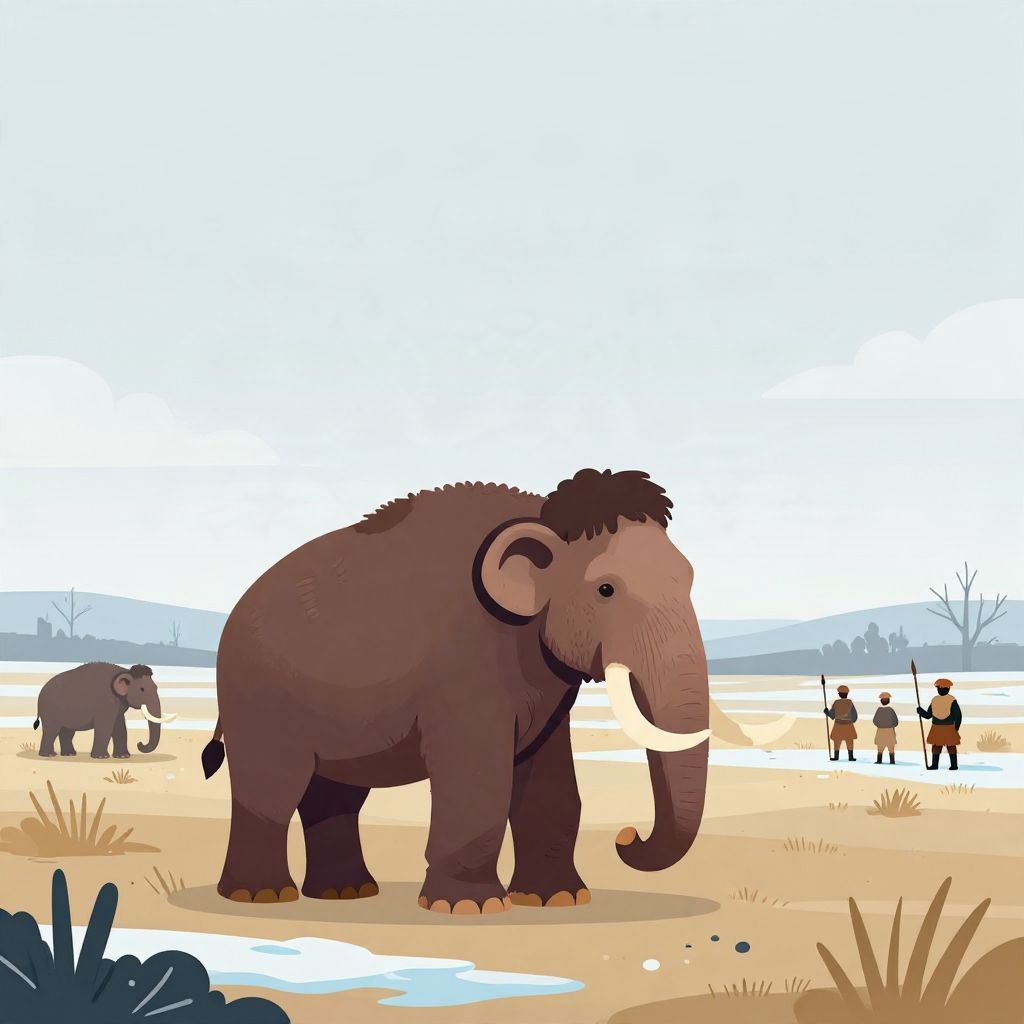
Why did woolly mammoths go extinct? The short answer is that they likely disappeared because several pressures hit them at once: warming climate, shrinking Ice Age habitat, reduced food supply, and hunting by humans. They did not vanish in a single moment or for a single reason. Instead, their extinction unfolded unevenly over thousands of years, with different populations dying out at different times.
For most of the Ice Age, woolly mammoths were successful cold-adapted animals across northern Eurasia and North America. But as the last glacial period ended, the world changed quickly. The mammoths’ grassland world contracted, and the species became increasingly vulnerable.
Why Did Woolly Mammoths Go Extinct?
Woolly mammoths went extinct because the end of the Ice Age transformed their environment faster than they could adapt. Rising temperatures replaced open, dry steppe with wetter forests, marshes, and tundra, reducing the grasses they depended on. Human hunting probably added pressure, especially on already stressed populations, but climate change was the main driver.
The Mammoth’s Ice Age World
A species built for cold grasslands
Woolly mammoths (Mammuthus primigenius) were large elephant relatives adapted to cold, open environments. They had thick fur, layers of fat, small ears, and curved tusks. These features helped them survive in the “mammoth steppe,” a vast Ice Age ecosystem that stretched across parts of Europe, Asia, and North America.
This landscape was not a frozen wasteland. It was a productive grassland-steppe with herbs, sedges, and grasses that supported herds of large herbivores, including mammoths, bison, horses, and woolly rhinoceroses. The mammoth was well suited to this world, and for tens of thousands of years it thrived in it.
When the environment changed
The last Ice Age ended gradually after about 19,000 years ago, with major warming episodes reshaping the northern hemisphere. As glaciers retreated, many mammoth habitats became wetter and more wooded. In some regions, forests spread where open steppe had once dominated. That mattered because mammoths were grazers, not forest browsers.
As their habitat fragmented, mammoth populations became smaller and more isolated. Smaller populations are more likely to suffer from inbreeding, low birth rates, and random losses from disease or harsh weather. In other words, climate change did not simply make life harder; it made mammoths more vulnerable to every other threat.
Climate Change Was the Main Cause
Loss of the mammoth steppe
The strongest scholarly explanation for woolly mammoth extinction is habitat loss caused by post-Ice Age warming. Mammoths needed broad, cold, grassy plains. As temperatures rose, those plains shrank. In many places, the vegetation changed from dry grassland to shrubs, birch, pine, and other plants that mammoths could not use as efficiently.
Food quality also changed. The mammoth steppe had supported a rich grazing system. When that system broke down, mammoths faced less abundant and less nutritious forage. Even if they could survive in some areas, they could not maintain the large, stable populations needed for long-term survival.
Sea level rise and shrinking range
Warming also raised sea levels, flooding low-lying land and cutting off habitats. This was especially important for island and coastal populations. As ranges contracted, mammoths were pushed into smaller refuges. Some groups survived in isolated pockets long after the mainland populations disappeared, but those refuges were fragile.
One famous example is Wrangel Island in the Arctic Ocean, where a small mammoth population survived until roughly 4,000 years ago, long after most mammoths were gone. Another population survived on St. Paul Island in Alaska until around 5,600 years ago. These late survivors show that mammoths did not vanish everywhere at once; instead, they lingered where conditions remained suitable for a while.
Did Humans Cause the Extinction?
Hunting likely mattered, but it was not the only factor
Humans and woolly mammoths overlapped for thousands of years. Ice Age hunter-gatherers hunted mammoths and used their bones, tusks, and hides. Archaeological evidence shows that mammoths were part of human subsistence and material culture in some regions. That means hunting pressure was real.
Still, most historians and paleontologists do not treat human hunting as the sole explanation. Mammoths had already survived alongside humans for a long time in many areas. The more likely picture is that climate change weakened mammoth populations, and human hunting added extra stress to groups already struggling with habitat loss and smaller numbers.
The “overkill” idea and its limits
One older explanation argued that humans rapidly hunted mammoths to extinction across the globe. That idea, often called the overkill hypothesis, is now seen as too simple. It may fit some local cases better than others, but it does not explain the uneven timeline of extinction or the survival of isolated island populations long after humans had spread widely.
The more balanced interpretation is that extinction usually comes from a combination of causes. For woolly mammoths, climate change appears to have been the primary force, while human activity likely accelerated decline in some regions.
Why Some Mammoths Survived Longer Than Others
Isolated refuges delayed extinction
Not all mammoths disappeared at the same time. Mainland populations died out earlier, while isolated island groups survived much longer. These refuges had fewer predators, less human contact, and environmental conditions that remained suitable for a time. But isolation also made them vulnerable to genetic problems and sudden environmental shifts.
The Wrangel Island mammoths are especially important because they show how extinction can be delayed rather than immediate. A population can persist for millennia in a small refuge and still be doomed by limited resources, disease, or a changing climate. Their survival was remarkable, but it was also precarious.
Genetic decline and small populations
Scientists studying mammoth DNA have found signs that some late populations experienced genetic deterioration. In small populations, harmful mutations can build up, and reproductive success can fall. This does not mean genetics alone caused extinction, but it likely made already weakened mammoths less resilient.
So the final collapse was probably the result of an ecological chain reaction: warming reduced habitat, smaller populations became isolated, genetic health declined, and human hunting may have intensified the pressure in some places.
How the Extinction Happened Over Time
A brief chronology
The extinction of woolly mammoths was not a single event. It unfolded in stages across different regions:
- Before about 20,000 years ago: Woolly mammoths were widespread across northern Eurasia and North America.
- After the last glacial maximum: Warming began to transform the mammoth steppe and reduce available habitat.
- By roughly 10,000 years ago: Mammoths had disappeared from most mainland regions.
- Later island refuges: Small populations survived on islands such as St. Paul and Wrangel.
- By about 4,000 years ago: The last known woolly mammoths were gone.
This staggered timeline is one reason historians and scientists reject a single-cause explanation. Different environments, different human populations, and different local conditions produced different extinction dates.
What the Fossil Record Tells Us
Evidence from bones, tusks, and ancient DNA
Scientists reconstruct mammoth extinction from fossils, radiocarbon dating, ancient DNA, and environmental evidence such as pollen and plant remains. These sources show that mammoth numbers declined as climates warmed and landscapes changed. They also show that late-surviving populations were often isolated and genetically stressed.
Radiocarbon dates are especially useful, though they are not perfect. They provide approximate timelines, not exact death certificates. Even so, the broad pattern is clear: mammoths disappeared as the Ice Age world that sustained them broke apart.
What the evidence does not show
The evidence does not support the idea that mammoths vanished because they were inherently weak or poorly adapted. They had been highly successful for a very long time. Their extinction was tied to a major environmental transition, not to a simple failure of the species.
It also does not support a single dramatic catastrophe, such as one sudden disaster wiping them out everywhere at once. The extinction was gradual, regional, and uneven.
Why the Mammoth Story Matters
A lesson in environmental change
The woolly mammoth’s extinction is one of the clearest examples of how climate change can reshape life on Earth. When temperatures shifted and habitats changed, even a dominant Ice Age animal could not easily survive. The mammoth’s story shows that extinction often happens when environmental stress, shrinking range, and human impact converge.
It also helps explain why conservation today focuses not just on individual species, but on ecosystems. Mammoths did not disappear simply because they were hunted or because the climate warmed. They disappeared because the entire ecological system that supported them collapsed.
Conclusion
Woolly mammoths went extinct mainly because the Ice Age ended and their cold, grassy habitat disappeared. Human hunting likely contributed, especially in weakened populations, but climate change was the central cause. Their extinction was gradual, region by region, until the last isolated island mammoths died out thousands of years ago.
For readers interested in related prehistoric history, it is also worth exploring the broader story of the Ice Age and its environments and the history of early human migration and hunting.