
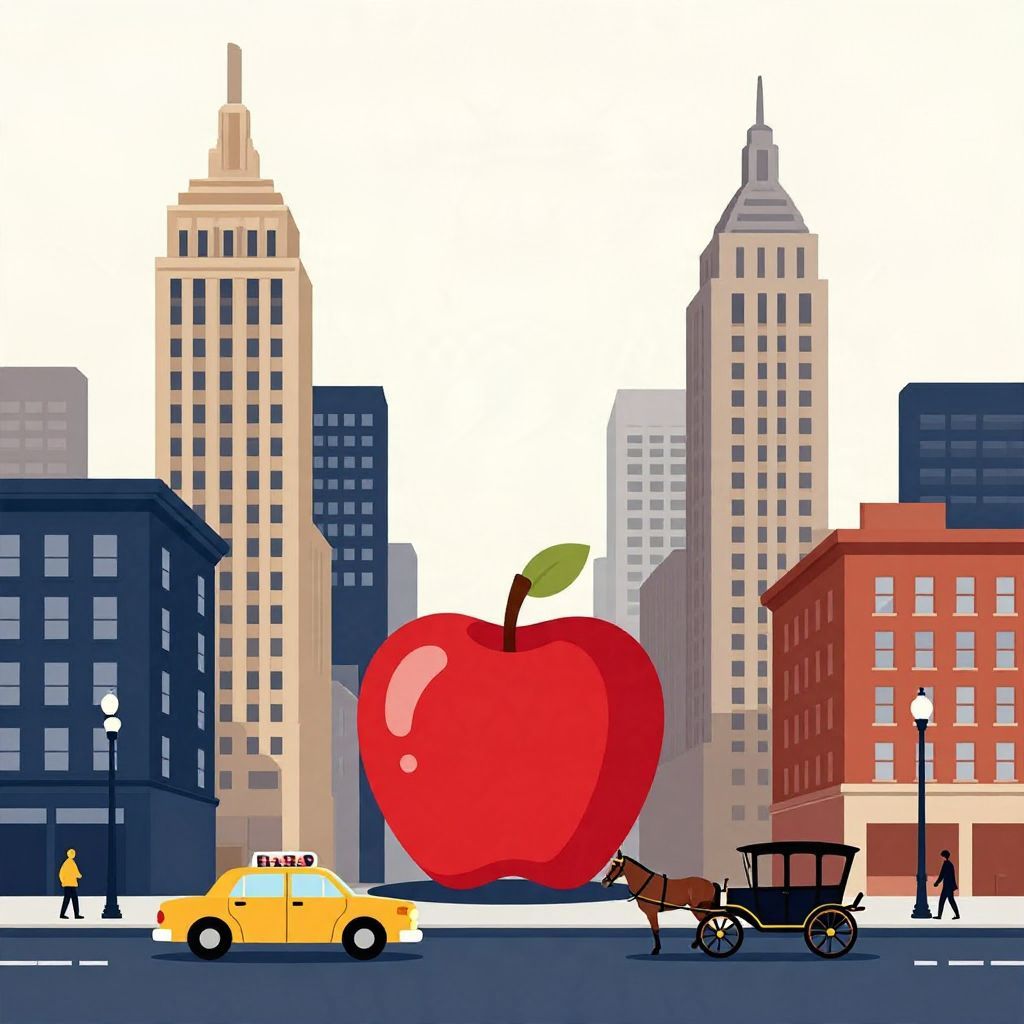
Why do they call New York “the Big Apple”? The nickname is one of the city’s most famous labels, but its origin is not ancient and not especially mysterious once the evidence is sorted out. It grew out of early 20th-century horse-racing slang, then spread through jazz culture and newspaper writing before becoming a citywide emblem.
The story is a good example of how place nicknames evolve: a local phrase can move from one subculture into the mainstream and eventually become part of a city’s identity. In New York’s case, the name reflects ambition, opportunity, and the city’s reputation as the biggest prize in America.
Why do they call New York the Big Apple?
New York is called the Big Apple because the nickname first emerged in the 1920s as slang for the city’s top horse-racing prizes, then was popularized by jazz musicians and newspaper columnist John J. Fitz Gerald. By the 1970s, it had been revived as an official civic brand and became widely associated with New York City itself.
The earliest meaning: horse racing and the “big apple” prize
The strongest historical evidence points to horse racing in the early 20th century. In that world, “the big apple” appears to have meant the biggest or most desirable prize, especially the major purses and prestige attached to racing in New York. At the time, New York tracks were among the most important in the United States, so winning there mattered enormously.
This usage fits the slang patterns of the era. “Apple” was sometimes used informally to mean something desirable, and “big apple” suggested the biggest reward of all. The exact moment the phrase entered racing slang is hard to pin down with certainty, but historians generally agree that the expression was already circulating before it became a nickname for the city in popular culture.
Why horse racing mattered
In the 1910s and 1920s, New York was a major center of American horse racing. Tracks such as Belmont Park and Aqueduct drew elite horses, wealthy bettors, and national attention. To horsemen, New York was where the biggest opportunities were concentrated. That made it a natural place for a phrase like “the big apple” to stick.
John J. Fitz Gerald and the phrase’s rise in print
The nickname became famous through the writing of John J. Fitz Gerald, a sports columnist for the New York Morning Telegraph. In the 1920s, he used “The Big Apple” in columns about horse racing, especially when referring to New York as the premier destination for racing success. His use of the term helped move it from insider slang into public language.
Fitz Gerald is often credited with popularizing the nickname, though he was not necessarily the first person to use it. That distinction matters. Historical nicknames often have messy origins: one group invents them, another group spreads them, and later writers simplify the story into a single “creator.” In this case, the evidence suggests Fitz Gerald was a crucial popularizer, not necessarily the original inventor.
A nickname with a sports-world route
Fitz Gerald’s columns connected the phrase to New York’s racing scene in a way readers could understand. By repeating it in a widely read newspaper, he helped transform a niche expression into a recognizable label for the city. This is one reason the nickname has such a strong sports-and-entertainment flavor even today.
How jazz musicians helped spread the nickname
After horse racing, the nickname gained another life in the jazz age. In the 1920s and 1930s, musicians used “the Big Apple” to describe New York as the biggest and best place to perform. For touring jazz players, the city represented the top of the profession: the largest audiences, the most prestigious clubs, and the greatest chance for success.
This broader cultural meaning helped the nickname escape the racetrack. It no longer referred only to betting and purses; it came to symbolize the city itself as the ultimate prize. That shift is important because it explains why the phrase lasted. A nickname tied only to one sport might have faded, but one tied to the city’s cultural power could endure.
New York as the “biggest stage”
For performers, New York was not just a place to work. It was the place where reputations were made. The phrase “Big Apple” fit that reality perfectly. It suggested a city large enough to offer opportunity, competitive enough to test talent, and glamorous enough to define success.
What the nickname meant in its historical context
The nickname reflected more than size. New York was already the nation’s largest city and a growing center of finance, publishing, theater, immigration, and commerce. Calling it the Big Apple implied that it was the biggest prize in the American urban system: the place where people came to make money, build careers, and seek a better life.
That symbolic meaning mattered because New York’s growth in the late 19th and early 20th centuries made it a magnet for ambitious people. Immigrants arrived through Ellis Island, businesses expanded, and neighborhoods became densely layered with different languages and cultures. The nickname captured the city’s reputation as a place of abundance, competition, and possibility.
Why “apple” worked as a metaphor
“Apple” was a flexible image. It could suggest something attractive, valuable, and ripe for the taking. Combined with “big,” it implied the largest and most desirable version of that reward. The phrase was catchy, easy to remember, and adaptable to different settings, which helped it survive long after its original context was forgotten.
The nickname faded, then came back
Despite its early popularity in certain circles, “the Big Apple” did not become the city’s dominant nickname right away. For a time, it remained somewhat obscure outside sports and entertainment. That changed in the 1970s, when New York City faced fiscal crisis and image problems and city officials looked for ways to promote tourism and civic pride.
During that period, the nickname was revived in a deliberate branding campaign. The city used “The Big Apple” to present New York as energetic, exciting, and open for visitors. This helped turn an old slang term into a modern identity marker. By then, the phrase had become so familiar that it felt natural as a slogan, even though its roots were decades old.
From slang to civic brand
This transition is one of the most interesting parts of the story. A nickname that began in a narrow professional subculture became a public symbol of the whole city. That kind of transformation is common in urban history: informal language can be reworked into official identity when it fits a city’s self-image.
Popular myths about the origin
Because the nickname is so famous, several folk explanations have circulated over the years. Some are colorful, but they are not well supported by historical evidence. The most important thing is to separate legend from documented history.
Myth: it came from apple sellers in New York markets
This explanation sounds plausible because apples were sold in city markets, but it is not the main historical source of the nickname. The strongest evidence points instead to horse racing and later jazz culture. Market imagery may have helped the phrase feel familiar, but it does not explain its documented rise.
Myth: it was a colonial-era nickname
New York was not called the Big Apple in the colonial period. The nickname is a 20th-century development. Earlier names and descriptions of the city existed, but “the Big Apple” belongs to the modern era of mass media, sports journalism, and urban branding.
Myth: one person invented it all at once
Nicknames usually do not have a single clear inventor. In this case, the phrase seems to have moved through several communities: racetrack insiders, journalists, jazz musicians, and later city promoters. Fitz Gerald is important, but the nickname’s history is broader than one person.
Why the nickname lasted
The Big Apple endured because it matched New York’s character. The city has long been seen as large, competitive, and full of possibility. The nickname suggests not just size, but a place where the biggest opportunities are found and where success is most visible. That meaning has remained useful across changing eras.
It also helped that the phrase is vivid and memorable. Unlike a purely descriptive label, “the Big Apple” sounds distinctive and slightly playful. It gives the city personality. Over time, that made it ideal for tourism, media, and popular culture.
What the nickname tells us about New York history
The history of “the Big Apple” reveals how New York’s identity was built through culture as much as through economics. The city became famous not just because it was large, but because people kept describing it as the place where the biggest rewards could be found. That reputation was reinforced by horse racing, jazz, newspapers, and later official promotion.
In that sense, the nickname is more than a catchy phrase. It is a historical record of how New York came to be imagined as America’s premier city: a place of ambition, competition, and reinvention. The name survived because it captured something real about the city’s role in modern American life.
So, why do they call New York the Big Apple? Because the phrase began as early 20th-century slang for the city’s biggest prizes, was popularized by sportswriting and jazz culture, and later became a proud civic symbol. If you enjoy the history of place nicknames, you may also like reading about why Boston is called Beantown or why Tennessee is called the Volunteer State.