
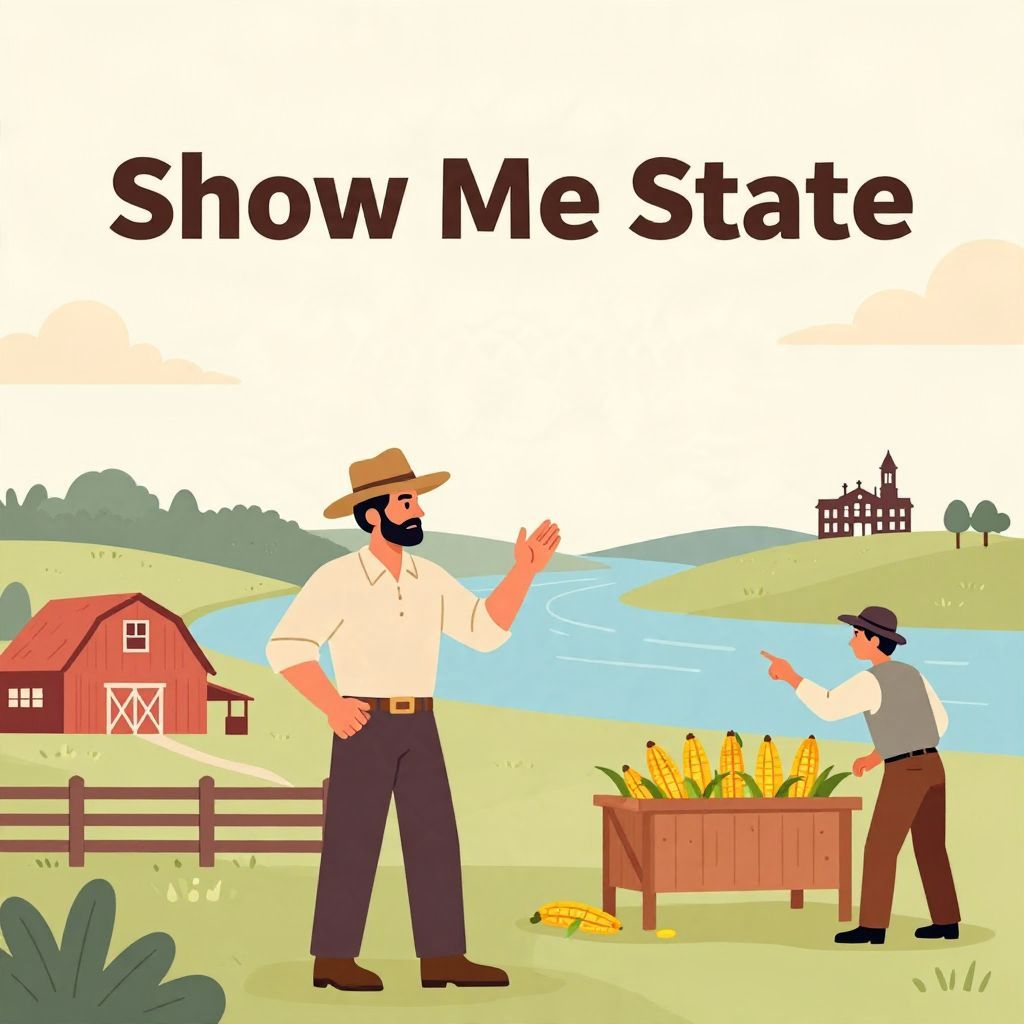
Why is Missouri called the Show Me State? The short answer is that the nickname reflects a long-standing reputation for practical, skeptical common sense. Missourians have often been described as people who want proof, not just promises, before they believe something or act on it.
The phrase became strongly associated with Missouri in the late 19th century, though its exact origin is debated. Over time, it grew from a political joke and a regional stereotype into an official state identity.
Why Is Missouri Called The Show Me State?
Missouri is called the Show Me State because the nickname captures a cultural image of cautious, plainspoken people who prefer evidence over talk. The phrase became linked to the state in the 1890s and was popularized nationally, especially through politics and newspapers. It does not come from one single official event.
The Origins of the Nickname
A phrase tied to skepticism and practicality
The most widely accepted explanation is that “Show Me” expresses a Missouri attitude: don’t just tell me, demonstrate it. In the 19th century, this fit a frontier state where settlers, farmers, merchants, and laborers often relied on direct experience and practical judgment. The phrase was easy to remember because it sounded blunt, memorable, and distinctly Midwestern.
Historians generally agree that the nickname was not invented by the state government. Instead, it emerged from popular speech and public culture. Like many state nicknames, it developed gradually and was later embraced as a point of pride.
The 1899 naval speech theory
One famous story links the phrase to U.S. Representative Willard D. Vandiver, who is said to have told a naval banquet in 1899 that he came from a state “that raises corn and cotton and cockleburs and Democrats, and frothy eloquence neither convinces nor satisfies me. I am from Missouri. You have got to show me.” This is the best-known version of the origin story.
However, scholars treat this account cautiously. It is widely repeated, but the exact wording and whether Vandiver truly coined the phrase in that moment are not fully certain. What is clear is that by the end of the 1890s, “Show Me” was already becoming strongly associated with Missouri in public life.
Earlier uses of “show me”
Some evidence suggests the phrase may have circulated before Vandiver’s speech. In the late 19th century, “show me” was already a common American expression meaning “prove it.” That makes it possible that Missouri’s nickname grew out of an existing phrase rather than a single invention. The state’s reputation helped fix the expression in national memory.
In other words, the nickname likely came from a mix of language, politics, and stereotype. It was not a formal title bestowed all at once, but a phrase that stuck because it fit Missouri’s public image so well.
Why the Phrase Fit Missouri So Well
A border state with a mixed identity
Missouri’s history helps explain why the nickname took hold. Admitted to the Union in 1821, Missouri sat at the edge of the American frontier and later became a border state during the Civil War. It was shaped by migration from the Upper South, the Midwest, and beyond, creating a culture that was both regional and transitional.
That setting encouraged practicality. People there often had to judge land, weather, trade, and politics for themselves. A skeptical attitude made sense in a place where promises could be unreliable and conditions could change quickly.
Politics and plain speech
Missouri’s political culture also helped the nickname spread. In the late 1800s and early 1900s, American politics was full of oratory, party loyalty, and exaggerated claims. A phrase like “Show Me” cut through that style. It suggested that Missourians were not easily impressed by rhetoric alone.
This image was flattering in a particular way. It implied independence, toughness, and a refusal to be fooled. At the same time, it also carried a hint of mockery, as if Missourians were unusually hard to persuade. Both meanings helped the nickname endure.
How the Nickname Became Official
From popular phrase to state symbol
Over time, Missouri embraced the nickname rather than resisting it. By the 20th century, “Show Me State” was commonly used in advertising, journalism, and civic identity. The phrase appeared on souvenirs, license plates, and promotional material, turning a once-informal expression into a recognizable brand.
Missouri later made the nickname official, reinforcing what had already become common usage. This is typical of state nicknames: many begin as informal labels and are adopted later because they resonate with residents and outsiders alike.
Why official adoption mattered
Once a nickname becomes official, it does more than describe a state. It helps shape how the state presents itself. Missouri’s adoption of “Show Me State” signaled that the phrase was no longer just a joke or a newspaper line. It had become part of the state’s public identity and tourism image.
That official recognition also preserved the phrase for later generations. Even people who do not know the exact origin story usually know what the nickname means: proof matters.
What the Nickname Does and Does Not Mean
It is not a literal historical command
Despite the familiar wording, “Show Me State” is not a record of a single law, slogan, or founding speech from Missouri’s earliest years. It is better understood as a cultural nickname that grew out of language and reputation. The phrase reflects attitude more than formal policy.
It also should not be taken too literally as a claim that all Missourians are distrustful or stubborn. Like most nicknames, it simplifies a diverse population into one memorable trait.
A stereotype with a positive edge
The nickname can sound skeptical, but it also suggests honesty and common sense. In American culture, being hard to fool is often admired. That is one reason the phrase endured: it was critical enough to be funny, but respectful enough to be embraced.
Missouri turned a regional stereotype into a badge of identity. Instead of rejecting the label, many residents adopted it as a sign of independence and realism.
The Historical Context Behind “Show Me”
Frontier life and self-reliance
In the 19th century, much of Missouri’s growth came from settlement, farming, river commerce, and expansion westward. In such a setting, self-reliance mattered. People often had to make decisions without much outside help, and practical proof was more valuable than abstract argument.
This broader frontier experience helps explain why the phrase felt believable. “Show me” matched the habits of a society where usefulness and results often counted more than polished language.
Missouri between regions
Missouri was neither fully Southern nor fully Northern in the way Americans often imagined those regions. It shared features with both, while also developing its own identity. That in-between position made a flexible nickname especially useful. “Show Me” could describe suspicion, independence, humility, or wit depending on the context.
Because the phrase was broad enough to cover several traits, it lasted. A nickname that only fit one moment would have faded. Missouri’s did not, because it could be reinterpreted again and again.
Popular Legend vs. Historical Evidence
- Well supported: The nickname became associated with Missouri in the late 19th century.
- Likely but not certain: Willard D. Vandiver helped popularize the phrase through a 1899 speech.
- Uncertain: Whether Vandiver truly originated the expression.
- Clear: The phrase reflected a broader American meaning of “prove it.”
- Clear: Missouri later embraced the nickname as part of its identity.
This distinction matters because state nicknames often grow from a blend of fact and folklore. The story of Missouri’s nickname is no exception. The legend is memorable, but the historical process was broader and messier than a single quotation.
Why the Nickname Still Matters Today
The phrase “Show Me State” remains powerful because it says something simple about how Missouri likes to be seen: practical, skeptical, and independent. It has outlived the political moment that helped spread it because it still sounds useful in everyday life. People continue to value proof, especially in an age full of claims and persuasion.
So, Missouri is called the Show Me State because the phrase captured a real and enduring public image, then became part of the state’s identity. Its origin is partly historical and partly legendary, but its meaning is clear: in Missouri, words alone are not enough. If you want belief, you have to show it.
For more on state nicknames and regional history, you may also enjoy History.org and why Tennessee is called the Volunteer State.