
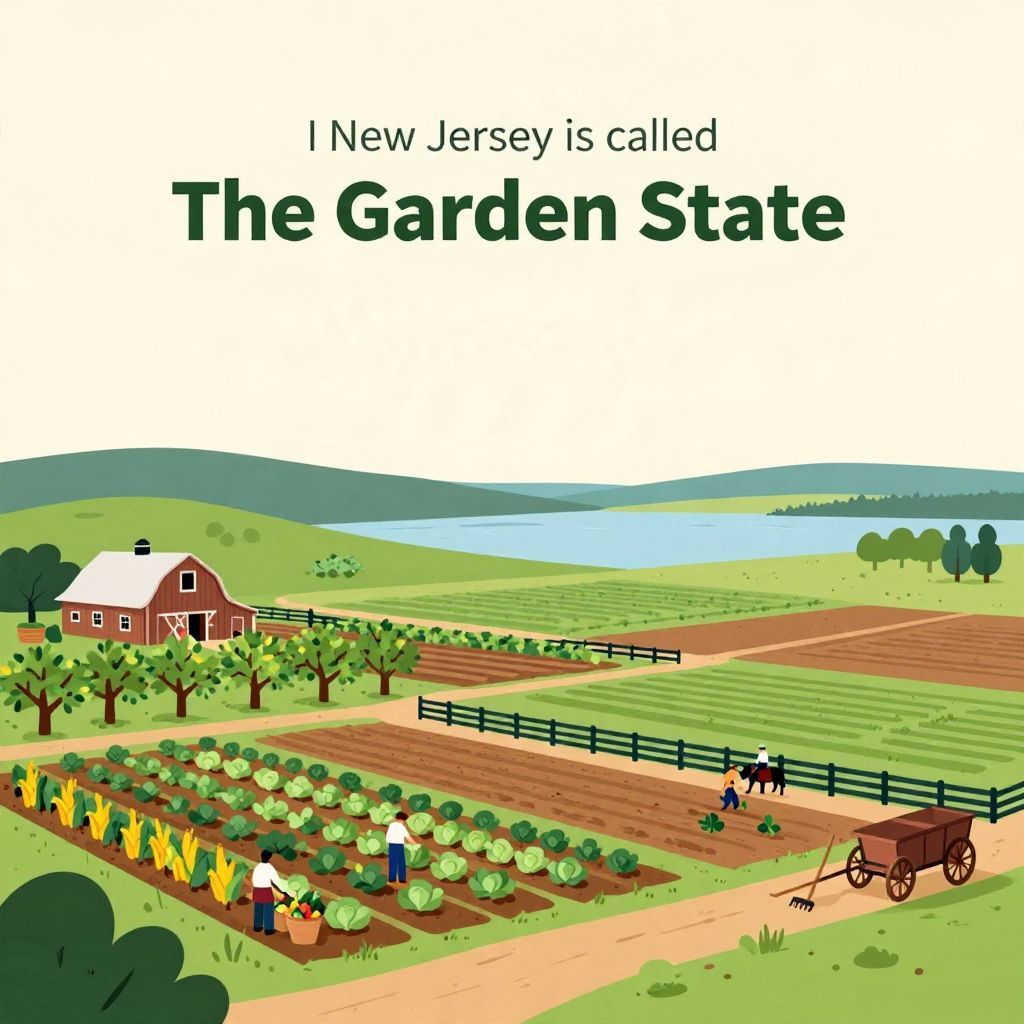
Why is New Jersey called the Garden State? The short answer is that the nickname grew from the state’s long-standing reputation for fertile farms, orchards, and market gardens, especially in the 18th and 19th centuries. It was not an official government title at first, but a popular image that reflected New Jersey’s agricultural abundance.
Over time, the phrase stuck because it captured something true about the state’s landscape and economy. Even as New Jersey became one of the most urbanized and industrialized states in America, the nickname survived as a reminder of its earlier rural identity and its continuing agricultural importance.
Why Is New Jersey Called the Garden State?
New Jersey is called the Garden State because for much of its history it was known for productive farmland, orchards, and truck gardens that supplied nearby cities like New York and Philadelphia. The nickname emerged in the 19th century as a way of praising the state’s rich soil and agricultural output, though the exact origin of the phrase is debated.
The Agricultural Roots Behind the Nickname
The most important reason for the nickname is simple: New Jersey was once deeply agricultural. Its varied soils, moderate climate, and location between major urban markets made it ideal for growing fruits, vegetables, and other crops. Farmers near the cities could sell fresh produce quickly, giving the state a strong reputation for abundance.
Farms, orchards, and market gardens
In the 1700s and 1800s, much of New Jersey consisted of farms rather than suburbs, highways, or industrial corridors. The state produced apples, peaches, cranberries, tomatoes, and other crops in large quantities. “Truck farming,” meaning the commercial growing of vegetables for sale in urban markets, became especially important in the 19th century.
This agricultural identity was visible to travelers and writers. Compared with the crowded cities nearby, New Jersey could seem like a cultivated landscape of fields, gardens, and orchards. That image helped the nickname take hold.
Why geography mattered
New Jersey’s geography helped create the conditions for the nickname. The state sits between the Atlantic coast and the Appalachian foothills, with a range of soils and microclimates. South Jersey, in particular, developed a strong farming economy because of its sandy soil, pine lands, and access to transportation routes that linked farms to urban consumers.
The state’s location was also crucial. Being close to major ports and dense cities meant farmers could specialize in fresh produce rather than only staple crops. That made New Jersey’s agricultural landscape distinctive and commercially valuable.
Where Did the Phrase “Garden State” Come From?
The exact origin of the phrase is not fully settled. Historians generally agree that it became popular in the 19th century, but there is no single universally accepted moment when it was coined. It appears to have developed gradually as a flattering description of the state’s fertility and farm production.
Popular attributions and uncertainty
One often repeated story credits the phrase to Abraham Browning, a New Jersey politician, who allegedly described the state as “an immense barrel from which the Garden State is filled.” This quotation is widely circulated, but scholars treat it cautiously because the wording is hard to verify in a reliable contemporary source. It may reflect later embellishment rather than exact historical record.
What is more secure is that by the late 1800s the nickname was in common use. It appeared in newspapers, speeches, and promotional material, showing that the phrase had become part of New Jersey’s public identity.
From description to nickname
Many state nicknames begin as informal descriptions before becoming fixed symbols. That is what happened here. “Garden State” was not originally a legal designation or marketing slogan created by a state agency. It was a cultural label that spread because it sounded accurate and appealing.
The phrase also worked well as a contrast to stereotypes of New Jersey as merely industrial or suburban. It reminded people that the state had a productive rural past and still contained large agricultural regions.
How New Jersey Changed in the 19th and 20th Centuries
As railroads, factories, and cities expanded in the 19th century, New Jersey changed dramatically. Industrial growth in places like Newark, Paterson, Jersey City, and Camden made the state a major manufacturing center. Later, highways and suburban development transformed large areas of farmland into residential and commercial land.
Industry did not erase the nickname
Even with rapid industrialization, the Garden State nickname remained. That is partly because the state never lost agriculture entirely. New Jersey continued to produce significant amounts of fruits, vegetables, and nursery products, even as the proportion of farmland declined.
The nickname also survived because it had emotional and symbolic value. It suggested continuity with the past, a sense of place, and a more appealing identity than smokestacks alone. In that sense, the phrase became a kind of historical memory.
State identity and tourism
By the 20th century, “Garden State” was useful in tourism and civic branding. It evoked green landscapes, shore resorts, and a more pleasant image than the industrial stereotypes often associated with New Jersey. The nickname helped present the state as varied rather than one-dimensional.
This branding was especially important because New Jersey’s public image was often shaped by its crowded highways, dense suburbs, and proximity to New York City. The nickname offered a counterbalance, emphasizing natural beauty and agricultural heritage.
Did New Jersey Really Deserve the Name?
Yes, historically speaking, the nickname was grounded in reality. New Jersey was not a wilderness of untouched nature, but it was a highly productive agricultural state for a long time. Its farms fed nearby cities and helped shape regional food systems. The “garden” in Garden State referred less to ornamental flower beds and more to cultivated land that was carefully worked and highly productive.
Not just a poetic label
Some state nicknames are purely symbolic, but this one had a practical basis. New Jersey’s farms mattered economically, and its produce had a real reputation. The nickname reflected both the landscape and the labor of generations of farmers, gardeners, and agricultural workers.
At the same time, the name should not be taken literally to mean that the entire state was one continuous garden. It was a broad metaphor for fertility, cultivation, and abundance.
What the Nickname Means Today
Today, New Jersey is one of the most densely populated and urbanized states in the United States, yet agriculture still plays a visible role in its identity. Blueberries, cranberries, tomatoes, sweet corn, peaches, and nursery plants remain part of the state’s agricultural profile. The nickname therefore continues to connect the modern state to its older rural history.
A symbol of continuity
The Garden State nickname now means more than farming alone. It represents resilience, regional identity, and the idea that a heavily developed state can still preserve open land and agricultural traditions. In that sense, the name has outlived the era that first inspired it.
It also reminds us that historical labels often survive long after the conditions that created them have changed. New Jersey is no longer mostly farmland, but the nickname preserves the memory of when agriculture defined much of the state’s economy and landscape.
Summary: Why the Name Stuck
New Jersey is called the Garden State because its fertile soil, productive farms, and market gardens made it famous for agriculture in the 18th and 19th centuries. The phrase likely emerged gradually as a popular description rather than from a single official source. Even after industrialization and suburban growth transformed the state, the nickname endured because it captured an important part of New Jersey’s historical identity.
In other words, the name is both a compliment and a historical record: a reminder that before New Jersey became known for highways and suburbs, it was widely admired for the richness of its land and the productivity of its farms.