
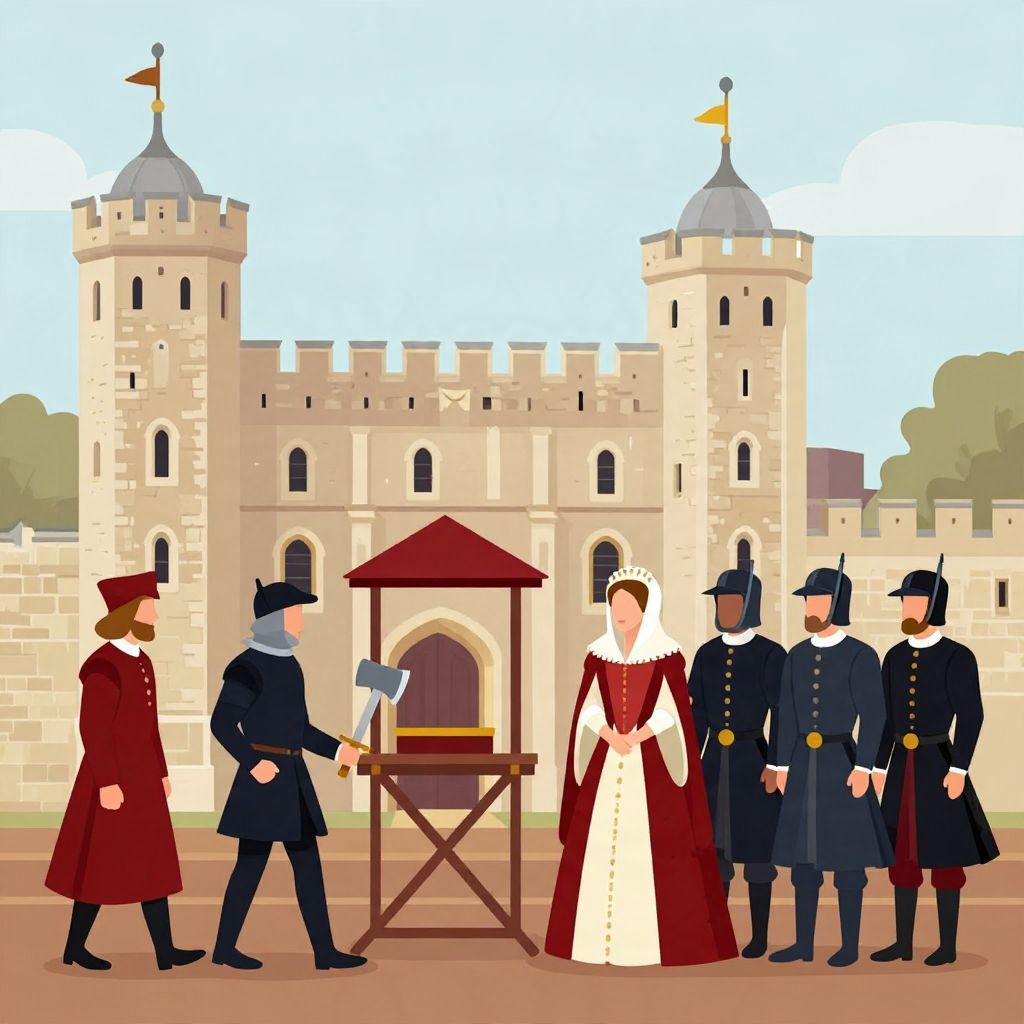
Anne Boleyn was executed in 1536 because King Henry VIII and his government decided she was no longer politically useful and could be removed once she had failed to produce a surviving male heir. The official charges against her were adultery, incest, and treason, but most historians see those accusations as fabricated or at least deeply manipulated.
Her fall was the result of court politics, Henry VIII’s desire for a new marriage, factional rivalry, and the dangerous instability created by the English Reformation. Anne’s execution was not simply the punishment of a guilty queen; it was the outcome of a Tudor power struggle in which law, religion, and royal authority were all used to destroy her.
Why was Anne Boleyn executed?
Anne Boleyn was executed in May 1536 because Henry VIII and his advisers wanted her removed, and the crown used charges of treason to make that removal legal. The accusations were almost certainly false or exaggerated. Her execution followed her failure to produce a male heir, a miscarriage in January 1536, and growing opposition at court, where Anne had enemies and the king was already turning toward Jane Seymour.
The political and personal reasons behind Anne Boleyn’s fall
Anne’s execution cannot be understood as a single cause. It grew out of several pressures at once: Henry’s disappointment over succession, Anne’s enemies at court, and the king’s willingness to sacrifice a queen when she no longer suited his needs. In Tudor England, royal favor could create power quickly, but it could disappear just as fast.
Henry VIII wanted a male heir
One of the central motives was dynastic. Henry VIII had married Anne after breaking with Catherine of Aragon, and the marriage was meant to secure the Tudor succession. Anne gave birth to Elizabeth in 1533, but she did not produce the longed-for son. A miscarriage in early 1536, around the time Henry was becoming interested in Jane Seymour, made her position far more vulnerable.
To a modern reader, it may seem harsh to blame a queen for not bearing a son, but in the Tudor world a queen’s value was closely tied to producing heirs. A living male child could stabilize the dynasty; repeated failure could be treated as a political crisis.
Anne had powerful enemies
Anne was not widely loved at court. She had risen rapidly and had helped bring about Henry’s break with Rome, which made her both influential and controversial. Many nobles and courtiers disliked her family, her supporters, or her reformist sympathies. Her sharp intelligence and strong personality also made her formidable in a court culture that expected women to be both royal and deferential.
Some of her enemies had personal motives, while others were political opponents who saw her as a threat. Once Henry’s affection cooled, those enemies had an opening. In a monarchy where the king’s will shaped justice, losing favor could become fatal.
Henry VIII had moved on
By 1536 Henry appears to have been emotionally and politically detached from Anne. He had become attracted to Jane Seymour, one of Anne’s ladies-in-waiting. That new relationship did not by itself cause Anne’s execution, but it mattered enormously. Henry had a pattern of using marriage as a political tool, and once he wanted a new wife, Anne’s survival became inconvenient.
It is important not to reduce the event to romance alone. Henry did not simply abandon Anne; he used the machinery of government to eliminate her. The process was political, legal, and theatrical.
What were the charges against Anne Boleyn?
The official accusations were that Anne had committed adultery with several men, including courtier Mark Smeaton, and had engaged in incest with her brother George Boleyn, Lord Rochford. She was also accused of plotting against the king, which made the case treason. In Tudor law, adultery by a queen could be treated as treason because it threatened the royal succession.
The main accusations
- Adultery with multiple men at court
- Incest with her brother George Boleyn
- Conspiracy against the king, framed as treason
- Threatening the succession by allegedly producing an illegitimate heir
These charges were extraordinary and, to most modern historians, not credible. The alleged affairs were said to have taken place over a period when Anne’s movements were closely watched and when some of the named men had little or no real opportunity to commit the acts described. The evidence was weak, and the speed of the proceedings suggests a predetermined outcome.
Why historians doubt the charges
The case against Anne was built on shaky ground. Several factors make it look more like a political purge than a genuine criminal prosecution:
- The accused men were arrested quickly and pressured under interrogation.
- Mark Smeaton, the only man to confess, may have been coerced.
- The timeline of the alleged meetings was implausible in several instances.
- Anne’s enemies stood to benefit from her removal.
- Henry’s interest in Jane Seymour had already created a strong motive to end the marriage.
That does not mean every detail was invented from nothing. Tudor courts were full of gossip, factional maneuvering, and sexual rumor. But rumor is not proof, and the legal case was designed to secure a conviction, not to test innocence fairly.
How the execution was carried out
Anne Boleyn was arrested on 2 May 1536 and taken to the Tower of London. Her alleged co-accused were arrested soon after. On 15 May she was tried by a panel of peers and found guilty. Four days later, on 19 May 1536, she was executed at Tower Green by a swordsman brought from Calais, rather than by the usual axe. That choice was probably intended to make the death quicker and more “merciful.”
A rapid legal destruction
The pace of events was striking even by Tudor standards. From arrest to execution took just over two weeks. That speed suggests the outcome had been decided before the formal trial. The legal process gave the appearance of justice, but the political decision had already been made.
Anne reportedly behaved with dignity in her final days, but the exact wording of her last speech is uncertain because later accounts differ. What is clear is that she met her death as a condemned traitor in the eyes of the state, even though many contemporaries and later historians have viewed her as a victim of royal power.
Was Anne Boleyn really guilty?
Most historians believe Anne Boleyn was not guilty of the crimes for which she was executed. The strongest explanation is that the charges were manufactured or grossly distorted to remove her from the political scene. Her guilt was less important than her usefulness to Henry VIII and his advisers.
Why the verdict is seen as unreliable
There are several reasons scholars are skeptical:
- The accusations emerged suddenly after Henry had lost interest in her.
- The evidence was inconsistent and often impossible to verify.
- The trial took place before a hostile panel in a system dominated by royal authority.
- Anne had already become politically isolated.
Some older writers treated Anne as morally suspect because Tudor and later Protestant and Catholic writers often had ideological reasons to condemn or defend her. Modern historical work tends to separate moral judgment from evidence. The best-supported conclusion is that Anne was executed because the regime wanted her gone, not because a fair court proved she was guilty.
The wider Tudor context: why this happened in 1536
Anne’s execution took place in a broader moment of upheaval. Henry VIII had broken with the papacy, dissolved monasteries, and made himself head of the Church of England. That revolution in authority made the monarchy more powerful, but also more unstable. The king’s marriages became matters of state, and the fate of queens became tied to religious and political change.
Religion and power were intertwined
Anne had supported reformist ideas and had helped create the conditions for Henry’s divorce from Catherine of Aragon. That made her politically useful during the break with Rome. But once the break had been achieved, her role changed. In a court where religious loyalties were divided, she could be recast as a liability. Her enemies could present her not just as an inconvenient wife, but as a dangerous figure whose fall would restore order.
Factional politics at court
Tudor court politics were highly competitive. Families and advisers competed for influence, offices, lands, and access to the king. Anne’s rise had benefited one faction; her fall helped another. Thomas Cromwell, Henry’s chief minister, is often associated with the plot against her, though historians debate how far he acted independently and how far he was carrying out the king’s wishes. What is clear is that Anne had lost the protection she once enjoyed.
What happened after Anne Boleyn’s execution?
Anne’s death did not solve Henry VIII’s succession problem. It did, however, clear the way for his marriage to Jane Seymour, whom he married just days later. Jane gave birth to the future Edward VI in 1537, which may have seemed to justify Henry’s ruthless decision at the time. But the long-term consequences were more complicated.
Her daughter Elizabeth became queen
Perhaps the most striking irony is that Anne’s daughter, Elizabeth I, later became one of England’s most successful monarchs. Elizabeth’s reign transformed Anne’s reputation over time, especially among Protestants who saw Anne as a martyr of sorts and as the mother of a Protestant queen. Yet Elizabeth’s success does not prove Anne was innocent in every sense; it does show how historical memory can reshape a condemned figure.
Anne’s legacy changed over time
Anne Boleyn has been remembered in many ways: as a schemer, a reformer, a victim, a catalyst of the English Reformation, and the mother of Elizabeth I. The truth is more ordinary and more tragic. She was a highly intelligent woman caught in a system where royal marriage was political, female fertility was scrutinized, and the king’s favor was the most fragile form of security.
So why was Anne Boleyn executed?
Anne Boleyn was executed because Henry VIII no longer wanted her, because she had failed to produce the male heir he desperately needed, and because court politics made it possible to destroy her through accusations of treason. The official charges were almost certainly false, but in Tudor England truth mattered less than royal power. Her death was the result of dynastic anxiety, factional rivalry, and an unforgiving political system.
In the end, Anne Boleyn was not executed simply for what she did. She was executed because she stood at the center of a dangerous struggle over succession, authority, and the future of the English monarchy. If you want to explore more Tudor history, related topics include the reign of Henry VIII and the story of Elizabeth I.