
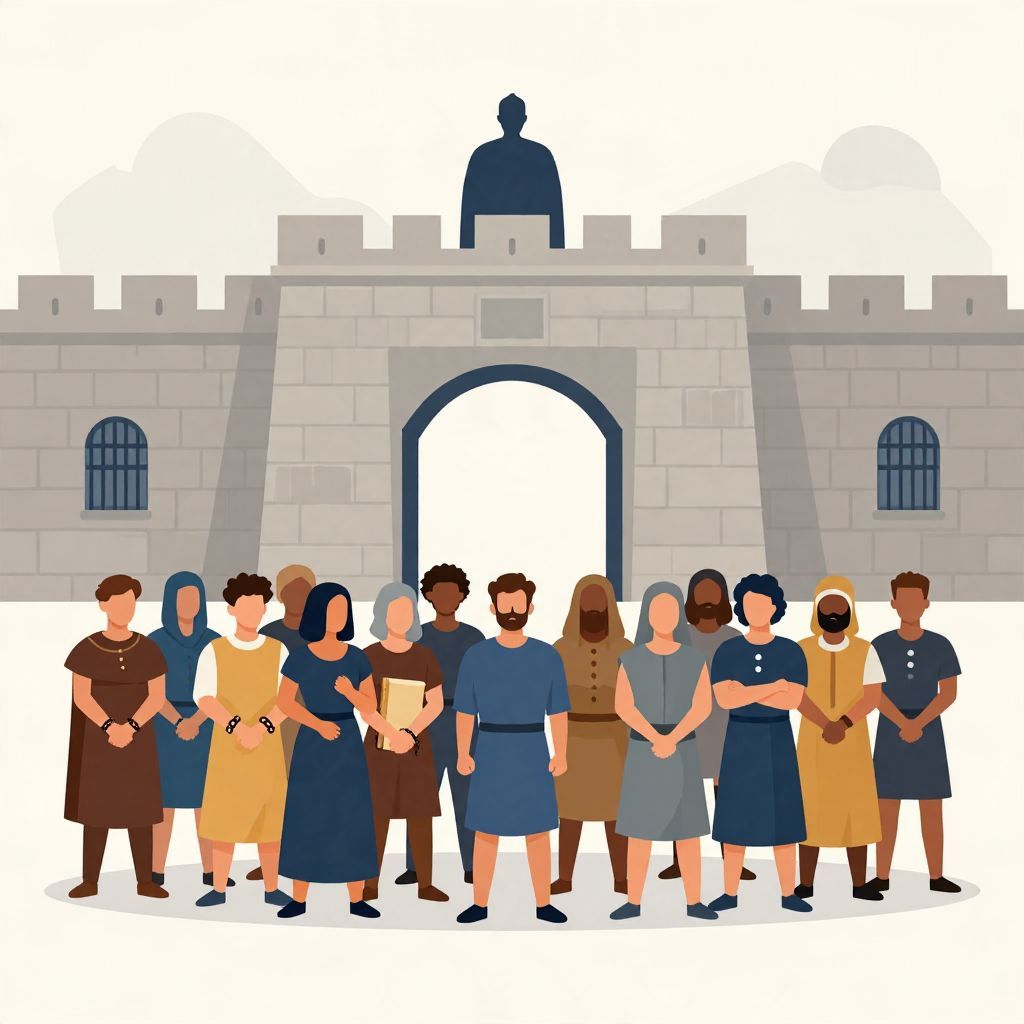
What does oppression mean? In history, oppression refers to the systematic exercise of power to control, exploit, silence, or exclude a group of people. It is not just unfair treatment in a single moment; it is a pattern built into laws, institutions, customs, or violence that limits freedom and equality over time.
The word has ancient roots, but the historical reality it describes appears across many societies: empires, monarchies, colonies, slave systems, and modern states. To understand oppression, it helps to trace how the term developed and how people in different eras recognized, justified, resisted, and sometimes dismantled it.
What does oppression mean in history?
Historically, oppression means the repeated and organized use of power to keep people subordinated. It can involve political repression, economic exploitation, social discrimination, forced labor, censorship, surveillance, or violence. Unlike isolated prejudice, oppression is structural: it is sustained by institutions and social norms, not only by individual attitudes.
The core idea: power held unevenly
At its simplest, oppression exists when one group has the authority to dominate another and uses that authority to deny rights, mobility, or dignity. The oppressed may be defined by class, ethnicity, religion, race, gender, caste, nationality, or political belief. In practice, these categories often overlap.
Why historians use the term carefully
Historians distinguish oppression from broader hardship. Poverty, war, or disaster can harm many people, but oppression specifically involves a relationship of control. A famine may be natural or political; oppression is the human system that keeps certain people vulnerable, voiceless, or dependent.
Where did the word oppression come from?
The English word “oppression” comes through Old French and Latin from opprimere, meaning “to press down” or “to crush.” That image is revealing: historically, oppression has often meant not only restriction but also the deliberate crushing of resistance, status, or autonomy.
Ancient and classical usage
Ancient writers in Greek and Roman worlds used related ideas to describe tyranny, domination, and abuse of power. They did not always use the modern word “oppression,” but they clearly understood the concept. Subjects of empires, enslaved people, and conquered populations often lived under legal inequality and coercion.
From moral complaint to political analysis
Over time, the term moved beyond a general sense of suffering. In medieval and early modern Europe, people used “oppression” to describe unjust taxation, arbitrary rule, religious persecution, and feudal burdens. By the 18th and 19th centuries, political thinkers increasingly treated oppression as a social and institutional problem rather than only a personal wrong.
A historical timeline of oppression
Oppression is not tied to one civilization or one century. It appears repeatedly in world history, though its forms change. The following timeline shows major stages in how oppression has been practiced and challenged.
- Ancient states — Kings, emperors, and elites often ruled through tribute, forced labor, slavery, and conquest.
- Classical antiquity — Large slave systems in Greece and Rome normalized legal inequality for millions.
- Medieval societies — Serfdom, religious persecution, and rigid social hierarchy limited freedom for many people.
- Early modern empires — Colonial expansion, plantation slavery, and racialized domination spread across the Atlantic world after the 15th century.
- 18th to 19th centuries — Revolutions, abolitionist movements, and liberal reforms challenged older forms of oppression, though they did not eliminate them.
- 20th century — Totalitarian regimes, segregation, apartheid, genocide, and political repression showed how oppression could be intensified by modern bureaucracy and technology.
- 21st century — Historians and social scientists increasingly examine structural oppression in law, policing, migration policy, labor systems, and digital surveillance.
How oppression worked in different historical societies
Slavery and forced labor
One of the clearest historical forms of oppression is slavery. Enslaved people were deprived of freedom, family stability, wages, and legal personhood. In the Roman Empire, in Islamic societies, in African kingdoms, and especially in the Atlantic slave trade, slavery was justified in different ways but always depended on coercion and inequality.
In the Americas after the 16th century, racial slavery became especially destructive because it linked forced labor to inherited status. This meant oppression was passed down across generations, embedding inequality into law, economy, and social identity.
Empire and conquest
Empires often claimed to bring order, civilization, or religion, but they also extracted taxes, labor, land, and loyalty from conquered peoples. The Roman, Ottoman, Spanish, British, and other empires varied widely, yet each could impose domination on subject populations. Colonial rule frequently denied local self-government and restructured economies for imperial benefit.
Feudal and class hierarchies
In medieval Europe and elsewhere, oppression could take the form of rigid estate systems. Peasants, tenants, and serfs were often tied to land and subject to dues, labor obligations, and local lordly power. While not identical to slavery, these systems limited mobility and reinforced inherited inequality.
Religious persecution
People have also been oppressed because of belief. In different periods, heretics, minority faiths, and dissenters faced exclusion, forced conversion, expulsion, or execution. The Spanish Inquisition, anti-Jewish violence in Europe, and persecution of religious minorities in many regions show how states and churches could combine authority with coercion.
Gender oppression
Women and gender minorities have often faced legal and social oppression through restricted property rights, limited education, forced marriage, exclusion from office, and control over sexuality and reproduction. These patterns varied by time and place, but they were widespread enough to shape much of world history. Modern women’s rights movements emerged in response to these long-standing structures.
Oppression in the modern age
Modern states did not end oppression; in some cases, they made it more efficient. Bureaucracies, censuses, police forces, prisons, propaganda systems, and identity documents could be used to monitor and control populations. The 19th and 20th centuries brought both expanded rights and new forms of repression.
Racial oppression and segregation
After the abolition of slavery in many places, racial oppression often continued through segregation, disenfranchisement, labor exploitation, and violence. In the United States, Jim Crow laws enforced racial hierarchy for decades. In South Africa, apartheid created a legal system of racial domination that lasted until the early 1990s.
Totalitarian and authoritarian rule
In the 20th century, regimes such as Nazi Germany and Stalinist Soviet rule showed how oppression could become extreme when the state claims total authority. Surveillance, censorship, secret police, labor camps, mass deportation, and genocide were used to eliminate opposition and reshape society. These cases are among the most studied examples of modern political oppression.
Colonialism and decolonization
Across Africa, Asia, the Middle East, and the Americas, anti-colonial movements argued that imperial rule was itself a form of oppression. Decolonization in the 20th century ended many formal empires, but the legacies of land seizure, economic dependency, and cultural suppression continued to shape postcolonial societies.
How people resisted oppression
Oppression has never gone unchallenged. Resistance is a central part of its history. People resisted through revolt, escape, legal petitions, labor organizing, religious dissent, writing, protest, and everyday acts of survival. Sometimes resistance was dramatic; sometimes it was quiet and persistent.
Forms of resistance
- Revolts and rebellions — from slave uprisings to anti-colonial wars
- Political movements — suffrage, civil rights, labor, and independence campaigns
- Cultural survival — preserving language, religion, memory, and identity under pressure
- Legal change — petitions, court cases, constitutions, and reforms
- Everyday defiance — work slowdowns, secret teaching, flight, and mutual aid
Why resistance matters historically
Resistance shows that oppression is not a permanent condition, even when it seems deeply rooted. Many rights now taken for granted—abolition, voting rights, labor protections, freedom of religion, and equal citizenship—were won because oppressed groups and allies challenged systems of domination over long periods.
How historians interpret oppression today
Modern historians often use “oppression” to analyze systems rather than only individual acts. This approach helps explain why unequal outcomes can persist even when formal laws change. For example, legal emancipation did not automatically end racial inequality, and political independence did not always bring social equality.
Structural oppression
Structural oppression refers to inequality built into institutions such as law, education, housing, labor markets, and policing. The term is especially useful when no single ruler or policy explains the problem. It helps historians connect personal experiences to larger systems.
Debates and limits
Scholars also caution against using oppression too loosely. Not every disagreement is oppression, and not every hardship is caused by deliberate domination. Careful historical analysis asks who holds power, how it is maintained, who benefits, and how long the system has lasted.
Why the concept still matters
Understanding what oppression means is historically important because it reveals how power operates across time. It helps explain slavery, empire, dictatorship, segregation, persecution, and exclusion, but also the long struggle for freedom and rights. The word points to a recurring pattern in human history: some groups have repeatedly tried to “press down” others, and those others have repeatedly fought back.
Seen this way, oppression is not only a moral label. It is a historical tool for understanding how inequality becomes organized, normalized, and contested. For related topics, see what is a police state and no one is illegal on stolen land.