
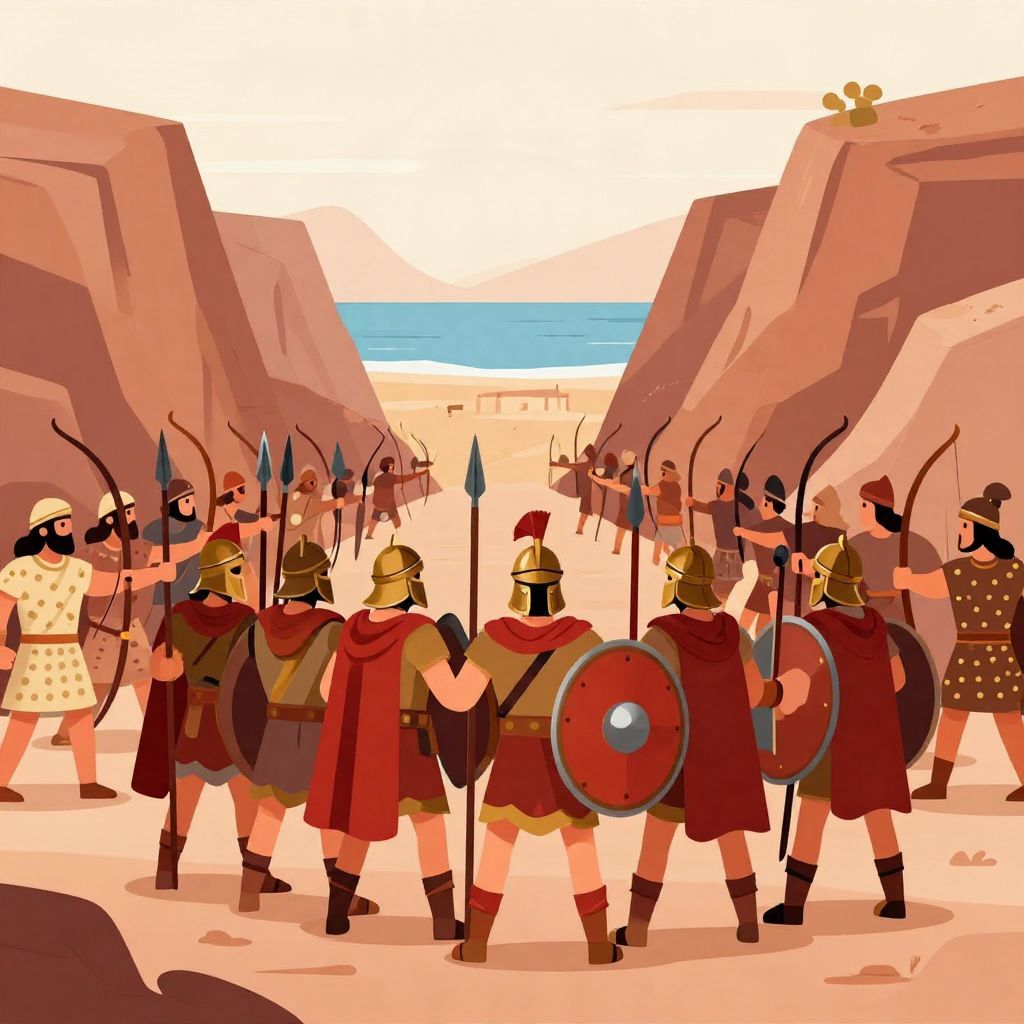
The short answer is that the famous “300” Spartans did not kill anywhere near 20 million Persians, as legend sometimes suggests. At the Battle of Thermopylae in 480 BCE, ancient sources describe heavy Persian losses, but the exact number is unknown and likely far lower than later myths claim. Modern historians treat the huge casualty figures with caution.
What we can say with confidence is that the battle was a desperate rear-guard action in the Greco-Persian Wars, not a cleanly measured slaughter. The story of the 300 has been remembered through Greek accounts, later retellings, and modern popular culture, each of which shaped the numbers in different ways.
How many Persians did the 300 kill at Thermopylae?
There is no reliable ancient or modern evidence that the 300 Spartans killed millions of Persians. The most cautious historical answer is that they likely killed hundreds, perhaps more, during the three-day stand at Thermopylae in 480 BCE. Ancient writers give no trustworthy total, and the surviving figures are shaped by propaganda, memory, and exaggeration.
Why the numbers are so uncertain
The Battle of Thermopylae is known mainly through Greek literary sources, especially Herodotus, writing decades after the event. He wanted to tell a dramatic story of courage against overwhelming odds, and his narrative preserved important details while also reflecting Greek pride and wartime memory. Persian records from the battle do not survive in a comparable form, so historians cannot verify a precise casualty count.
Ancient armies also did not record battlefield losses with modern accuracy. Even when writers gave numbers, they often relied on hearsay, political messaging, or broad estimates. In the case of Thermopylae, the famous image of a tiny Greek force cutting down waves of Persians is powerful, but it is not a statistical report.
What ancient sources imply
Herodotus describes the Persian army as enormous and the fighting as fierce, with repeated assaults failing to break the Greek position until a local guide, Ephialtes, revealed a mountain path that allowed the Persians to outflank the defenders. The Greeks held the narrow pass for several days, which made it possible for a relatively small force to resist a much larger one. That does not mean the Spartans alone were responsible for most Persian casualties, however.
The 300 Spartans were not the only Greeks at Thermopylae. They were accompanied by other Greek contingents, including Thespians and Thebans, and earlier in the battle the full Greek force was larger. By the final stand, Leonidas and his Spartans remained with a few hundred others. Any casualty estimate must account for the entire Greek defense, not just the Spartans alone.
What historians think the real casualty range may have been
Most modern historians avoid a precise number because the evidence does not support one. A reasonable estimate is that the Greeks at Thermopylae may have killed several hundred Persians, and possibly more, but not the tens of thousands found in some popular retellings. The Persian army was large enough that even a few hundred losses would not have changed the campaign’s overall outcome.
Some older or popular accounts inflate the Persian dead dramatically to emphasize Spartan heroism. Others minimize the losses to stress Persian military superiority. The truth likely lies between those extremes. Thermopylae was tactically important because of terrain and morale, not because the defenders annihilated a massive Persian force.
Why narrow terrain mattered
Thermopylae was a mountain pass and coastal corridor, meaning the Persians could not easily use their full numbers at once. In tight ground, disciplined infantry could hold off a larger army for a time. This is one reason the Greeks were able to resist so effectively. The battlefield favored defense, and the Persians had to attack in constrained waves rather than in one overwhelming mass.
That geography helps explain why casualty estimates can seem impressive even if they were not enormous by modern standards. A force trapped in a bottleneck can inflict disproportionate losses without destroying the enemy army.
Where the “millions of Persians” idea came from
The claim that the 300 killed millions of Persians is a modern myth, not an ancient historical fact. It grows out of a long tradition of heroic storytelling in which the Spartans symbolize discipline, sacrifice, and resistance. Over time, retellings exaggerated the scale of the battle to make the stand appear even more miraculous.
Popular culture has amplified the legend. Films, comics, and simplified classroom stories often present Thermopylae as a clash between 300 perfect heroes and an endless Persian horde. That version is dramatic, but it flattens the complexity of the battle and distorts the historical record.
Myth versus history
- Myth: 300 Spartans alone killed millions of Persians.
- History: The Spartans, with other Greeks, fought at Thermopylae and likely caused significant but limited Persian casualties.
- Myth: The battle was a total Greek victory.
- History: The Persians won the battle and advanced, though the Greek defense became a lasting symbol of resistance.
How many Persians were at Thermopylae?
The size of the Persian army is also disputed. Ancient sources give enormous figures, sometimes hundreds of thousands or even more, but modern historians generally believe those numbers are exaggerated. The Persian force was certainly large, likely in the tens of thousands, but the exact total is unknown. This matters because casualty ratios depend on the size of the army being attacked.
If the Persian army was smaller than the ancient sources suggest, then the “300 killed millions” story becomes even less plausible. Even a very successful defense cannot kill more soldiers than are present, and the logistics of supplying and moving a force the size described in legend would have been extraordinarily difficult in the ancient world.
What actually happened at Thermopylae
Thermopylae was one episode in the wider Greco-Persian Wars, which followed the Persian Empire’s expansion into the Greek world. In 480 BCE, King Xerxes led a major invasion of Greece. The Greek city-states, often divided among themselves, attempted to resist by combining naval and land defenses. Thermopylae was chosen because it could delay the Persian advance while the Greek fleet operated nearby.
- 480 BCE: Xerxes invades Greece.
- Early battle: Greek forces hold the pass and repel repeated assaults.
- Turning point: A local path is used to outflank the defenders.
- Final stand: Leonidas and the remaining Greeks fight to the death.
- Aftermath: The Persians move forward, but the Greek resistance gains symbolic power.
The battle mattered because it delayed the Persian advance and demonstrated that Persian forces could be checked in difficult terrain. It also became a moral story for later Greeks, especially the Spartans, whose military reputation was already strong.
Why Thermopylae became so famous
Thermopylae became famous not because of an exact casualty count, but because it offered a powerful narrative: a small force choosing sacrifice in the face of defeat. That story resonated in ancient Greece and has continued to resonate ever since. The Spartans’ discipline, the narrow pass, and the final stand all made the battle easy to remember and retell.
But historical fame can distort scale. A memorable story often survives better than a precise one. That is why the question “How many Persians did the 300 kill?” is best answered with caution rather than a dramatic number.
The best historical answer in one sentence
The 300 Spartans did not kill millions of Persians; at Thermopylae in 480 BCE, they and their Greek allies likely killed a limited but significant number of Persian soldiers, probably in the hundreds, while exact figures remain unknowable.
Why the story still matters
Thermopylae remains important because it shows how history and legend intertwine. The battle was real, the sacrifice was real, and the Persian victory was real. What is uncertain is the exact body count, especially in the exaggerated form popular culture often repeats. Understanding that difference helps us appreciate both the courage of the defenders and the limits of our evidence.
If you want more background on the wider world behind the battle, see where Persia was located and explore early warfare in historical context. The lesson of Thermopylae is not that numbers are unimportant, but that history is often clearer about meaning than about exact totals.