
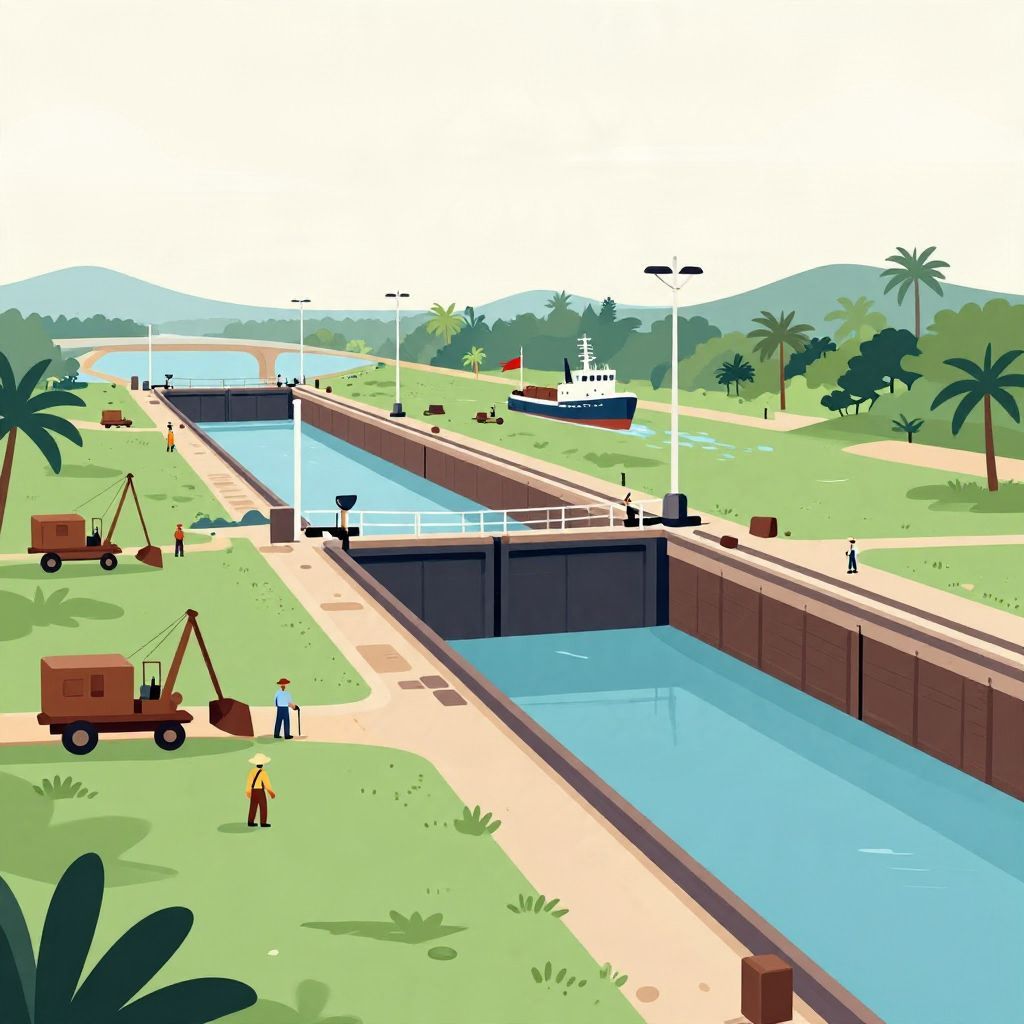
The Panama Canal was built in the early 20th century, with construction under the United States beginning in 1904 and the canal officially opening in 1914. It was one of the most ambitious engineering projects in modern history, linking the Atlantic and Pacific oceans through Panama’s narrow isthmus.
The answer is not just a single year, though. The canal’s construction followed earlier failed French efforts in the 1880s, and its completion in 1914 marked the end of a long international struggle to create a faster sea route between the world’s major oceans.
When Was Panama Canal Built?
The Panama Canal was built between 1904 and 1914 under U.S. control, after an earlier French attempt in the 1880s collapsed. The canal officially opened on August 15, 1914, though its origins go back decades earlier. In historical terms, the canal was not a single-year project but a long construction effort shaped by engineering, disease control, diplomacy, and imperial politics.
Panama Canal Timeline: Key Dates
The canal’s history is best understood as a sequence of failed plans, renewed efforts, and final completion. Each stage helped shape the route and the political struggle around it.
- 1879 – An international congress in Paris discusses a possible canal through Panama.
- 1881 – French construction begins under Ferdinand de Lesseps.
- 1889 – The French effort collapses amid financial scandal, disease, and engineering problems.
- 1903 – Panama separates from Colombia with strong U.S. support; the U.S. secures canal rights.
- 1904 – The United States officially begins construction.
- 1906–1907 – Major excavation and lock design work intensify; disease control becomes central.
- 1913 – The canal is functionally completed, including the final major engineering work.
- August 15, 1914 – The Panama Canal opens to traffic.
Why the Panama Canal Took So Long
The canal was difficult to build because Panama’s geography and climate created enormous obstacles. Engineers had to cut through mountains, control the Chagres River, and manage heavy rainfall that could trigger landslides and flooding. In addition, yellow fever and malaria killed large numbers of workers during the earlier French attempt and remained a serious concern until disease-control measures improved under U.S. administration.
The failed French attempt
The first major modern effort to build a canal in Panama began in 1881, led by the French diplomat and engineer Ferdinand de Lesseps, who had helped build the Suez Canal. But Panama was far more difficult than Egypt. The terrain was mountainous, the soil unstable, and the tropical environment deadly. By 1889, the French company had failed financially and the project stopped.
The U.S. decision to take over
By the early 1900s, the United States wanted a canal for military and commercial reasons. A canal would shorten voyages between the Atlantic and Pacific coasts and strengthen U.S. naval mobility. After negotiations and political conflict, the U.S. supported Panama’s independence from Colombia in 1903 and quickly obtained the rights to build and control the canal zone.
How the Panama Canal Was Built
The canal was not a sea-level trench, as some had originally imagined. Instead, U.S. engineers built a lock canal, using a system of chambers that lift ships up to an artificial lake and then lower them on the other side. This design was more practical for Panama’s terrain and saved the project from the problems that had doomed earlier plans.
Major engineering features
Several large-scale works made the canal possible:
- Gatun Dam created Gatun Lake, a huge artificial lake that became central to the route.
- Locks at Gatun, Pedro Miguel, and Miraflores raised and lowered ships between sea level and the lake.
- Culebra Cut required excavation through the continental divide, one of the hardest parts of the project.
- Sanitation reforms reduced mosquito-borne disease and made large-scale labor possible.
These works were completed through massive excavation, concrete construction, and careful management of water levels. The project relied on thousands of laborers, many of them from the Caribbean, as well as engineers, doctors, and administrators.
Who led the project?
Two figures are especially important in the U.S. phase. John F. Stevens helped organize the early engineering and railroad systems, while George Washington Goethals oversaw the final construction as chief engineer. Their work reflected a shift from grand but impractical ideas to disciplined engineering and logistics.
When Did the Panama Canal Open?
The Panama Canal officially opened on August 15, 1914. The first ship to make the official transit was the SS Ancon. The opening came just as World War I began in Europe, which affected public attention and made the canal’s debut less celebrated than it might otherwise have been.
Although the canal was essentially finished in 1913, the opening in 1914 is the date most people mean when they ask when the Panama Canal was built. That date marks the moment it became operational and transformed global shipping routes.
Historical Facts About the Panama Canal
The canal was more than an engineering project; it was also a political and economic turning point. It changed how ships moved around the world and increased the strategic importance of the Americas.
1. It shortened global sea travel dramatically
Before the canal, ships traveling between the Atlantic and Pacific often had to sail around Cape Horn at the southern tip of South America, a dangerous and time-consuming route. The canal cut thousands of miles from many voyages, making trade faster and cheaper.
2. It became a major U.S. strategic asset
The canal gave the United States a powerful naval advantage by allowing ships to move between oceans much more quickly. This mattered especially in the 20th century, when global military and commercial competition intensified.
3. It depended on disease control as much as excavation
One of the most important breakthroughs was the reduction of malaria and yellow fever through mosquito control. This was not a minor side issue; it was essential to keeping workers alive and the project moving.
4. It reshaped Panama’s political history
The canal zone was controlled by the United States for decades, and that arrangement became a major issue in Panamanian politics and nationalism. The canal’s history therefore includes not only engineering success but also questions of sovereignty and foreign influence.
Why the Panama Canal Matters in World History
The Panama Canal is one of the great infrastructure projects of the modern era because it connected two oceans and changed patterns of commerce, war planning, and migration. It also showed how engineering, medicine, labor, and geopolitics could combine to transform a region. Its completion in 1914 symbolized both human ingenuity and the costs of imperial ambition.
So, when was the Panama Canal built? In the most direct sense, construction took place from 1904 to 1914, with the canal opening on August 15, 1914. But its full history includes the failed French attempt of the 1880s, the U.S. takeover after 1903, and the decades of political consequences that followed. For readers interested in transportation history, you may also enjoy related stories such as what happened to Pan Am Airlines and why Pan Am went out of business.