
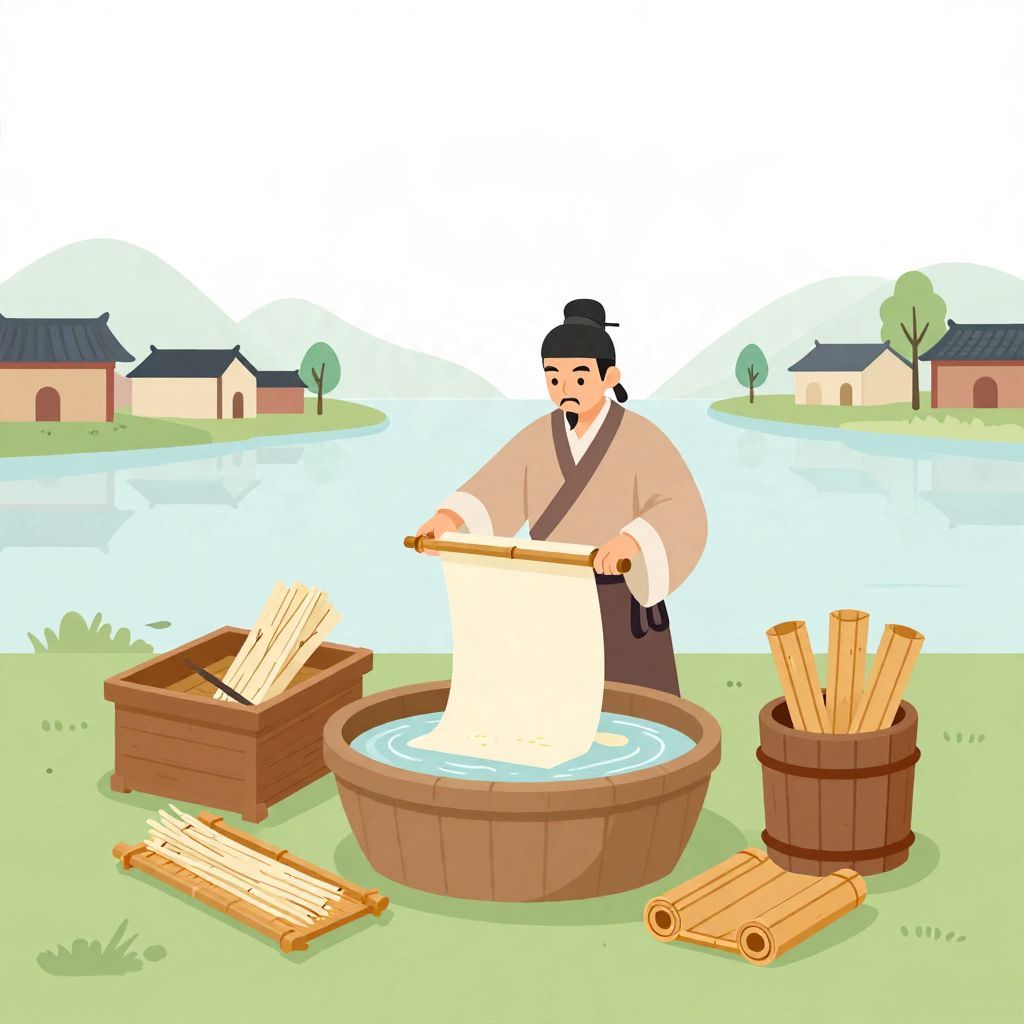
Where was paper invented? The short answer is that paper was invented in China, most likely in the early 2nd century CE. Although people in earlier civilizations wrote on materials such as papyrus, parchment, and bamboo, the true paper-making process developed in China and then spread across Asia, the Islamic world, and eventually Europe.
The invention is usually associated with Cai Lun, a court official of the Han dynasty, because he is credited in later Chinese records with improving and standardizing paper production. The story is more complex than a single “inventor,” but the historical center of paper’s origin is firmly in ancient China.
Where Was Paper Invented?
Paper was invented in China, during the Han dynasty, probably around 105 CE or somewhat earlier. The earliest surviving paper fragments suggest that experimental paper-making may have begun before Cai Lun’s time, but China is the clear place where paper emerged as a practical writing material. From there, the technology spread outward over centuries.
Why China Is Considered the Birthplace of Paper
China is considered the birthplace of paper because it is where a durable, inexpensive sheet material made from plant fibers was first developed for writing. Unlike papyrus, which was made from reeds, or parchment, which came from animal skins, Chinese paper was created by breaking down fibers and forming them into thin sheets. That process became the foundation of modern papermaking.
What made Chinese paper different?
The key innovation was not just using plant material, but turning it into a smooth, flexible sheet through pulping and drying. Early Chinese papermakers used materials such as hemp, mulberry bark, rags, and fishing nets. These fibers were soaked, beaten into pulp, spread in a mold, and dried into sheets. This method was cheaper and more adaptable than earlier writing surfaces.
The Historical Background of Paper in Ancient China
Before paper became common, Chinese writers used materials such as bamboo strips, wooden tablets, silk, and sometimes lacquered surfaces. Bamboo was heavy and awkward for long texts, while silk was light but expensive. As the Chinese state grew more bureaucratic, there was a strong need for a writing material that was lighter, cheaper, and easier to produce in quantity.
Why did paper develop when it did?
Paper likely emerged because of practical administrative needs. The Han dynasty governed a large empire and relied on records, reports, taxes, laws, and correspondence. A more efficient writing medium would have been extremely useful. Paper also fit broader Chinese technological traditions, including advanced fiber processing, textile production, and skilled craftsmanship.
Cai Lun and the Traditional Origin Story
Cai Lun is the best-known figure in the history of paper because later Chinese histories credit him with improving paper-making in 105 CE. According to traditional accounts, he presented a new paper to the emperor using bark, hemp, rags, and fishing nets. This story made Cai Lun famous, but historians usually treat him as a major improver and systematizer rather than the sole inventor.
Was Cai Lun really the first inventor?
Probably not. Archaeological evidence shows that paper existed before Cai Lun’s reported innovation, though perhaps in less refined forms. His importance lies in helping standardize and promote a better method that made paper more practical for widespread use. In other words, Cai Lun is central to the history of paper, but he did not create it out of nothing.
Early Evidence of Paper in China
Archaeology has pushed the history of paper earlier than the traditional date alone would suggest. Fragments of early paper have been found in Chinese sites associated with the Han period and possibly earlier. These finds indicate that paper-making was already underway before it became widely recognized in official histories.
How certain are historians about the date?
The exact moment paper was invented is not known with complete certainty. The traditional date of 105 CE comes from historical texts, while archaeological discoveries suggest that paper may have appeared somewhat earlier. What is well established is that by the Han dynasty, China had developed a paper-making tradition that was distinct, practical, and influential.
How Paper Spread Beyond China
Once paper was established in China, it gradually spread westward through trade, diplomacy, and conquest. The process was slow, but the technology moved across Central Asia and into the Islamic world by the early medieval period. From there, it eventually reached Europe, where it transformed literacy, administration, and book production.
Important stages in the spread of paper
- China — paper developed during the Han dynasty.
- Central Asia — the technology moved along Silk Road networks.
- Islamic world — paper production expanded after the 8th century.
- Europe — paper mills appeared later in the medieval period.
Paper in the Islamic World
Paper-making became especially important after it reached the Islamic world, where it was adapted and expanded. By the 8th and 9th centuries, paper was being produced in major centers such as Samarkand and later Baghdad. Islamic papermakers improved production methods and helped make paper a major medium for scholarship, record-keeping, and literature.
Why was this stage so important?
The spread of paper in the Islamic world helped preserve and transmit knowledge on a large scale. Paper was cheaper than parchment and easier to produce in volume. That made it ideal for copying books, scientific works, legal documents, and administrative records. In this sense, paper was not just an invention; it was a technology that reshaped intellectual life.
When Did Paper Reach Europe?
Paper reached Europe later, through contact with the Islamic world in the medieval Mediterranean. By the 12th and 13th centuries, paper mills were established in parts of southern Europe, including Spain and Italy. At first, parchment remained important, but paper gradually became the dominant writing surface because it was less expensive and easier to mass-produce.
How paper changed Europe
Paper played a major role in the growth of bureaucracy, commerce, education, and eventually printing. When movable-type printing expanded in Europe in the 15th century, paper became even more essential. The combination of paper and print helped accelerate the spread of books, documents, and ideas across the continent.
What Paper Replaced and Why It Mattered
Paper did not replace all older writing materials immediately, but it offered major advantages. It was lighter than bamboo, cheaper than silk, and easier to produce in quantity than parchment. These qualities made it ideal for governments, merchants, scholars, and printers. Over time, paper became one of the most important materials in human history.
Why paper was revolutionary
- It reduced the cost of writing and copying texts.
- It made record-keeping more practical for large states.
- It supported the spread of literacy and education.
- It eventually enabled the printing revolution.
Common Misunderstandings About Paper’s Origin
People sometimes confuse paper with earlier writing surfaces. Papyrus came from ancient Egypt and was used for writing, but it was not paper in the technical sense. Parchment and vellum were animal-skin materials. True paper is defined by its fiber-based pulp process, and that process was first developed in China.
Paper versus papyrus
Papyrus is often mentioned alongside paper because both were used for writing, but they are different materials. Papyrus was made from strips of the papyrus plant pressed together, while paper is made from pulped fibers formed into sheets. That distinction is why the answer to “Where was paper invented?” is China, not Egypt.
The Lasting Legacy of Paper
The invention of paper changed the history of communication. It made writing more accessible, helped states govern more efficiently, and allowed knowledge to circulate more widely. Its influence reached far beyond China, shaping the development of libraries, schools, religions, trade, and printing traditions across Eurasia.
So, where was paper invented? The best historical answer is ancient China, during the Han dynasty, with the invention traditionally linked to Cai Lun around 105 CE. The exact moment is debated, but the origin is not: paper emerged in China and then reshaped the world. If you want to explore related history topics, you may also enjoy reading about where ink comes from and where the name America came from.