
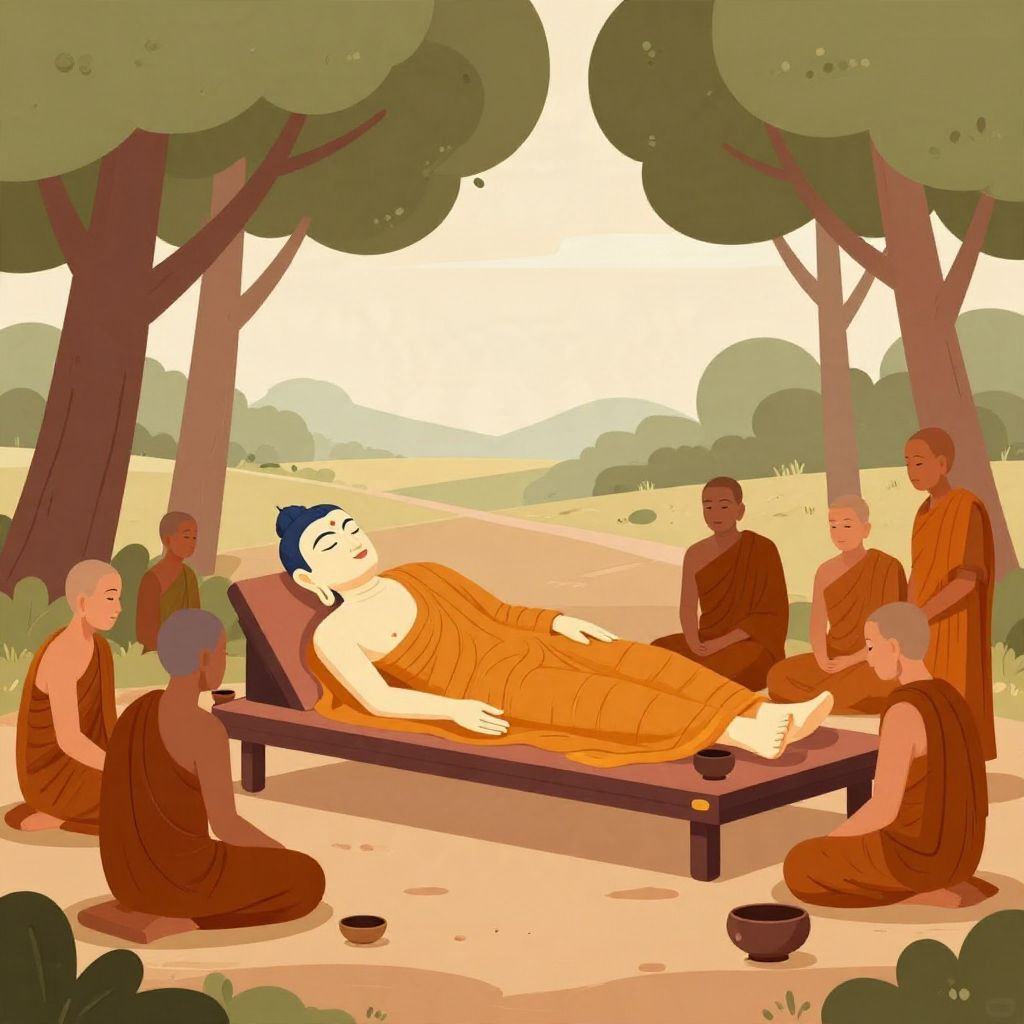
How did Buddha die? According to the oldest Buddhist traditions, the historical Buddha—Siddhartha Gautama—died of natural causes after a final meal during his travels in northern India, probably in the 5th century BCE. Buddhist texts describe his last illness in detail, but historians treat those accounts cautiously because they were written down centuries later.
What is clear is that Buddha’s death, known in Buddhism as his parinirvana, became one of the most important events in Buddhist history. It marked the end of his earthly life, the beginning of the community’s leadership without him, and the start of the long process by which his teachings spread across Asia.
How Did Buddha Die?
Buddha died after becoming ill following a meal offered by a lay follower named Cunda. The most common traditional account says he suffered severe digestive distress and later died peacefully at Kushinagar. Modern historians generally accept that he died from illness or food-related complications, but the exact medical cause cannot be known with certainty.
The Historical Setting of Buddha’s Final Days
Buddha lived during a period of religious and social change in ancient northern India. He taught in the region of the Ganges plain, moving among small kingdoms and republics where wandering teachers competed for followers. By the end of his life, he was an established spiritual leader with a growing monastic community.
Most scholars place his death around the 5th century BCE, though the exact date remains debated. Traditional Buddhist chronologies often give earlier dates, while modern historical reconstructions usually place his life somewhat later. The uncertainty reflects the fact that the earliest surviving narratives were preserved orally before being written down.
Why the exact date is uncertain
There are no contemporary inscriptions or records from Buddha’s own lifetime that document his death. The main sources are Buddhist texts compiled and edited over time, especially traditions associated with the Mahaparinibbana Sutta, which presents a detailed narrative of his final journey. Historians use these texts carefully, separating likely historical memory from later devotional embellishment.
What Caused Buddha’s Death?
The traditional account does not describe Buddha’s death as violent or mysterious. Instead, it presents him as growing weak after eating a meal, then suffering an acute illness before dying. The text emphasizes his composure, not the medical details. In historical terms, the safest conclusion is that he died of natural causes, possibly involving food poisoning or another digestive ailment.
The meal offered by Cunda
One of the most famous episodes in the story is the meal given by Cunda, often described as pork or perhaps a type of mushroom or truffle, depending on interpretation of the original term. Scholars disagree about the exact food because the ancient language is ambiguous. What matters historically is that the tradition links Buddha’s final illness to this meal, while also defending Cunda from blame.
The text goes out of its way to say that Buddha instructed his followers not to criticize Cunda, suggesting that the tradition wanted to protect the donor’s reputation. That detail is important because it shows how Buddhist communities later shaped the story to preserve both compassion and reverence.
Illness, aging, and mortality
By the time of his death, Buddha was an elderly man by ancient standards. Even without a specific disease diagnosis, age itself may have made him vulnerable to a sudden illness. The tradition presents his final days as a deliberate lesson in impermanence: even a fully awakened teacher must pass away.
The Final Journey to Kushinagar
According to Buddhist tradition, Buddha spent his last days traveling through the region and teaching his followers. He eventually arrived near Kushinagar, where he lay down between two sal trees and entered his final passing. This location became sacred in Buddhist memory and pilgrimage.
Key events in the final narrative
- Buddha accepts a meal from Cunda.
- He becomes seriously ill afterward.
- He continues to instruct his disciples despite weakness.
- He reaches Kushinagar and lies down for his final rest.
- He dies and enters parinirvana, the final release from the cycle of rebirth.
The narrative’s structure is as important as the event itself. It presents Buddha not as a tragic victim, but as a teacher who remains mindful and calm while facing death. That tone became central to later Buddhist devotion and doctrine.
What Does Parinirvana Mean?
In Buddhism, Buddha’s death is not usually described simply as “dying.” It is called parinirvana, meaning final nirvana or complete release. For Buddhists, this means the end of rebirth after the body dies. The term reflects a religious understanding of death that is different from a purely historical or medical explanation.
Historians distinguish between the religious meaning of the event and the historical question of what physically happened. The religious tradition sees the death as spiritually significant and liberating. Historical scholarship, by contrast, can only say that Buddha likely died from illness after a final meal, in a setting remembered by his followers as sacred.
How Reliable Is the Traditional Account?
The traditional story is valuable, but it is not a modern eyewitness report. It comes from texts shaped by generations of oral transmission and community memory. As a result, some details may preserve genuine historical recollection, while others may be symbolic or didactic.
What historians generally accept
- Buddha was a historical teacher who died in northern India.
- His death likely occurred in old age, around the 5th century BCE.
- The tradition connects his final illness with a meal offered by Cunda.
- He died at or near Kushinagar, which later became a pilgrimage site.
What remains uncertain
- The exact year of his death.
- The precise medical cause of illness.
- The exact nature of the food he ate.
- How much of the final journey narrative is literal history versus later religious shaping.
This balance between evidence and tradition is typical in ancient history. The sources preserve a meaningful memory of Buddha’s last days, but they do not allow a clinical certainty about his death.
Why Buddha’s Death Mattered So Much
Buddha’s death was a turning point because it forced his followers to preserve his teachings without his physical presence. The Buddhist community, or sangha, had to organize itself around memory, discipline, and doctrine. His passing also encouraged the development of relic worship, pilgrimage, and the idea that sacred presence could remain after death.
According to tradition, his cremated remains were divided and distributed among several groups, which later became associated with stupas. Whether every detail is historical or not, the story shows how quickly Buddha’s death became part of a broader religious landscape of reverence and commemoration.
Lasting historical consequences
Buddha’s death helped transform Buddhism from the life of a single teacher into a durable religious tradition. After his passing, followers compiled teachings, debated interpretation, and carried the religion beyond its original region. In that sense, his death was not the end of the story but the beginning of Buddhism’s long historical expansion.
Buddha’s Death in Buddhist Memory
For many Buddhists, the story of Buddha’s final illness is not mainly about biology. It is a teaching about impermanence, compassion, and acceptance. The image of Buddha lying calmly between the sal trees has become one of the most enduring scenes in Buddhist art and literature.
The story also serves a practical religious purpose. It reminds followers that even the greatest teacher is subject to death, and that liberation comes through understanding, discipline, and insight rather than dependence on a single living person. That message helped Buddhism survive and adapt after its founder’s passing.
Conclusion
Buddha died of natural causes after an illness that followed a final meal, most likely in northern India near Kushinagar. The exact medical cause is unknown, but the broad historical outline is clear enough: he was an elderly teacher who passed away peacefully and whose death became known in Buddhism as parinirvana. If you want more context on his life, see when Buddha was born and the wider religious world in which his teachings later spread, including how Hinduism spread.