
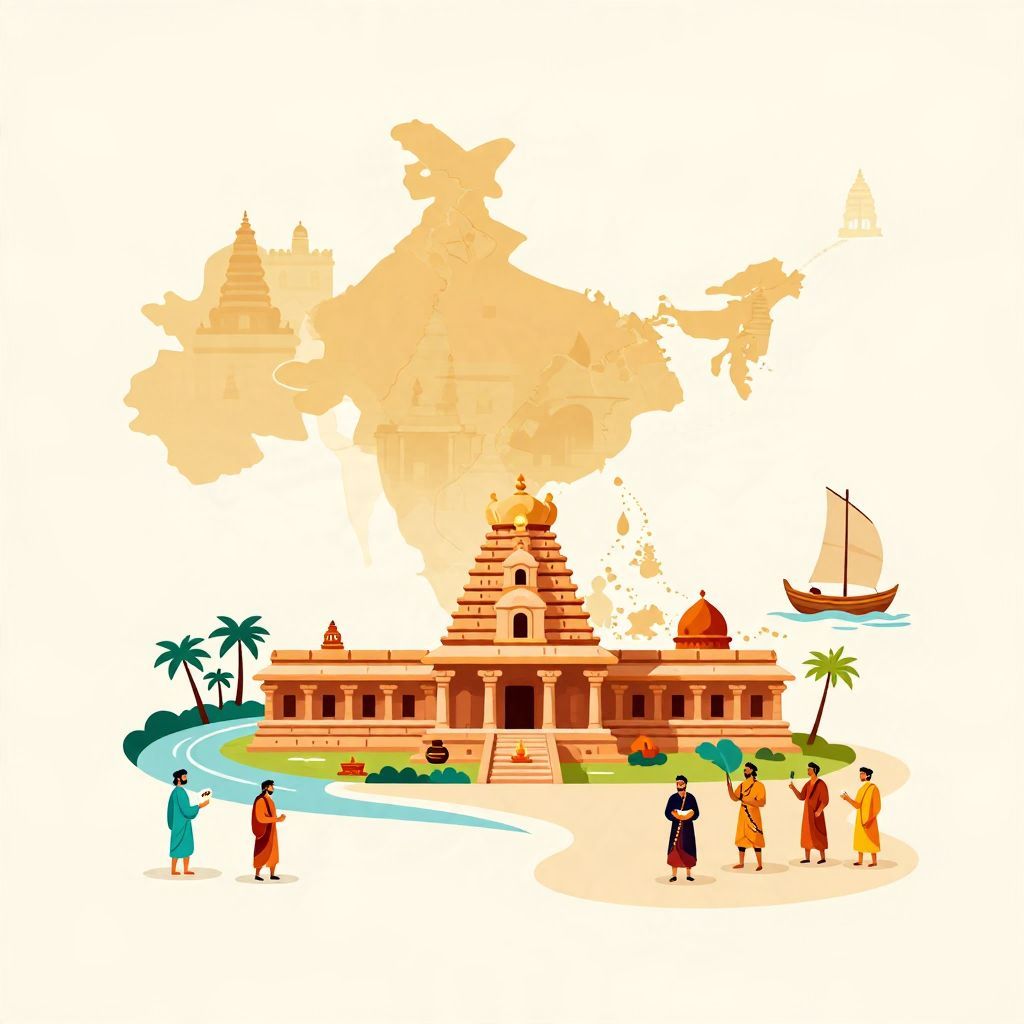
How did Hinduism spread across South Asia and beyond? The short answer is that it did not spread through a single conquest or missionary campaign. Instead, Hinduism grew over many centuries through migration, trade, royal patronage, Sanskrit learning, temple building, and the gradual blending of local beliefs with wider Brahmanical traditions.
Because Hinduism is not a single founder-led religion, its spread is best understood as a long historical process rather than one event. Its ideas moved with priests, merchants, rulers, pilgrims, and communities, and they adapted to different regions as they spread.
How did Hinduism spread?
Hinduism spread mainly through cultural exchange, political support, and social integration rather than forced conversion. From the late Vedic period onward, Brahmanical rituals, Sanskrit texts, and temple-centered worship expanded across the Indian subcontinent, while local deities and customs were often absorbed into Hindu practice. Later, Hindu ideas also traveled to Southeast Asia through trade and state patronage.
The early roots of Hinduism in ancient India
Hinduism developed gradually from the religious world of the ancient Indian subcontinent, especially from the Vedic tradition that emerged after Indo-Aryan-speaking groups entered northwestern India, probably in the second millennium BCE. The Rigveda and later Vedic texts did not create “Hinduism” as a single religion, but they helped shape ideas about sacrifice, cosmic order, gods, and social duty that became central to later Hindu traditions.
From Vedic ritual to broader religious traditions
Over time, religious life in India expanded beyond fire sacrifice and priestly ritual. The Upanishads, composed roughly between 800 and 300 BCE, explored questions of the self, ultimate reality, rebirth, and liberation. At the same time, devotional worship of gods such as Vishnu, Shiva, and the Goddess became more prominent. This widening religious landscape helped Hinduism become flexible enough to absorb many regional traditions.
Local beliefs and regional deities
One reason Hinduism spread so widely was its capacity to incorporate local cults, village gods, fertility rites, and tribal practices. Rather than replacing older traditions completely, it often reinterpreted them within a broader Sanskritic framework. This process made Hinduism adaptable in different ecological and cultural settings, from river plains to forest regions and hill kingdoms.
What helped Hinduism expand across India?
Hinduism expanded across India through a combination of state power, social organization, pilgrimage networks, and the prestige of Sanskrit culture. Rulers supported Brahmins and temples to legitimize their authority, while religious specialists carried texts, rituals, and ideas into new areas. Pilgrimage sites and sacred geography also tied distant regions to a shared religious world.
Royal patronage and political legitimacy
Many Indian dynasties supported Hindu traditions because they helped kings present themselves as righteous rulers. Grants of land to Brahmins and temples became common in early historic and medieval India. Such patronage did not merely reward priests; it also spread Sanskrit learning, ritual practice, and temple institutions into regions where they had previously been less influential.
Important dynasties such as the Guptas (c. 4th to 6th centuries CE) are often associated with the strengthening of Hindu religious culture, especially devotion to Vishnu and Shiva. Later regional states in South India, Bengal, Rajasthan, and elsewhere also sponsored temples and religious endowments, helping Hindu practice take deep root in local societies.
Temples as centers of community life
Temples were not just places of worship. They were economic, cultural, and political centers. They employed priests, musicians, dancers, scribes, and artisans; they received land and gifts; and they helped organize festivals and local identity. As temple networks expanded, Hinduism became more visible in everyday life and more closely tied to regional communities.
Sanskrit, vernacular languages, and religious texts
Sanskrit gave Hinduism a shared intellectual language across wide areas of South Asia. Epics such as the Mahabharata and Ramayana, and later the Puranas, spread religious stories, moral ideals, and devotional themes. At the same time, Hindu ideas also spread in vernacular languages, especially through bhakti poetry and regional retellings. This helped ordinary people engage with Hindu traditions without needing elite education in Sanskrit.
The role of pilgrimage and sacred geography
Pilgrimage helped Hinduism spread by linking distant places into a single sacred landscape. Rivers, mountains, forests, and temple towns became associated with divine power. People traveled to these sites for merit, healing, vows, and ritual renewal, carrying stories and practices back to their home regions.
Sacred places and shared identity
Sites such as Varanasi, the Ganges River, Prayagraj, Puri, Kanchipuram, and Rameswaram became major centers of Hindu devotion. Pilgrimage did not require political unity; it created cultural unity. Even when India was divided among many kingdoms, sacred travel helped people imagine a wider Hindu world.
How did Hinduism spread through trade and migration?
Trade and migration carried Hindu ideas beyond the Indian subcontinent. Merchants, priests, artisans, and settlers moved along land and sea routes, bringing religious customs with them. Hinduism spread especially through Indian Ocean commerce, where Indian communities established themselves in Southeast Asian ports and courts.
Indian Ocean networks
By the early centuries CE, Indian merchants were active in maritime trade with Sri Lanka, Southeast Asia, and beyond. These exchanges moved not only goods such as spices, textiles, and metals, but also stories, ritual practices, artistic styles, and religious specialists. Hinduism spread most successfully where local rulers found Indian cultural forms useful for state-building and prestige.
Hindu influence in Southeast Asia
From roughly the 1st millennium CE, Hinduism influenced kingdoms in present-day Cambodia, Thailand, Indonesia, Vietnam, and Malaysia. This was not usually a case of mass migration from India replacing local religions. Instead, local elites adopted Indian religious and political ideas selectively. Sanskrit inscriptions, temple architecture, royal titles, and epics such as the Ramayana became part of court culture.
Examples include the Khmer world in Cambodia and the early Javanese and Sumatran states in Indonesia, where Hindu and Buddhist traditions often coexisted. In these regions, Hinduism was adapted to local beliefs rather than copied unchanged.
Important clarification: spread versus transformation
It is more accurate to say Hinduism was transmitted and transformed than simply exported. Outside South Asia, Hindu traditions often became part of mixed religious systems. Even within India, Hinduism changed from region to region. Its spread was therefore not uniform, and it did not erase older local identities.
The bhakti movement and wider popular devotion
From about the early medieval period onward, bhakti devotional movements helped Hinduism reach broader audiences. Bhakti emphasized loving devotion to a personal god rather than only ritual status or priestly mediation. Saints and poets composed in local languages, making religious ideas more accessible to common people.
Why bhakti mattered
Bhakti traditions spread through song, storytelling, temple worship, and traveling teachers. They made Hindu devotion more emotionally direct and socially flexible. In many regions, bhakti also helped integrate groups who were not part of elite Brahmanical circles, even though social hierarchy remained a powerful feature of Hindu society.
Did Hinduism spread by force?
Generally, no. Hinduism did not spread mainly through military conquest or forced conversion in the way some later empires promoted religion. Its expansion was usually gradual and negotiated. That said, political power mattered greatly: rulers, landlords, and temple institutions could encourage Hindu practices, privilege certain communities, and reshape local religious life.
Coexistence, competition, and adaptation
Hinduism also spread in a religious environment where it interacted with Buddhism, Jainism, Islam, and many local traditions. Sometimes these traditions competed for patronage; at other times they coexisted or borrowed from one another. Hindu traditions changed in response to these encounters, which is one reason they remained durable over such a long period.
Key events and long-term stages in the spread of Hinduism
Hinduism’s spread can be understood as several overlapping historical stages rather than one timeline. The following outline shows the broad pattern:
- Second millennium BCE: Vedic religious traditions develop in northern India.
- c. 800–300 BCE: Upanishadic thought, new philosophical ideas, and changing ritual practices deepen religious diversity.
- c. 300 BCE–300 CE: Early Hindu devotional traditions and epics gain wider influence.
- c. 4th–6th centuries CE: Gupta-era patronage strengthens Brahmanical and devotional Hindu culture.
- c. 600–1200 CE: Temple building, pilgrimage, and bhakti traditions expand Hindu practice across India.
- 1st millennium CE onward: Hindu cultural influence spreads to Southeast Asia through trade and elite patronage.
Why did Hinduism spread so successfully?
Hinduism spread successfully because it was highly adaptable. It could coexist with local gods, support royal authority, offer philosophical depth, and provide personal devotion through many forms of worship. Its lack of a single founder or fixed central authority made it flexible, while its texts, rituals, and temple systems gave it continuity over time.
Adaptability was the key
Unlike religions built around one prophet or one founding event, Hinduism developed as a family of traditions. That allowed it to expand without becoming uniform. In one region it might emphasize Shiva, in another Vishnu, in another the Goddess, and in yet another a blend of local and pan-Indian practices. This flexibility was central to its historical spread.
Conclusion
Hinduism spread through centuries of migration, trade, royal patronage, temple culture, pilgrimage, and the absorption of local traditions into a wider religious framework. It expanded not by one dramatic conversion campaign, but by gradual cultural exchange and adaptation across South Asia and parts of Southeast Asia. For related background, you may also want to read about how Islam spread and which religion is the oldest.